Blurb:
Embark on a cozy fantasy tale of found family and quiet mysteries. A quaint quest to find the place that feels like home and the ones who make it so. A journey filled with self-discovery and new romance.
From cloaks and daggers to mugs and flagons …
Hazkul Bern spent years in the shadows, becoming Kelvur’s most prominent assassin. When his notorious guild is torn apart in a war with a wicked sorcerer, he has no choice but to retreat into hiding in the seaside town of Lornash Point.
With his life as an assassin seemingly over, a local alehouse brewer gives Hazkul a chance at a fresh start in a new life he never wanted.
But when an ominous note is pinned to the bar top, threatening his new friends, the elf assassin wonders if he’ll ever escape his past mistakes.
Take a seat at the table and see what magic awaits.
Come enjoy the hospitality of the seaside town of Lornash Point. Meet new friends as you sample amber ale at a local tavern, uncover mysteries in the shadows, and taste pub comfort food prepared by a culinary wizard.
Read this heartwarming, feel-good fantasy today.
Review:
Assassin in the Alehouse is the kind of story that never needs to shout to make itself heard. It avoids world-ending stakes and sweeping prophecies, choosing instead to sit quietly beside you like a stranger at a bar who turns out to have the most compelling story in the room. Z.S. Diamanti writes with that same quiet confidence, creating a cosy fantasy that feels warmer and more generous than expected.
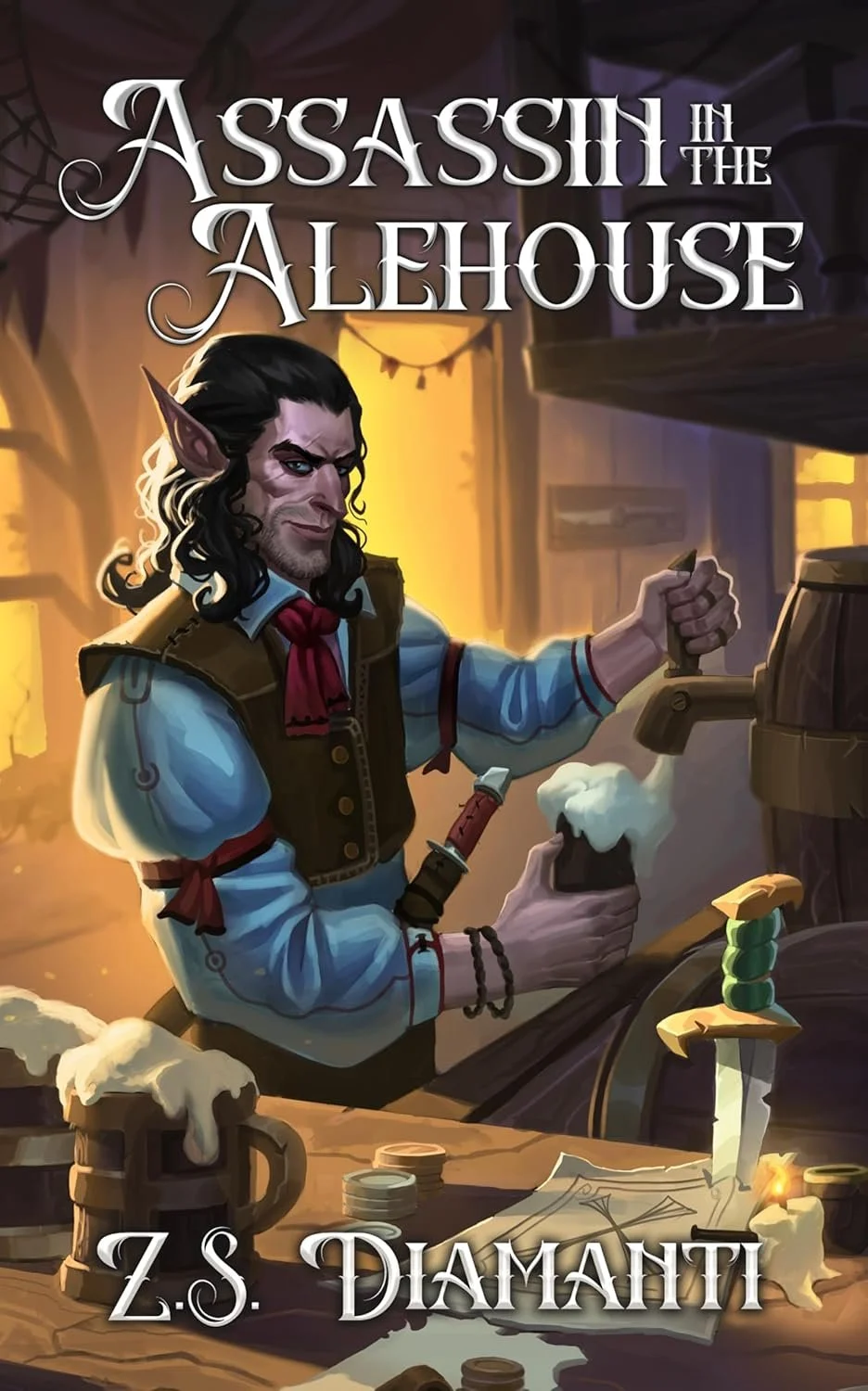
At its centre, this is a novel about second chances and the unexpected places where belonging takes root. Hazkul Bern, once the founder of the infamous Sons of Silence, carries the weight of a life shaped by secrecy and violence. His organisation has collapsed, leaving him hollowed out and unsure of what remains. What makes Diamanti’s approach so effective is his refusal to turn Hazkul’s journey into a simple redemption arc. Instead, he offers something far more honest. Hazkul is a man who does not yet know how to stop being what he was, and who has no clear sense of what he is allowed to become.
The emotional strength of the book lies in its quietest moments. Two types of scenes linger long after they pass. The first are the rare instances when Hazkul speaks openly about his past and the armour slips. Vulnerability is unfamiliar territory for him, and Diamanti writes these moments with such restraint that you feel the cost of every admission. The second type of scene is even more affecting. Hazkul often cannot accept kindness, and his instinctive deflection of praise reveals more about him than any dramatic confession could. These small, human fractures are where the story truly breathes.
Importantly, Diamanti never lets Hazkul’s brokenness define him. Hazkul is shaped by his past but not reduced to it. The book earns its emotional weight by refusing to rush his discomfort or smooth it over.
Diamanti’s prose is warm, grounded, and quietly immersive. The world feels lived in from the first pages, and the alehouse setting does a surprising amount of thematic work. It is a place of refuge and transaction, which mirrors Hazkul’s own uncertain position. You settle into the story the way you settle into a chair that turns out to be far more comfortable than expected.
If there is a criticism to raise, it is that Diamanti returns to a familiar emotional pattern. Several characters are lost, wounded, or fleeing their pasts, and each finds a path toward healing through connection. Each arc works beautifully on its own, but the repetition becomes noticeable when viewed across the novels. Even so, it is difficult to fault the book for this. Cosy fantasy is a genre built on restoration and on the quiet mending of the human spirit. The recurring shape feels less like a limitation and more like a deliberate commitment to the heart of the genre. What keeps it fresh is that each character learns something different. The doorway may be familiar, but what waits on the other side is never the same.
What stays with me long after finishing is not a single plot point but a feeling. It is something warm with a touch of melancholy, similar to the moment when a good conversation ends and you are not quite ready for it to be over. Diamanti never forces emotion. He earns it. By the final pages, I cared deeply about whether Hazkul found his footing. That is the entire game, and Diamanti plays it with quiet mastery.
If you prefer the glow of a hearth to the clash of armies, and if you find richness in stillness and small kindnesses, Assassin in the Alehouse is absolutely worth your time. It is a story about the strange grace of being seen and about the cost and the reward of finally allowing yourself to be known.
