Assassin's Quest by Robin Hobb
Blurb:
King Shrewd is dead at the hands of his son Regal. As is Fitz—or so his enemies and friends believe. But with the help of his allies and his beast magic, he emerges from the grave, deeply scarred in body and soul. The kingdom also teeters toward ruin: Regal has plundered and abandoned the capital, while the rightful heir, Prince Verity, is lost to his mad quest—perhaps to death. Only Verity’s return—or the heir his princess carries—can save the Six Duchies.
But Fitz will not wait. Driven by loss and bitter memories, he undertakes a quest: to kill Regal. The journey casts him into deep waters, as he discovers wild currents of magic within him—currents that will either drown him or make him something more than he was.
Review:
SPOILER-FREE BOOK AND SERIES REVIEW
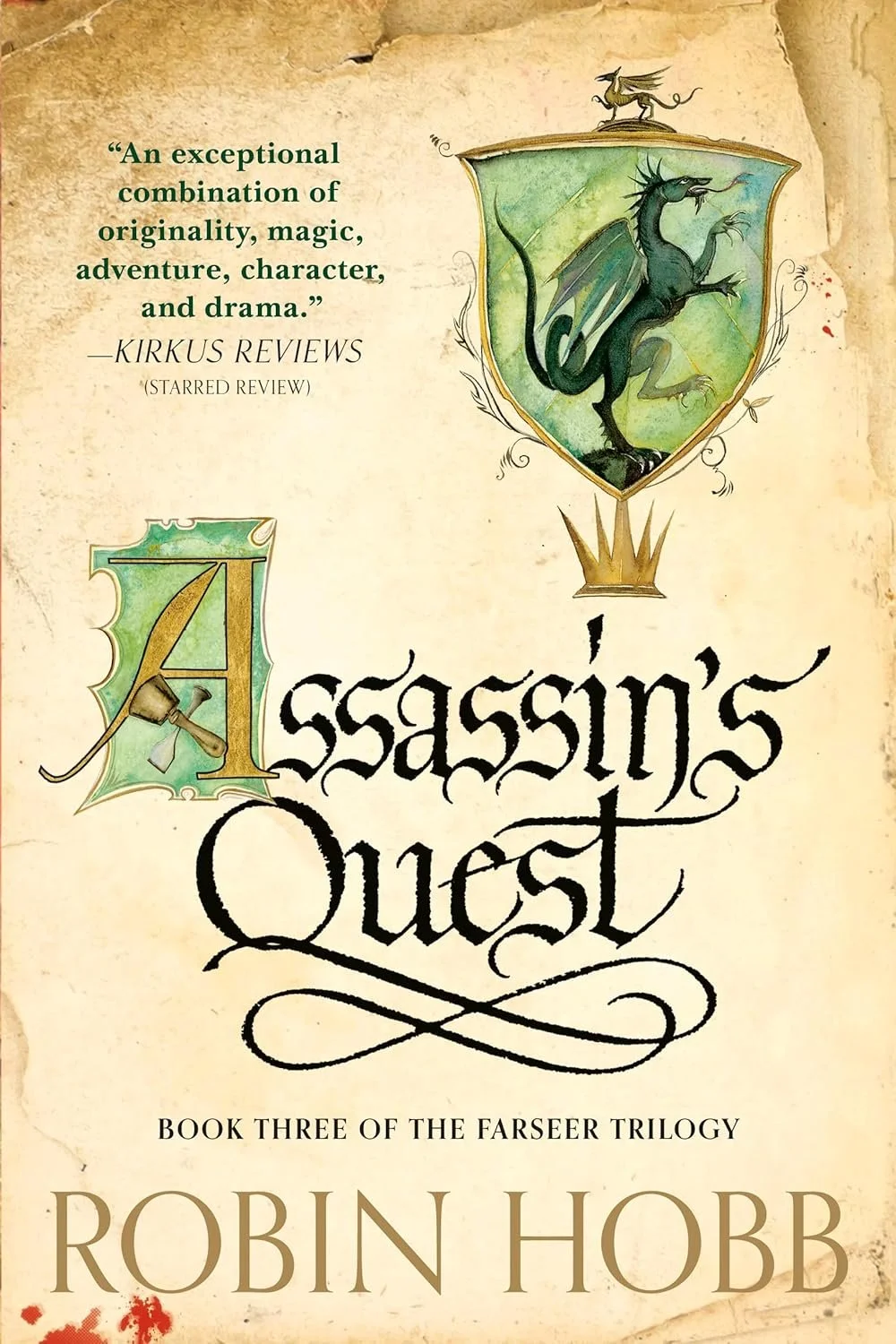
Assassin’s Quest brings the Farseer Trilogy to a beautiful and bitter end. Fitz and friends pull out the world map as they go on a veritable multi-stage quest to not just save a kingdom but to save those they love as well. Pretty sweet, right?
The stakes couldn’t be clearer, and in this final entry, Robin Hobb continues to deliver what we’ve come to love most. She’s at the peak of her powers, giving us page after page of rich characterizations and depth from only a single point of view. Her atmospheric writing was so lovely, I savored every moment of our journey through the rivers and forests.
And it’s been a long journey. We began the trilogy with Assassin’s Apprentice following young Fitz, seeing the world from his eyes. We shared all the wonders and horrors this realm of the Elderlings held, and although subtle, this naive and limited field of view was a unique strength far more than it detracted.
Because of this choice, I’ll forever give plaudits to how those early years of Fitz were handled when he was so prone to misunderstanding people and what was happening around him. Hobb doesn’t hold your hand; she tells it plainly from the child’s perspective and it has this wonderful effect of leading you by an unintentionally unreliable narrator.
That first book laid out all the important pieces for us: the story, antagonists, friends, and family. We’re introduced to the splendid melody of Hobb’s prose, her beautiful melancholy of autumn’s fading light. And while Assassin’s Apprentice’s endingmay not have been the strongest, it was still a memorable tear-jerker, foundational for everything else to come.
Then in the second book, Royal Assassin, we again started slow. But its crescendo was violent, wild, and foreshadowed, yet completely unbelievable in the best of ways. A true jaw-dropper, and when it emerged from such a heartfelt story, the added contrast served to make it stand all the stronger. That second entry remains my favorite of the three, teeing up our final installment perfectly, leaving me begging for resolution.
And it was in this final book, Assassin’s Quest, that we got the sprawling adventure I dreamed of. However it came at a cost—it was long. The longest of the three books by far. And while you may think, “Hey Grady, don’t you like thicc chonkers?” Why yes, dear reader, I do! But with that size comes responsibility. Obviously Robin Hobb takes it seriously, and there was nothing truly offensive here. But pacing is hard no matter what length we’re working with, and especially for long reads, if it’s not flowing well, that pain can be acute.
Had it been trimmed down, especially in the front half, pacing could have improved significantly. Instead, sections dragged, detracting from and even devaluing the progress the rest of the series had worked hard to achieve. Specifically, Fitz’s ineptitude was on full display. He’s so dumb. It’s like a video game character in a sequel when they lose all of their cool stats and abilities you had earned by the end of the previous game. Ok, maybe not so egregious, and certainly there’s no explicit plotholes like that. But by the time he gets his act together, hundreds of pages have passed us by and there has been very little to actually show for it. It made for a frustrating and dragging experience for me when I pulled out of the beautiful page-to-page trance I was in and thought about it.
“You would have been a worthy opponent, save that in your conceit you always underestimated me.” — Will
Beyond Fitz, there are many prominent characters that feel crushingly under utilized in how they’re sidelined. We’ve had two full books of building up dynamic relationships; it would have been thrilling and densely emotional to keep them in the forefront, but instead, many of them are missing in action for the majority of the story. TheRealm of the Elderlings is a long series however, so no doubt there will at least be more opportunities to spend time with them again. Okay, enough heresy, for now. Please don’t burn me at the stake!
As for the back half of the book? When Fitz does get his act together and things start clicking? Ohhhh-ho-ho MAMA. This is a rich payoff not just for the book but for the trilogy as a whole. Full spoilers will be in the section labeled below, but here where we’re safe, I’ll say we got the expansive quest and the lush landscapes I’ve been hoping and asking for. There are daring adventures, danger, bravery, love, and loss. Every part of this works together beautifully. It sings gloriously, ending the trilogy competently and proudly. The conclusion again isn’t perfect, certainly not reaching the highs of Royal Assassin with its jaw-dropping cliff-hanger, but it has a bittersweet serenity to it that feels peaceful, and in a way, blissfully endearing.
It’s a payoff that rewards the reader for their investment to this point, yet leaves enough meat on the bone to let them know, There will be more to come. More questions to answer. More people to see. More hell to pay. This trick must have had razor thin margins, but Hobb balanced it perfectly. So for someone like me, typically wary of wanting to tackle a dozen-plus book series, I’m now much more comfortable with taking on the next set of books (Liveship Traders, anyone?). I know Robin Hobb’s going to catch me in a trust fall…but she may just bury me after.
So if you’re wondering at this point, “Is this trilogy really worth it after all that? There certainly are a lot of criticisms in these reviews.” The answer is Yes! Still a resounding yes. You don’t need to slog through the bad to get to the good. It starts off strong—Assassin’s Apprentice remains a gem in my eyes. The middle is nigh perfect, and the end is thrilling and lush, giving so much of that familiar wonder. It’s a phenomenal and complete entrance to the world Robin Hobb has created and in my eyes it’s easily cemented itself into the Rushmore of fantasy series.
Now all that said, time for the gory details…
SPOILER-FULL ASSASSIN’S QUEST ANALYSIS
Because I’m feeling sassy, let’s cut back to the main critique for a closer look: this book was far too long (ironic, I know). Let’s dig in.
At the start, I understand just how slow the healing for Fitz must be as he recovers from being soul-bonded to Nighteyes and then re-bonded to his dead body. I can’t imagine the amount of trauma that would cause someone. So in a sense, everything that follows makes sense. But that doesn’t mean it’s enjoyable or makes for an evenly paced experience.
Then, his initial clumsy assassination attempt of Regal was so frustrating to me, just so innately childish. Despite its rushedly planned nature, this tangent took a massive amount of pages, and gave us very little, primarily serving to underscore the threat of Will as a dangerous opponent, while also showing how Nighteyes will go to bat for Fitz. So not just slow, but it also showcased the regression in character development we spent all series to earn for Fitz. I daresay it felt tedious.
Now the good news, which is very good, is that Hobb’s writing and worldbuilding remains absolutely enchanting throughout all this. So even when you zoom out, the page to page experience is still sublime. Some may see the length as a strength because we get even more time in the Realm of the Elderlings, just existing and breathing in the world, and spending moments with the different characters, enjoying their triumphs and sharing their losses. If that’s you, honestly more power to you and no judgment. It’s a valid point of view you can hold, and shows how some critiques really can be subjective. By addressing them anyway I hope it makes for a good conversation regardless.
Before we get to the second half and the ending of Assassin’s Quest (which to me were far superior to the first half), let’s give our characters a closer look.
Be Still My Heart
I already spoke on Fitz a bit, but how he relates to his loyal wolf companion, Nighteyes, is a critical piece in our final installment. Nighteyes was always a fierce and loyal companion, but as he spent more time bonded with Fitz, he began to take on more human characteristics. This was a great development. With it, Hobb is unique with her animal writing; giving an animal character greater emotional depth than you normally otherwise could, while anthropomorphizing him in a way that’s consistently logical in-world. Brilliant. Fitz and Nighteyes’ relationship was my favorite of the story. Even within a straightforward setup, there was a lot of depth and layers to how they affected each other and it was a joy to explore.
As much as I didn’t like Fitz being separated from Nighteyes, once he left for an extended period, when Fitz departed for Blue Lake and Nighteyes joined a wolfpack, that’s when things finally started to pick up in the story. It was important for his character to show an aptitude to stay alive out in the wild on his own, surviving his own dangerous encounters without outside aid..
I had believed myself a self-sufficient and clever fellow…But take away both King Shrewd’s largesse and my wolf companion’s hunting ability, subtract from me Chade’s secret information and plotting skill and Verity’s Skill-guidance, and what I saw left was a starving man in stolen clothes, halfway between Buckkeep and the Mountains, with small prospect of getting any closer to either one.
Once reunited, and after all the journeying to the end of the story, I was just glad Fitz and Nighteyes could end up safely together—I was afraid they might lose one another in the highwire conclusion.
Missed Potential
Beyond that, I was sad Fitz lost contact with his wife Molly. We’re led to believe this was a shallow romance of their youth that was never going to last, but for me it didn’t seem fake during Royal Assassin. I felt they genuinely cared for each other, and so the resolution we got to their relationship here felt hanging.
As for Molly, we see very little of her, which is the beginning of an unfortunately troubling pattern of underutilizing established characters. But what we do see is promising. I’m ultimately happy for her ending with Burrich and their budding relationship, as they lovingly raise a child together. I also think they could do well despite the age gap, and have a bright future ahead—as long as he can maintain sobriety for her…
For Burrich, while I’m happy for him, I am sad we didn’t get to spend more time with him and Fitz after everything they’ve been through. Especially considering Burrich’s feelings towards the Wit and seeing Fitz embrace it, before he then self-actualized outside of his bond with Nighteyes. It could have made for some dynamic encounters, but because they parted so early in the story we never saw them.
Similarly, our Assassin’s mentor, Chade, was sidelined again for the second book in a row, even more this time than last. Again I thought, maybe he is just dead now? But instead, he was merely off-page for most of the book, though he did play an important part of the story from a distance. Still, his unique relationship with Fitz had developed deeply over the course of the trilogy, whenever he had a chance, and similar to Burrich, seeing how he relates to Fitz’s post-self-actualization could have been hugely enriching and rewarding. Alas.
New Faces
Now to mix it up, let’s talk about a new character, Kettle. This older woman’s introduction was solid, and gracefully intermixed with the rest of the story with plenty of foreshadow and appetizing intrigue. To be introduced so late in a trilogy can be difficult, but she played a great role, serving as an experienced Skill user who could step up to educate both Fitz, and the reader, about magic and the Elderlings of the world. Not only was she useful for our characters and our own conceptual understanding of the world, but she had her own beautiful arc as well with a poignant and bittersweet ending that came to fruition in the conclusion.
As for another new character, Starling, she was also a welcomed, if somewhat minor addition to the cast. I loved her personality, befitting a minstrel dreaming of glory. While she was dynamite, her development was more gentle compared to others. Yet she was still a great friend, confidante, and at times even a tender companion to Fitz. Through close discussions with her, we helped develop, interrogate and explore other characters even further. A very solid supporting character who I hope to see more from in the future.
Our Intrepid Pack
Kettricken returned, and in both seemingly losing her husband, their child, and in being on the run from the Kingdom where she was meant to serve as Queen, she was in understandably very rough shape. Oh, how my heart went out for her. However, despite her journey through utter darkness, she remained at her core a lovely and layered character to root for with a heart of gold. While I liked her, and her arc, Fitz and the story kept a certain distance from her. Even when traveling together, we failed to reach certain in-depth interactions other characters seemed to enjoy more regularly, and as a result, we didn’t get to excavate into her iceberg quite as deeply as I would have liked. Her relationship with Verity is beautiful and tragic and I remain enthralled with her story and hope it continues in later stories.
Ah, now time for the Fool…or the White Prophet…Assassin’s Quest had great utilization of his character. He not only experienced a good arc for himself, but in how he was reflected by others, like how they perceived his gender fluidity presented unexpected surprises for me to think on while fleshing out the cast even further, especially Starling. I was certainly uncertain until he himself made things clearer, which for him is a real shock.
But then came the Fool’s newly acquired magical abilities, which were yet another surprising and welcomed twist. Even more welcomed than that, Fitz, the Fool and Nighteyes all became a core pack, and I was glad of it. This larger pack,including Kettle, Kettricken and Starling, was a most merry crew and has now seared its memory into me as a high watermark of fantasy questing. Their dynamics were earnest and wholesome, and for me represented the best parts of the entire book. This is the good stuff.
Included in these best parts of the book: their flight through the mountains, the mysterious magical road, the visions, the waystones to ancient pasts, the sense of discovery and adventure through the wild… all of this was everything I hoped for in this series and it was infused with so much magic and wonder it may as well have been dripping off the page. So often in the first two books when we were stuck in Buckkeep, I hoped we could wander further afield across the map and see more of the world. In this, Hobb delivered completely.
Journey’s End
And so at the end of the journey, when they finally reached Verity in the quarry, he was incoherent and inconsolable. This culmination was ultimately…underwhelming. There was absolutely a sense of melancholy to this, but I felt it missed the mark slightly on the emotional highs I was hoping for. There was no immediate danger or sense of thrill which would have elevated this moment for me, he was merely there, at the end of the road, flailing hopelessly at his task. But once they did all join together, this wasn’t the end of the story.
Regal still needed to be defeated, the Elderlings still needed awakening, and they still all needed to get out of there in one piece. Verity himself had a great recovery of his own sense of identity and ability which helped propel us into the final act. The purposeful unveiling of how he worked to carve the majority of his own Elderling, a stone dragon, by himself, was wondrous.
Normally I try to take stories as they come and just make observations, but to Hobb’s credit I had all these little biases and secret hopes that had formed over the course of the trilogy. I wasn’t sure how we were going to put a bow on all this, and sometimes that’s such a thrill, and sometimes it’s completely anxiety inducing. This was somewhere in between because of all the hopes and expectations built up. However, by revealing Verity’s plans and Kettle’s history we were able to conjure the basis of an epic and satisfying ending.
After such a long book, I’m so pleased to say the conclusion was absolutely breathless and a beautiful payoff to the entire trilogy. I stayed up so late to finish the final one hundred or so pages, I just couldn’t put it down.
“Strange,” he said softly. “I wonder if this is what it feels like to be Forged. To be able to recall what one once felt, but unable to feel it anymore. My loves, my fears, my sorrows. All have gone into the dragon. Nothing have I held back. Yet it is not enough. Not enough.” — Verity
I loved the usage of the Wit and the Skill together being needed to awaken all the Elderlings. It’s so thematically relevant and fits the story beautifully. It forces Fitz to reconcile two halves of himself and to no longer suppress and mask but to embrace who he is fully. A wonderful completion of his thematic and developmental arc of the entire trilogy.
Kettle’s own revelations and redemption, helping Verity finish his dragon and becoming part of it herself was extremely emotional for me. Equally, and even more, emotional was Verity needing to pour himself fully into his Elderling, ceasing to any longer exist in his physical human body. I felt so deeply for Kettricken here, my heart breaking all over again. I think she was proud her husband was able to accomplish his task, and yet still was broken at how she was losing her love regardless. Yet even with this loss there was a sense of closure, completeness and finality that made it a happy and triumphant, if melancholic, ending for her and their kingdom.
Sorry to again be a downer, but there are a couple nits of the end I’d say. The first is the resolution of Fitz vs Will which had been built up so much, but was ultimately underwhelming for me. I think how it happened was great: Will was beaten by one of the wakened dragons, and then Fitz watched over him as he died. But it was all rather sudden and felt for me a little flat and lacking some of the emotional payoff that I was hoping for.
Secondly for Regal, I think over the whole series he has not been the strongest villain and even as he was much crueler here, he was still underwhelming and his demise happening off-page was also ultimately a big letdown. It was very that’s-that. But these two nits have been somewhat constant thematic weak points for me throughout the trilogy so it’s hard to hold them against the work too harshly.
Okay, let’s end this on a good note.
It’s after every climactic battle is won, and all the enemies are defeated, or at least beaten back as in the case of the Red Sea Raiders, it appears Fitz and Nighteyes get to retire quietly and peacefully, living alone with occasional visits from Starling, as most believe him dead. It’s a victory, but not one without great loss and sadness. I’m glad he isn’t completely alone from a romantic viewpoint, but it hardly seems the happily ever after he was originally dreaming of. There’s still time with the remainder of The Realm of the Elderlings to read, after all. So while certain dreams can come true, it seems other nightmares continue to haunt us at the edges. Art truly does imitate life, I suppose.
