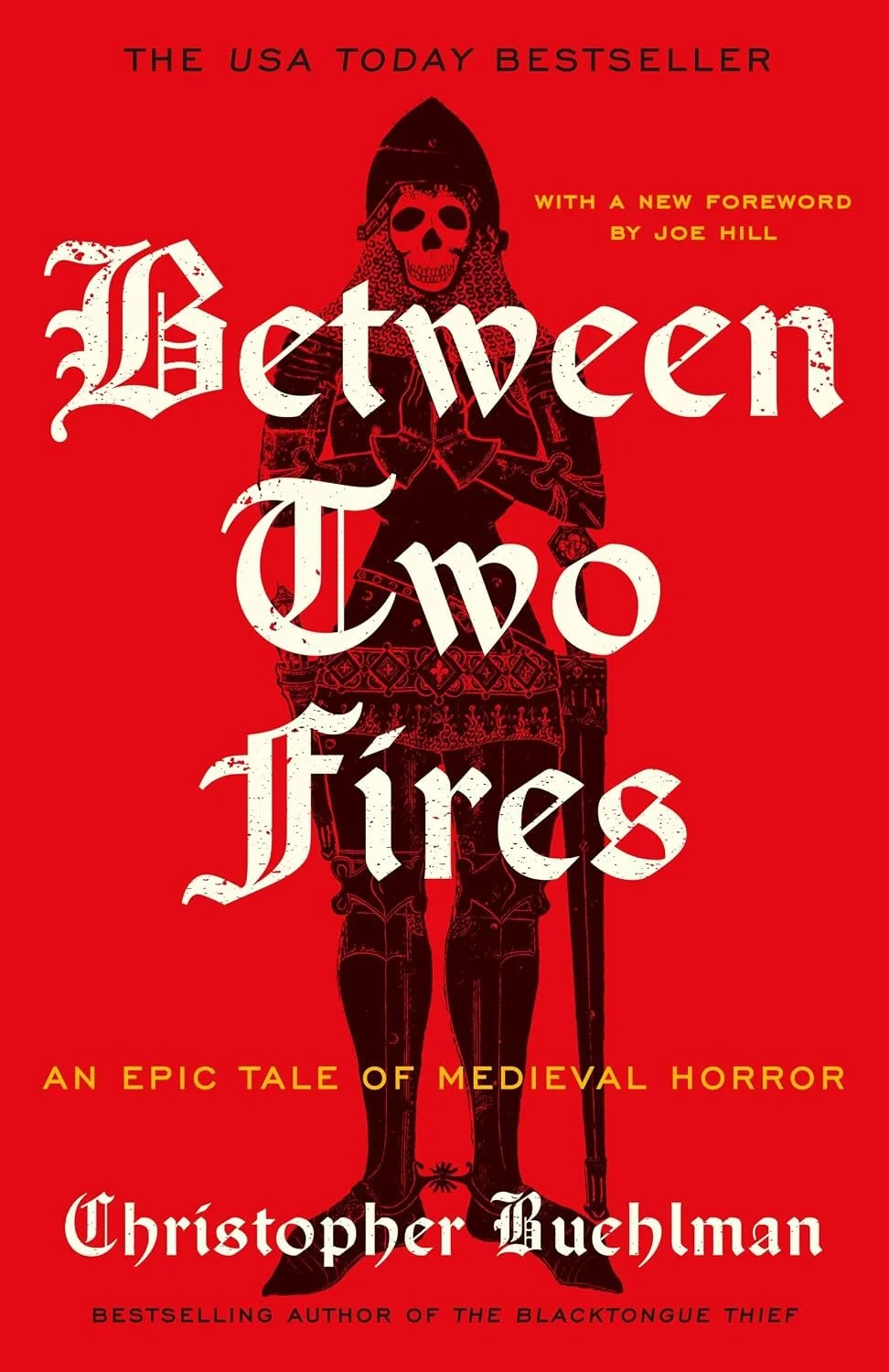
Between Two Fires by Christopher Buehlman
Blurb:
Enter a darker age with New York Times bestselling author Christopher Buehlman's Between Two Fires, a medieval horror adventure unlike anything on the shelf.
And Lucifer said: “Let us rise against Him now in all our numbers, and pull the walls of heaven down…”
The year is 1348.
Thomas, a disgraced knight, has found a young girl alone in a dead Norman village. An orphan of the Black Death, and an almost unnerving picture of innocence, she tells Thomas that plague is only part of a larger cataclysm—that the fallen angels under Lucifer are rising in a second war on heaven, and that the world of men has fallen behind the lines of conflict. Is it delirium or is it faith?
She believes she has seen the angels of God. She believes the righteous dead speak to her in dreams. And now she has convinced the faithless Thomas to shepherd her across a depraved landscape to Avignon.
There, she tells Thomas, she will fulfill her mission: to confront the evil that has devastated the earth, and to restore to this betrayed, murderous knight the nobility and hope of salvation he long abandoned.
As hell unleashes its wrath, and as the true nature of the girl is revealed, Thomas will find himself on a macabre battleground of angels and demons, saints, and the risen dead, and in the midst of a desperate struggle for nothing less than the soul of man.
Review:
Let’s set this straight, if you’re at all skeptical whether this medieval tale is for you: fans of Dark Fantasy, Grimdark, Historical Fiction, or even just Horror would all do well to give Christopher Buehlman’s Between Two Fires a shot. Bonus points if you have an underlying appreciation for European and Christian histories.
I, myself, grew up Pentecostal, and though I no longer align with the faith, here the book of Revelation, whose horrors and monsters I had always been warned of, were made vividly real in a plague ridden landscape. Yet we find even in those darkest of days, the barest sources of light can draw us near and keep us warm, like moths to flame. Such is the power of a good story, and such is Between Two Fires.
It’s a bleak journey across a ravaged France, where we follow disgraced knight Thomas de Givras, who was excommunicated from the Church and dispossessed of land and title. His road to redemption is the catalyst for the story, as he diverges from his path to take a stand, saving young and newly orphaned Delphine from his own bandit compatriots of reprehensible morals and intent.
Delphine, a singular character embodying the goodness and light of Jesus, appears to be actually quasi-divine; it may be because of her that the party is kept safe from the plague, and she has many visions. But the ambiguity around her is a driving mystery pulling us through the countryside and infested cities. Thomas isn’t sure what to believe and neither is the alcoholic priest, Père Matthieu Hanicotte, who joins them along the way.
It’s less that this mystery is so pressing and particularly important for Thomas and Père, and more it seems just as likely that with death surrounding them on all sides and chasing them at each turn, there’s nothing better to do than see this out in following and protecting Delphine. Why not chase this sliver of hope and goodness if any other alternative is certain death and damnation? And if they can save their own souls in the process, it may as well be a bargain.
The one time they did take a voluntary detour for their own enjoyment, they found themselves in a horrific night tournament featuring Eldritch and primeval ghouls who champed at the bit to damn their souls. Delphine was wise to sit out while this all played out. Her supernatural senses, including the ability to see and converse with Angels, presses further upon Thomas and Père with every stop. Her influence grows with them and has Thomas especially upside-down and transfixed. Maybe she’s actually a Demon in disguise? It’s initially unclear, but that would arguably be more appropriate given the environment.
All in the background being played out is the ultimate biblical war between Angels and Demons. Were God and Lucifer directly involved? Unknown. But their lieutenants certainly were, and they were fighting ferociously for dominion over the earth. This not only sets the stage for the in-world conflict, but it also directly affects and informs our characters. Some of the more impressive sequences are even pulled straight from dramatic chiaroscuro renaissance paintings. Blinding light contrasted against the deepest darks. Ultimate good versus ultimate evil. This layer of conflict grants a larger, more explicit scope for our story. It underlines the stakes while helping inform the nuance and repercussions of all to unfold.
As an experience, from start to finish this whole journey made me feel gross and dirty. Always I could smell the stink of death. Setting an engrossing story during the Black Death made one’s senseless demise always imminent, and you could easily empathize with the paranoia that covered the land. Everyone’s fear was palpable as they were unable to commune in hospitality with their neighbors, robbed of basic humanities as fundamental concepts of society shattered overnight. Having lived through the COVID pandemic’s many quarantines, this was a familiar nightmare to envision.
All throughout we’re taken from scene to scene of peak Dark Catholic Horror™. There truly is no respite. The omniscient third person is expertly executed here, giving us a view behind the curtain without going so far into anyone’s head that we ever feel quite grounded, let alone safe. What were these people truly thinking? What might they do? It’s not that their actions themselves were so unnerving, but the circumstances they found themselves in were so bewildering, how could you possibly feel confident at any moment what would happen next?
The general cadence, with notable variations, was such: travel to a new location, hear about a new monster straight out of the bible that terrorized the locals, face the adversary and try to survive. It gave the book, which isn’t very long for a standalone, a nearly serialized feel that helped set the pace expertly.
However, in the last quarter, the pace not just accelerated, but underwent an entire time signature change. I believe the intent was to crank up the tension and throw us further off-balance than before, but for me it was a little messy. We do get characters’ final descents into this hellish reality. I found it disorienting to a fault, but it might be exactly what Buehlman intended.
How do our characters endure this utter nightmare fuel they’re subjected to? Not well, reader. But they not only persevere, they grow in themselves a strength, boldness, and resolve. This crew is the definition of trauma bonded. Family forged in blood and sacred trials. And crucially, they’re not just dependent on each other, but they also find a shared larger mission to drive toward. It grants a near religious zeal that this nightmare might one day end, and they strive for it to save each other, both physically and spiritually, as much as themselves.
It felt like an appropriate allegory for the time, imagining the mental state that people would find themselves in during the Black Death when half the country died for no reason. They would be searching and praying for any cure, any rescue, and casting blame at all ill-shaped shadows. The holy Catholic church, disheveled in their split between Rome and Avignon, would be straining against this hellacious attack. To Buehlman’s credit, this historical schism is used devastatingly for his purposes to drive the conflict further. By the time we reach the dynamic climax, the fates of not just our characters, but their physical world, and even the spiritual world have all intermingled in a gripping conclusion that steals the breath.
From this unreal crescendo we attempt to land the bird and return to reality. It appears a happy end. But once overturned, things cannot return to how they once were. It is a dense web of clue and metaphor to unravel to understand what happened in those final sequences and figure out where we landed. While it’s a meaningful and affecting puzzle to solve, that lack of clarity diminished the emotional weight we could have otherwise achieved. Maybe we’re not meant to truly know. A bittersweet high-note; unexpected, but undoubtedly earned.
Between Two Fires is a monumental triumph of the genre. Its grip upon you is iron and twisting. It dares to reach new heights. It’s confident in its quiet moments. There is in the heart of our cadre a persistent tenderness to help, and to love. Going forward, all Dark Catholic Horrors will be held in comparison, and as we’ve already seen from a book that came out over a decade ago, it will continue to age like fine wine.
Citations
https://lareviewofbooks.org/article/epidemics-in-history-of-vaccines-and-saints/
https://www.newadvent.org/cathen/04701a.html
https://magazine.libarts.colostate.edu/article/invasion-pandemic-cascade-of-crisis-14th-century/
https://www.roman-catholic-saints.com/blessed-delphina-of-glandeves.html
