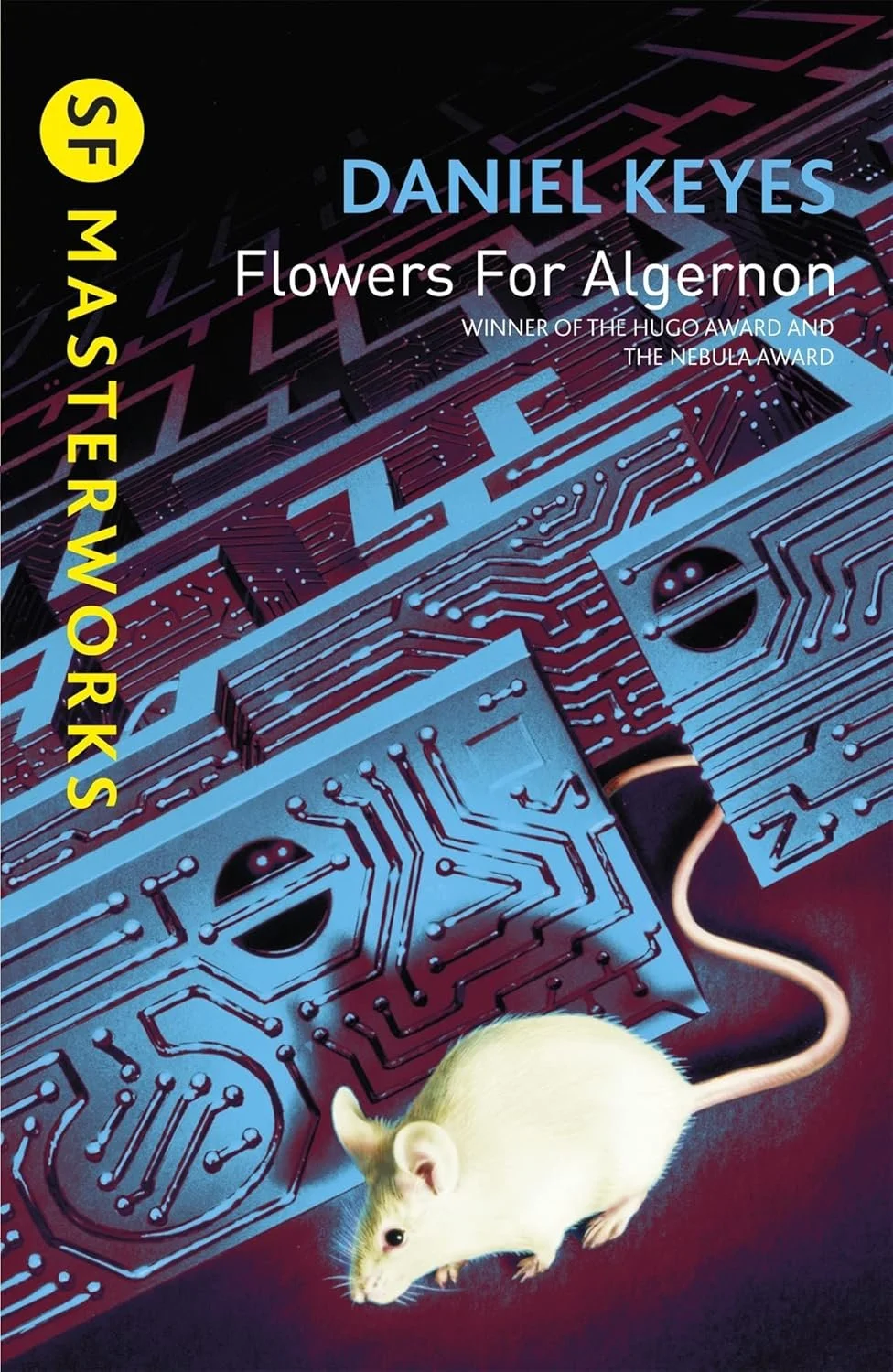
Flowers For Algernon by Daniel Keyes
Blurb:
Winner of both the Hugo and Nebula Awards, the powerful, classic story about a man who receives an operation that turns him into a genius...and introduces him to heartache.
Charlie Gordon is about to embark upon an unprecedented journey. Born with an unusually low IQ, he has been chosen as the perfect subject for an experimental surgery that researchers hope will increase his intelligence – a procedure that has already been highly successful when tested on a lab mouse named Algernon.
As the treatment takes effect, Charlie's intelligence expands until it surpasses that of the doctors who engineered his metamorphosis. The experiment appears to be a scientific breakthrough of paramount importance, until Algernon suddenly deteriorates. Will the same happen to Charlie?
Review:
Flowers for Algernon is a classic whose plot I remember being partially adapted in one episode of Pinky & The Brain. Now, I didn’t know about Flowers for Algernon at the time, but as I was reading this book, that episode popped up in my mind, making me realize that this sci-fi classic has actually impacted the genre in a more profound way than I had known before.
I read Flowers for Algernon for the ‘Epistolary’ square for r/Fantasy’s Bingo Card 2026. I had heard a lot of good things about this book, including that it is heartbreaking. I just didn’t expect it to be that profoundly moving.
So, without further ado…
SPOILERS AHEAD!
What I liked:
I had a lump in my throat throughout the last month of reports that Charlie Gordon writes. I had tears in my eyes and a numb, empty feeling in my stomach as I read his last 2-3 reports, a visceral, gut-wrenching feeling that still haunts me as I write this review. That’s how powerfully moving this book is. A classic for a reason, and a must-read for all. But I am getting ahead of myself.
When you read the first few chapters, you immediately notice the simplistic writing riddled with errors and almost devoid of punctuation. After all, it’s from the perspective of a man whose IQ is a mere 70 and who suffers from intellectual disability. (Note: The book makes frequent use of ‘retard’ and its relative terms, but it’s important to remember that this was a book written in the 50s-60s; the terms are used as descriptors and sometimes as insults, but all appropriate for their respective scenes and the time during which this was written). Charlie Gordon has the IQ of a child. However, he has an unusual inclination to keep learning. Reading his initial reports feels endearing as you see this person with so much positivity and naivety approaching such a complex problem with a pure heart. Then, the operation happens. As his intellectual abilities grow, his purity begins to taint. Not just that, his diminishing innocence is replaced with scepticism, self-awareness, shame, and ego. All this is reflected by the slowly changing writing style of each progress report. What started out as simplistic ramblings with poor vocabulary and spelling ended up as sophisticated, at times difficult-to-read clinical reports full of pride and ego.
This epistolary style of writing that Daniel Keyes employed to tell this story does wonders with 1) immersing you in this character’s mind, and 2) exploring the themes and philosophical dilemmas of this story to their fullest through the eyes of the key subject. The writing is a huge part of why I loved this book. It felt like Charlie Gordon was a real man, a neighbour or an acquaintance that I was getting to know with each progress report. I could empathize with Charlie in the beginning, as well as feel his hurt as he began remembering traumatic childhood events. It’s depressing reading about all the unjust, unfair treatment that Charlie endured as an unsuspecting child with developmental issues. It’s equally unsettling to see this pure heart degrade into a narcissistic egomaniac whose intelligence becomes his hubris, surpassing his superiors to the point of not even feeling human anymore.
This one is an out-and-out character-driven novel that explores some pretty hard-hitting truths about the human condition. How empathetic can we be towards some of the weakest members of our society? The rejects, the ‘abnormals’, the ones that most would prefer to forget about. What even is empathy? What is the value of a human life? Is it only worth something if it can contribute to society in a tangible manner? That and so much more… you’re in for a short but dense read. All these heavy subjects are explored within the emotionally turbulent mind of Charlie Gordon’s ever-changing intellectual capacities.
Flowers for Algernon is a deeply moving tragedy. It’ll keep you hooked with its brilliant writing, constantly tugging at your emotions with every event, every memory, and every little detail that makes up Charlie’s cruel and unjust world. The plot might feel slow at times, but the emotional and intellectual progression (and regression) make it as thrilling as it is thought-provoking. An absolutely brilliant, if not often saddening, experience, but a must-read.
What I didn’t like:
Flowers for Algernon was written in the fifties (1958 was the original novelette, and 1966 was the full-length expanded novel). As you can expect, some issues that were common to that era do persist in this book.
The most prominent of them is the depiction of female characters. Admittedly, this book is about Charlie Gordon and his perspective, one of which is his maturity into being an adult male with male needs. Despite that, the male gaze and the way the female characters are presented feel very dated. I did not like the way Keyes treated Alice. She seemed to almost have some agency, but quickly devolved into being a love interest with traditionally ‘weak feminine’ traits. Same with Fay, who was just an object to address Charlie’s carnal needs and nothing more. No matter how good the book is, this era-appropriate flaw will certainly deter modern readers. And with good reason.
Also, there were a few dated ideas and treatments that diminished my overall enjoyment, but I can’t hold that against the book because all of those echo the sentiments of the time this book was written in.
If you’re able to look past those issues, the book is an absolute masterpiece and a must-read.
Conclusion:
A thought-provoking tragedy that’s equally full of heart and heartbreak, this classic masterpiece poses important questions of human empathy and intelligence.
TL;DR:
WHAT I LIKED: Epistolary style, Gordon’s character progression, thought-provoking themes
WHAT I DIDN’T LIKE: Depiction of female characters, era-appropriate issues