Green City Wars by Adrian Tchaikovsky
Blurb:
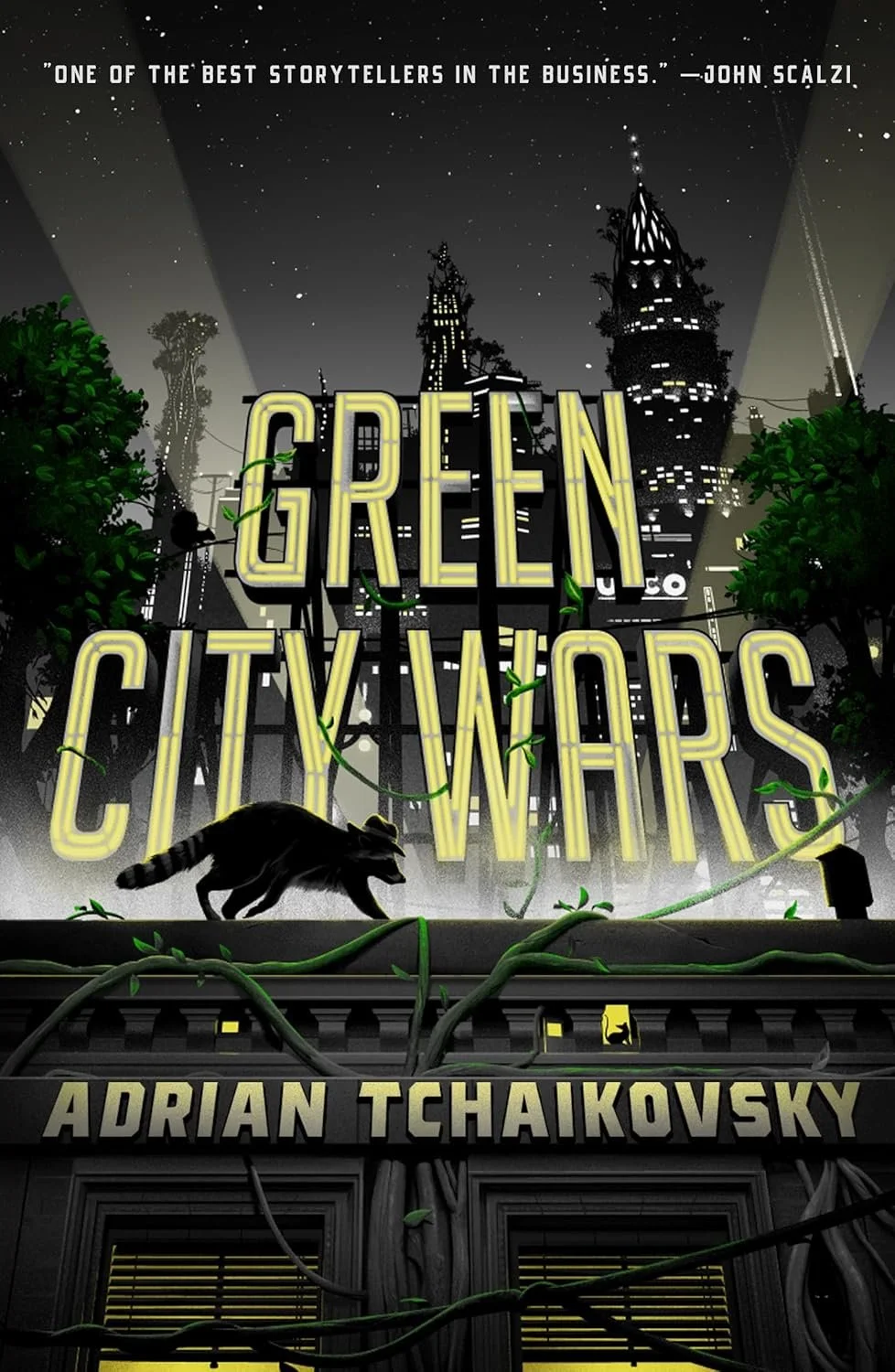
Philip Marlowe meets Redwall in this superior adult noir tale, where all the characters are animals, fighting for survival in the city underneath the humans.
In the solar cities of the future, the humans relax in the sun and the animals work in the shadows. Genetically engineered Little Helpers, serving humanity―unseen, unheard.
Meet Skotch. Raccoon, PI―yours for a few buttons as long as the job isn't too illegal, whatever that means.
A mouse has gone missing. Normally this wouldn't raise any hackles, nor any alarms, but this mouse has something that everyone seems to want, though nobody appears particularly eager to say what that something is.
The fee is good―perhaps too good. Certainly not something Skotch can easily turn down.
If only Skotch can work out where the mouse is hiding, what he’s hiding, and why his secrets are upsetting a lot of animals caught up in the Green City wars.
Review:
I only started reading Adrian Tchaikovsky’s work last year, and I hold it in high regard. I’ve only read two of his books so far, and they have both exceeded my expectations by quite a huge margin. Tchaikovsky has this brilliant imagination that goes all out with its science and world-building, resulting in a very rich and dense world that feels plausible enough to exist.
Green City Wars is no exception.
SPOILERS AHEAD!
What I liked:
Imagine an environmentally friendly city where humans don’t need to work. All the baser jobs like trash collecting, segregation, mail, etc. are handled by genetically engineered animals whose neurology and biology has been altered to render them sapient enough to live almost-complete lives, but still subservient enough that they remain under humanity’s rule. Now think of all the complex machinations that must go behind such a phenomenon to exist. Well, we actually get a deep dive into its creation, something that I found especially fascinating. From the existence of Plantgent and the Gerhiners’ dependency on it, to the political factions that exist, all while maintaining the façade of peace for humans that are aware but ignorant of their existence, everything about this world was a mind-blowing puzzle of imagination and speculation.
Plotwise, the book is pretty straightforward, if not a bit convoluted. The politics and power dynamics between the different factions form a larger part of the conflict, and the narrative mostly pushes forward in a straight line. However, every single faction’s existence and role in the larger Gehirner society make for immensely thought-provoking ideas that are reflective of many real-life communities and conflicts. From the existence of militarized factions to the development of weapons and the implication of basic intelligence and sapience being used as currency, everything about this setting’s conflicts and power dynamics is compel you to think. The book is not easy to read, but it will stay with you. Could this commentary on intelligence and dignity be Tchaikovsky’s subtle hint at what our world, with its increasing dependency on the internet and AI, is heading towards? This idea really gets fully realized with the finale, which I will talk about in a bit.
As difficult as the book is to read, it is an incredibly rewarding experience. Whether you sit back and immerse yourself in the visual ingenuity of the Green Cities, or you muse over the many philosophical implications of the existence of such a social hierarchy, Green City Wars has something that’s bound to stay with you for a long time, even after the story ends. Because this isn’t just a story, but an emotionally and philosophically compelling experience. What does humanity really look like, now that they’ve deferred entire sets of baser tasks to animals? What other technological developments could there be branching out from the success of the Gehirner? What happens when the Gehirner develop a whole new layer of subservient class underneath them? Will the Gehirner society change, and if so, how?
Of all the many things that blew my mind, the most brilliant to me was the ending. Admittedly, the ending isn’t something you can’t guess. I didn’t, but I’m sure a more prudent reader will be able to guess what Dr Meece is actually working on. SPOILERS: It’s cheap and easily available Plantgent. There are several stakeholders here, and the complex conflict that has been brewing throughout the book suddenly begins to make sense. What if the Gehirner don’t have to depend on a constant supply of the brain juice? Without that dependency, they’d be independent to live life as they want, instead of slaving off to the corporations. The entire Plantgent-based economy would collapse then, no? Also, if the very purpose of their existence becomes redundant, how then would Gehirner society change? The more you ponder over these questions, the more you will begin to notice certain parallels with real life itself. And when books hold a mirror to real life in a way that makes you question the world and its status quo, those books immediately shoot up in my list of recommendations.
Green City Wars is not a perfect book. It has quite a few issues, which I will discuss in the next section. However, Adrian Tchaikovsky has crafted a wonderfully reflective experience with this one. A neo noir crime mystery thriller with a rich and realized world building that’s as thought-provoking as it is immersive.
What I didn’t like:
While the negatives don’t really take away from the satisfying and rewarding finale, they do affect the overall reading experience. So, it’s only fair for me to list them here.
Firstly, the book is incredibly dense. With such a fully-realized world as its setting, the first half of the book spends a lot of time explaining the science and social dynamics of different factions. These sections aren’t always the smoothest reads. At times, they tend to affect the plot and pacing. Other times, they feel a little overwhelming. While the eventual philosophical questions that might arise because of these explanations (either in the book or in your mind) are worth exploring, they may not appeal to everyone out there. As I mentioned, they tend to affect the plot and pacing at times, resulting in an oddly paced book.
Secondly, none of the characters really stand out. From Scotch to Benson, to even the vivacious Lulu, each character has an individuality, but none feels relatable. In a world that feels so fully realized, the characters don’t, ironically. They aren’t badly written. It’s just that the characters are not the primary focus of this book. As someone who prefers character-focused works, this was an issue for me.
Lastly, the writing. I mentioned multiple times how dense this book is. That also means there are a ton of made-up terms, phrases, and factions, which need some getting used to. While the terms make themselves apparent along the narrative, the factions and the many characters felt a little confusing at times. The fact that the characters don’t really stand out only made this problem marginally worse than it is.
All that being said, these problems don’t take away from the philosophical complexity of this book and the ending that I found very fitting. Despite my complaints, I’d still say this was a great read.
Conclusion:
A dense and fascinating neo-noir mystery thriller that is sure to captivate you with its insanely complex world, power dynamics, and philosophical dilemmas.
TL;DR:
WHAT I LIKED: World-building, philosophical questions and moral dilemmas, the ending.
WHAT I DIDN’T LIKE: Can be hard to read at times, characters don’t really stand out, some pacing issues.