Jonathan Putnam's SPFBO Semi-Finalist Pick
First of all, I thank each author who entered this competition and each author who ended up in my slushpile. Putting your works out there for others to put under a microscope and review with notes scribbled all over the place about characters, sensible plot, world building and oddities takes courage. Second of all, I went into this with no plan whatsoever since I more or less entered the competition as a judge at the beginning of May, so I picked a book at random and went at it with those that were on Kindle Unlimited first, and then the ones that weren’t last. All of us were supposed to read, at least, the first one hundred pages to make our pick. I read each book front to back because why not? And also, because my choice of semi-finalist would be wildly different due to everything making sense far later into the story than the first 100 pages for everyone in my pile.
These books being (in order of what I read):
Die Young by Morgan Shank
Violence & Vigilance by David T. List
Reyuul’s Redemption by David Liberton
Firefax by A. M. Vergara
The Desolation by Andrew Gillsmith
Now, before I go into each novel, I will have to say that no matter which one I pick as the semi-finalist, all of them were equally amazing reads with very, very, very small margins of who got picked and who didn’t. Without further ado, here is my honest critique/dissection of the five tales that ended up on my table to read.
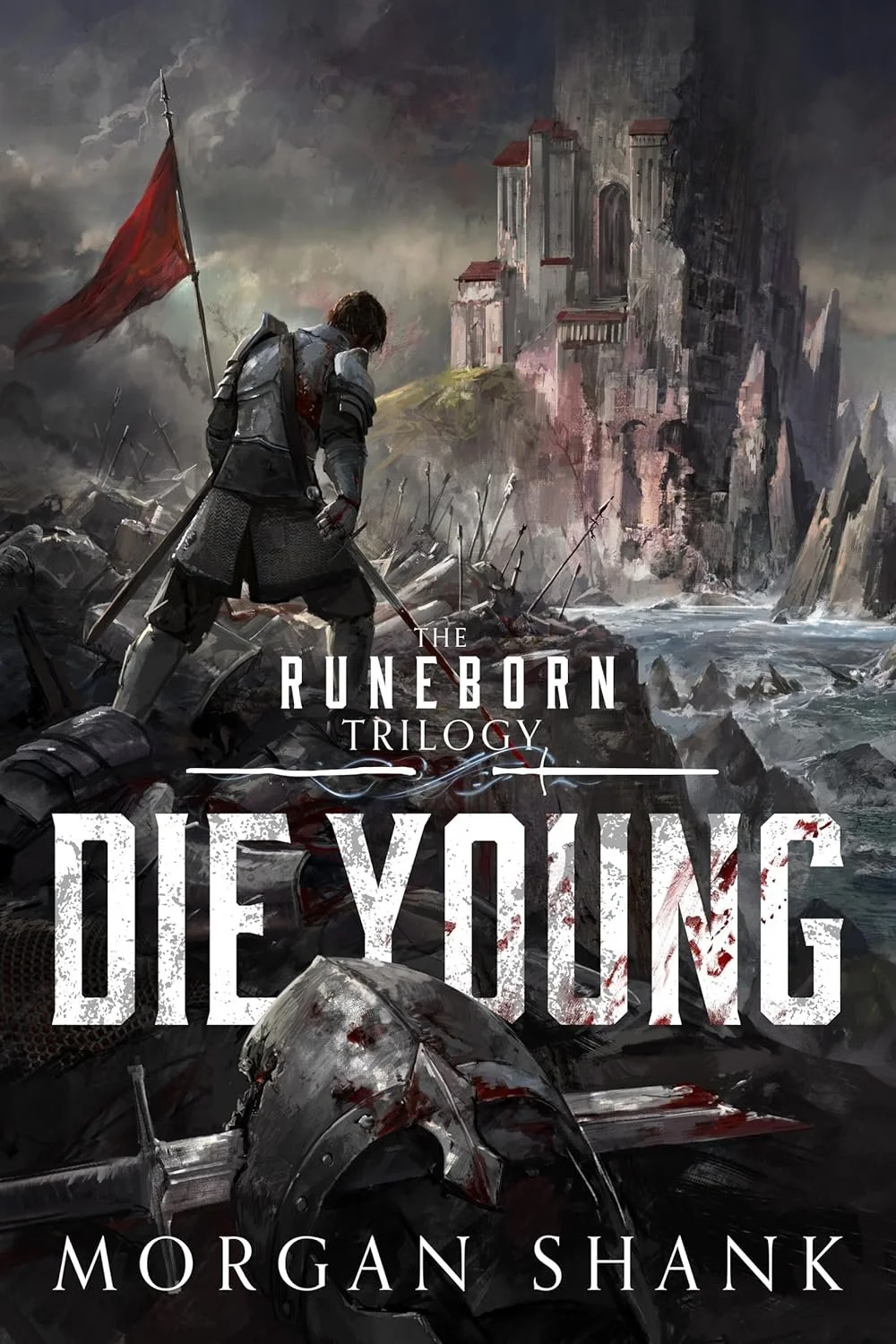
Die Young by Morgan Shank
Magon Dross graduated his mage school, the Tower, with flying colors. Then his old schoolmaster burned his runebook and stole his magic. Now the Tower wants him dead.
To spare himself, his family, and his people from danger, Magon must find help and answers. His country is on the brink of war, and a school of rogue mages could topple everything.
Powerless and on the run, he'll find help through his childhood friend, his estranged sister, a tribal exile, a violent priest, and the daughter of King Terrus, Freytilia's most hated man. This makes for a precarious alliance, but it must hold.
The Tower's pursuit spreads collateral damage, and as war approaches, it grows apparent that if the Tower isn't stopped, every country will fall.
“Die Young”, written by Morgan Shank,was my first read of my SPFBO XI slushpile. The novel has an ethereal writing quality to it, making it very reader deliberate with how they view the story. A confusing start, but a very satisfying end (I have book two queued up on my Kindle).
Characterwise, we have the motley crew of Magon, Seneka, Joska, Itula, Elthren and Oath.
Magon is constantly on adventure mode and is estranged from home; Seneka wants to become a knight and is more or less stuck as a squire until her brother throws a wrench into her life, again; Joska follows Magon around and is a steadfast friend with the goal of getting everyone in the Highlands into a better life; Itula wants to belong; Elthren wants to escape her father’s hated shadow; and Oath is soul searching for why he is the way he is.
Plotwise, we have Magon and Joska getting shafted by someone in the tower, before they go and collect Magon's blade from his father while not explaining to his parents what happened. Then they go and collect Seneka, Magon’s sister, who hates that he just shows up, says that she should come with him because he is on a quest to find traittors to their country and leaves without explaining further. Meanwhile, Itula finds a kid in a burned out house, wants to keep him safe and so turns to a religious order to keep them both safe from pursuers. Meet Oath who is sitting in an inn eating food when Itula and the kid walk in. He feels insulted that a group of people are targeting a child and so goes with them.
A few hundred miles away Elthren gets married off to another country by her father, who likes war. Through various traveling methods, mundane and magical, the two groups run into each other in Elthren’s father in-law's throne room. From there, off they go to find the traitors on an island and chaos ensues. The ephemeral writing here truly does lend to the chaotic nature of the latter parts of the book. As all things do, this book ends, with a promise of more to come in book two.
With worldbuilding, we get maps to know where everything is. As for magic, it is done via various bloodletting techniques (by thy own peril will you either throw a fireball or die), soul crystals and bargains with the unreal using either your own life or others. Technology is a thing, but that’s a bit further away in the low and high country of a nation who wanted to experiment.
The only thing I could nitpick about this novel is that it is too chaotic at times, with the ethereal writing being a detriment rather than a boon. However that is my own critique and I do encourage that one read this novel for themselves in order to get a full idea of the novel.
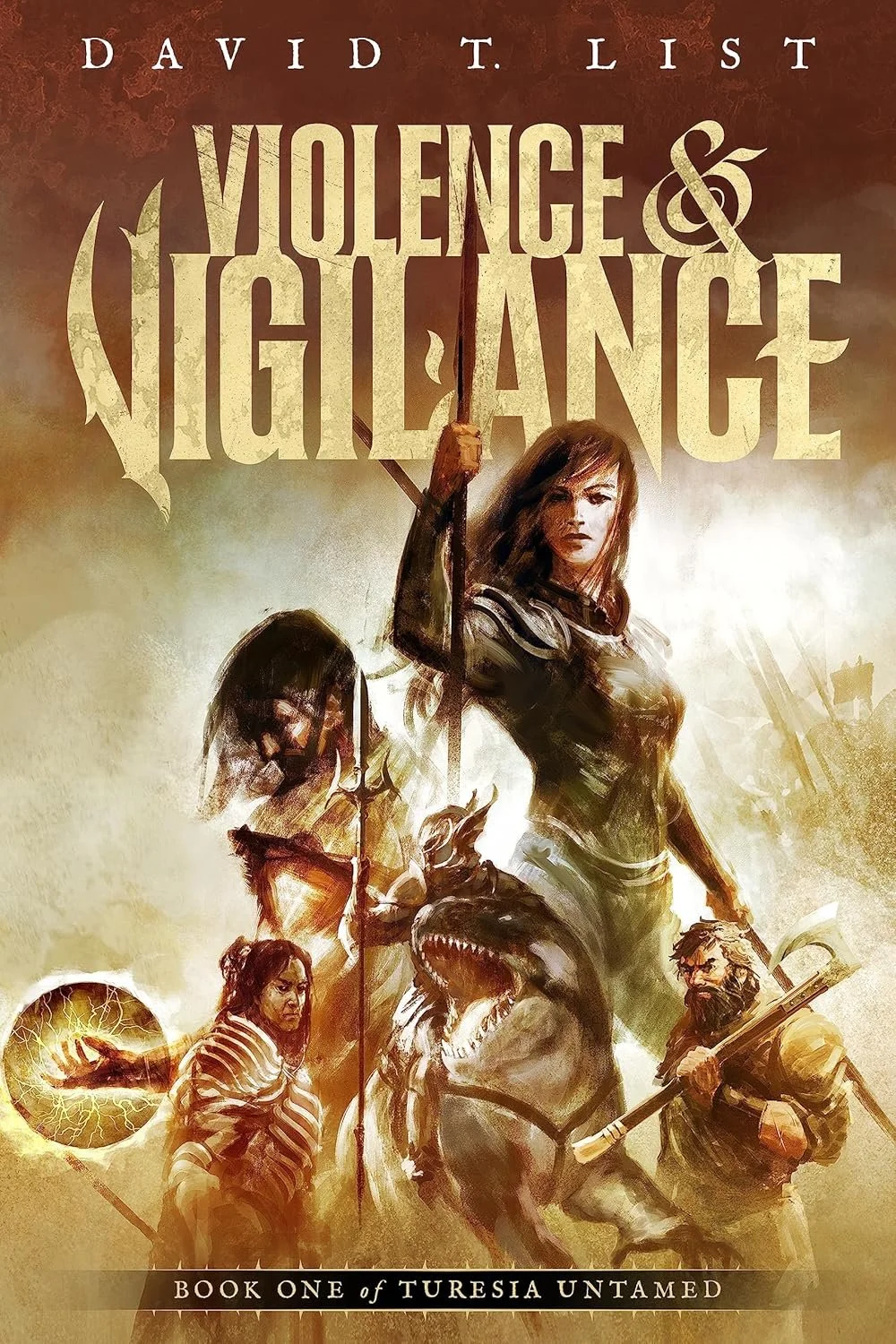
Violence & Vigilance by David T. List
Irdessa the Undying, a renowned arena fighter in Fohrvylda, has escaped imprisonment but at great cost. Broken and alone, she must outwit and outfight her pursuers.
Basalt Kale, a failed Consonant monk of the lowest order, embarks on a quest to improve Ausgan but discovers vile secrets of his order that he cannot abide.
The heathens of Fohrvylda amass ships and beasts of war to sail the Faithless Sea and assault the monks of Ausgan, who will greet the steel-bearing invaders with elemental destruction.
The second read of my SPFBO XI slushpile, “Violence and Vigilance” by David T. List was another read that had me hooked by the end of it, leaving me wanting the second installment as soon as it comes out. The start was not as confusing as “Die Young”, but after a few chapters, I was getting out my compass to figure out where the story dropped me in comparison to the beginning. And then I gave up trying to understand where I was going and just went along for the ride.
First of all, the characters. It may seem like there are fewer characters than in “Die Young”, by just reading the blurb, yet I felt very overloaded from named characters with PoV chapters by the end of it. So that this stays relatively short, let me just introduce you to Irdessa, Basalt Kale, and Kraus.
Irdessa the Undying, as she is called in the arena of Keswal, is pushed into escape by her best friend, Torvald so that she can go back and revive her fathers mercenary company. Throughout the book, she suffers from Stockholm syndrome, imposter syndrome and self-doubt while trying to pick up the pieces of her fractured life.
Then there’s Kraus, the thirsty bandit. He’s a drunkard and a highway man, ambushing carts for their contents. In terms of ability, he knows when to run and when to fight, when not drunk. Wants to survive and feels protective of Irdessa out of a sense of duty to Torvald.
Lastly, an ocean away, Basalt Kale can’t get a tune straight, and feels like a failure. He has thoughts of suicide via lava lake. Outside of that plan, he is loyal, ashamed that he doesn’t belong, and has a strong sense of justice and how that should be meted out.
Plotwise, Irdessa and Kraus fight together in Keswal, they escape, reach an understanding of each other and both suffer mentally and physically as their past and present try to hit them over the head with a staff. They journey to Idressa's old home, rally her father’s company of mercs and go on the run from the Promontory, always losing some to the mounts and soldiers. Meanwhile Kale, after obtaining the means to pull of his suicide plan, doesn’t go through with it because someone in the prison that had the lava lake told him to go see the truth of his faith before taking a dive. He does so, gets beat up by the jungle, meets some people, then goes back, and is caught in a web of plotting that would make any super villain proud. Things get out of hand for both the Keswal escapees and Kale, shenanigans abound, and I want book two, whenever it comes out due to the epilogue.
Worldbuilding, there is no map. We have to imagine the world as it is described to us. There are two forces that are important. The Ausgan monks who are preparing for the heathen tide and the godless of Fohrvylda are preparing to assault the monks on their home turf with steel. Why there is no naval battle, well, that blame lies with the two who created the mythos after a falling out. The Ausgan monks can use consonance to manipulate the elements and the Fohrvyldans have steel and beasts galore. Both sides hate the deceiver for different reasons, and there are immortalish creatures that stalk the land and sea.
The only thing I disliked was the amount of differing PoVs. It felt very Malazany and made me want to stop reading until I got to the point where I finally understood most of what was going on. However, that is my own critique of an otherwise well written novel, so I suggest that one reads it for themselves before agreeing or disagreeing with me.
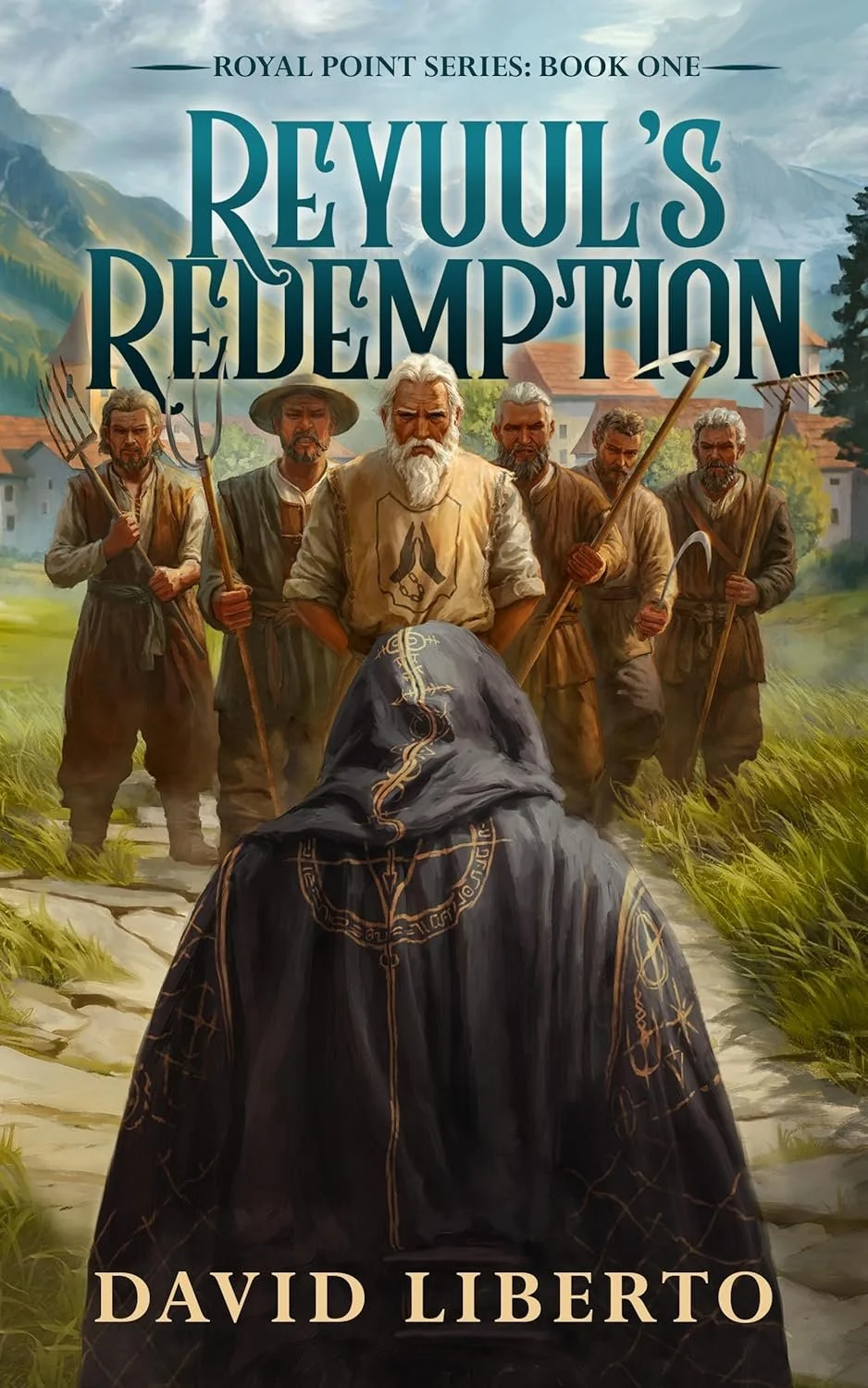
Reyuul’s Redemption by David Liberton
For 400 years, Joern was the monster in every prayer.
The Scourge of Cordiae. The dark mage so feared that a god forged new weapons just to stop him. He razed cities with elemental fury, stole holy men for twisted experiments, and left kingdoms trembling at the mention of his name.
His magic consumed him from the inside out—transforming his body into something as grotesque as the evil he'd become.
Then something impossible happened.
The monster confessed.
Now Joern stands before the Royal Point, his power stripped away, his body broken and deformed. He's confessing his crimes to souls who suffered at his hand. The same clerics whose predecessors he tortured. The same kingdom he nearly destroyed.
But confession isn't the same as redemption.
Can a soul steeped in four centuries of darkness ever truly be saved? Can the people he terrorized ever forgive him? And what drove the most feared dark mage in history to suddenly seek the very light he spent lifetimes destroying?
Some villains can't be redeemed. Some sins can't be forgiven.
Joern is about to find out which kind he is.
“Reyuul’s Redemption”, book 3 of my slushpile was a roller coaster of a read. At first I thought it would be rather boring with Joern standing at a pulpit talking in third person for the entirety of the 400ish pages. Then the first person PoV chapters started. And then back to the third person PoV chapters. A very interesting story telling method. Add to the fact that Joern is a reyuul, or a mandrate, depending on which country you’re in, and everyone’s reaction to him is mixed.
First of all, the main character, Joern, is prideful, stubborn and merciful. At least in the moment of life that he is in while recounting his life to a bunch of people in a lecture hall. How he got to that point was through a father who wanted him gone, a manipulative cohort of mandrates who taught him about mandra and a cleric out in the boonies having mercy on him after being betrayed.
Then, plotwise, Joern is regalling the young folks about his long life and what mistakes not to make and what temptations not to do. All the while, during the breaks of him speaking, he is hobbling about meeting with old friends and while doing so, notices mandra sigils carved into the stone of royal point. So, during his free time, he is chasing down the mandrate that is haunting the royal point until the very end of the novel, with a promise of more in a second installment.
In terms of worldbuilding, we have a map of all the countries that exist. Joern is in Cordiae, at the Royal Point, with all the clerics, who call upon Lohem to protect both themselves and innocents. Straightforward enough. Then, there’s the mandrates, or as those in Cordiae call them, reyuuls. Mandrates use mandra over ten disciplines (technically nine with the tenth being sigils), which is fed to them by a demon into a well that they can grow and after a certain point they’ll either ascend to a dragon or some other sort of higher power, or descend into a mindless life form that other mandrates then use to fight their wars. Over time, the usage of mandra causes scales to grow on those who use it, with most mandrates having various deformities that require them to constantly use telekinesis to move about by the end of their natural lifespan of hundreds to a thousand years.
As for how the demons feed the well that each mandrate has? They have a certain allotment of power from souls harvested by either the mandrate themself or previous mandrates.
In addition to that there are various realms. Joern is retelling his story in the MidRealm, but there is also the DreamRealm, FeyRealm, OverRealm, UnderRealm and the Primordial Realm. Shenanigans happen throughout all of them, with Lohem living in the OverRealm.
As you can probably tell, a lot went into world building. And as for what I have typed out here, it’s probably a small fragment of the overall world.
Now, if I had to critique a part of the novel, it would be the plot. The entire line of Joern explaining his life story in third person PoV is great, as well as the plot that goes with it, however, his life story could literally be anything but he’d still be there at the pulpit by the end. In that regard, more could’ve been done to have more of the third person PoV plot go on with less talking of his life story, making it more mysterious and enticing to the reader, But I digress, that’s only my view of what could’ve been done a bit better. Before you agree or disagree with me, I’d recommend reading the novel first, since the work itself would give a better painting of its highs and lows than I ever could.
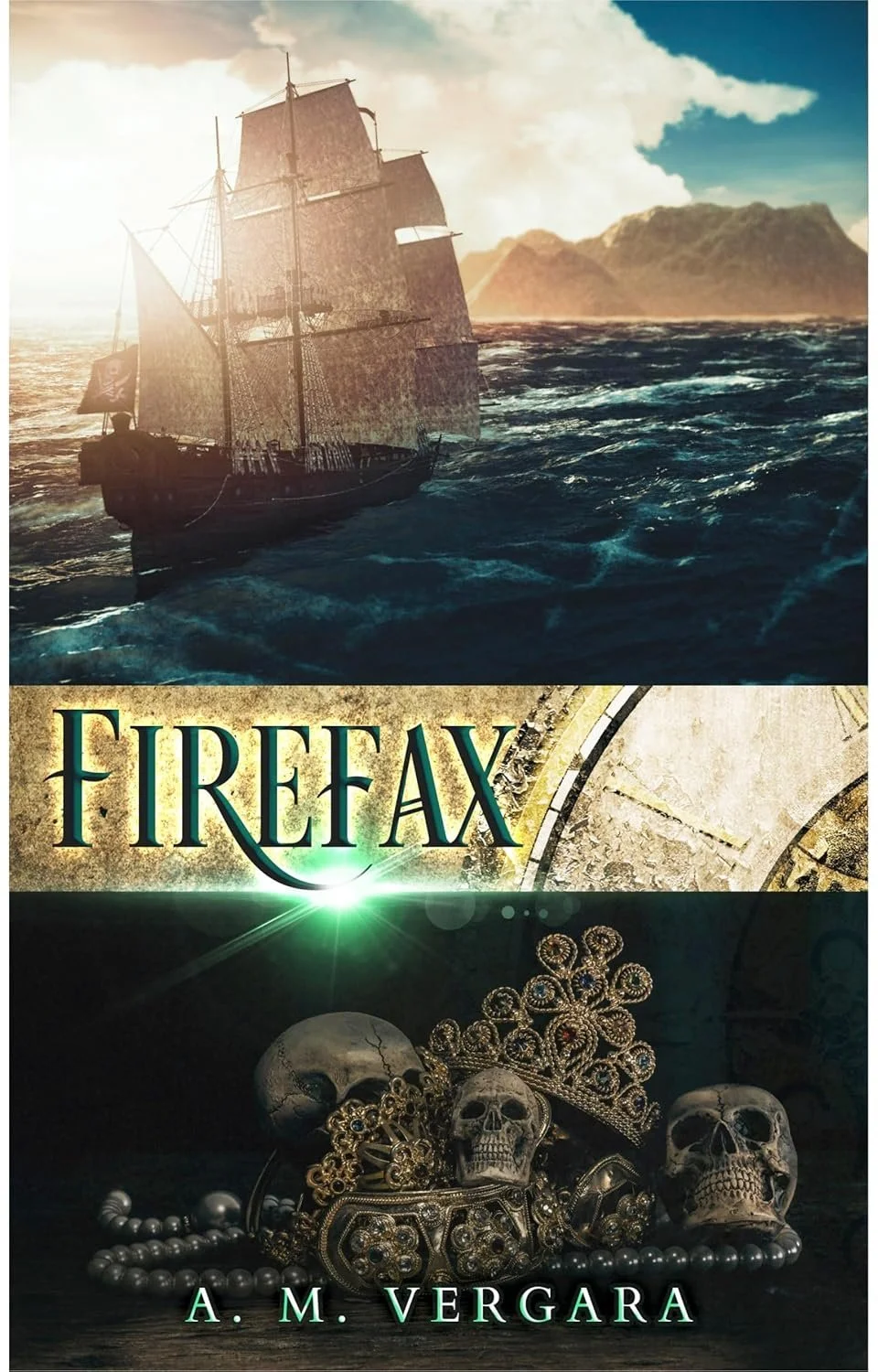
Firefax by A. M. Vergara
"I would advise you, young man, to take care around anyone with the surname Firefax. I know not if the rumors be true that they be king killers, but they are, without any doubt, a dangerous family."
Legend tells of a city of gold on a phantom island. The wealth of that city could end the American Revolution. But the only person who knows the island’s location is the world’s deadliest assassin. And he’s not giving up that secret without a fight . . .
The world’s oldest family of high-profile assassins, the Firefaxes, have been killing off dignitaries—and being well-compensated to do so—for centuries. The family is thrown into turmoil by their patriarch’s death and the return of their cunning, cruel prodigal, Murdoch. With their father dead, Murdoch is the only one who knows where the Firefax wealth is, kept on a secret island. But two competing intelligence networks in the American Revolution are bent on tracking down the legendary treasure to end the war, whatever the cost. However, these spy networks may have met their match in this wily, dysfunctional family of killers.
Now, this one, this one was my first historical fiction without supernatural shenanigans read of this year. And it was, for all intents and purposes, a well written spin on the El Dorado mythos, except that instead of a city of gold in the middle of the Amazons it was an island of plenty with a city of gold upon it. Like the other reads in the slushpile, stopping after 100 pages would have been difficult, this time however laying upon the fact that my font size choice on my iPad is diabolical and only 32 pages would have been left had I done the bare minimum.
Starting off, we have the Firefax family. Cara, Rafael, Louis, Henry and Murdoch.
Cara is kind, and the youngest of the family, with not a kill to her name due to her father and her brothers trying to shelter her while bringing her on missions. She wants her skills to be validated, goes into shock after traumatic experiences and resembles her eldest brother Murdoch in looks and skill.
Rafael is only a year older than Cara and is very pragmatic, willing to pursue the family business in order to gain admission to Oxford to become a methodist preacher, as well as trying to keep the assassin family business separate from friends and the other family business.
Then there’s Louis who is the only non-Firefax child of the family, and is Cara and Rafael’s half-brother. He’s arrogant, somewhat a lecher before settling down with an opera singer, and part of the American revolution spy network. On good terms with Cara, Rafael and Henry but is thought dead by Murdoch.
After that, there’s Henry, with a farmer's disposition, however with his right hand maimed by his brother Murdoch. He’s the longest married of the Firefax siblings, with 7 children. A generally jolly person, kindhearted and pleasant to be around, loves all his family members and is not the best at the assassin part of the family business.
Finally, Murdoch, reviled by most of the neighbors, considered cruel and evil by everyone, is a calculating monster who considers assassinations to be fun and wants to protect the family secret.
Plotwise, it goes like this: The Firefax patriarch kicks the bucket during a riding accident, the siblings on the farm call a family reunion, sans Louis, since he’s off doing spy stuff for Washington and it took him a while to get the note. Murdoch disappears and his protege comes by and is wondering if they know where the eldest ran off to. Louis arrives, shenanigans at a tavern/brothel occur. Two brothers flee, another kicks the bucket. Then the revolution spies come by, threaten to burn the farmstead down with Henry’s family still inside if the two surviving Firefax siblings at the farm don’t go with them. More shenanigans in Boston, the four surviving Firefax children are forced on a boat. They get to the island with no casualties amongst them, can’t say the same for the crew of the boat or the revolution spy network that followed them. More shenanigans on the island, and then the book ends with the still living Firefax siblings traumatising each other with book two picking up where book one ended.
Worldbuilding has the revolutionary war happening as usual with the addition of a secret island full of gold, a family of murderhobos for hire and the protege of the eldest Firefax siblings causing havoc on everyone's war plan. Very light but lets Vergara get away with inventing an island with items that belie all healing methods of that time period as well as a culture that is so controlled that anyone who goes there feels like they are descending into madness. It’s the minor changes to actual history that make it work.
The only thing that irked me was that the sibling PoVs were confusing from time to time, but that hardly detracts from the rest of the story. I implore whoever is reading my critique here to check out the book for themselves to build their own opinion and whether they agree with me or not.
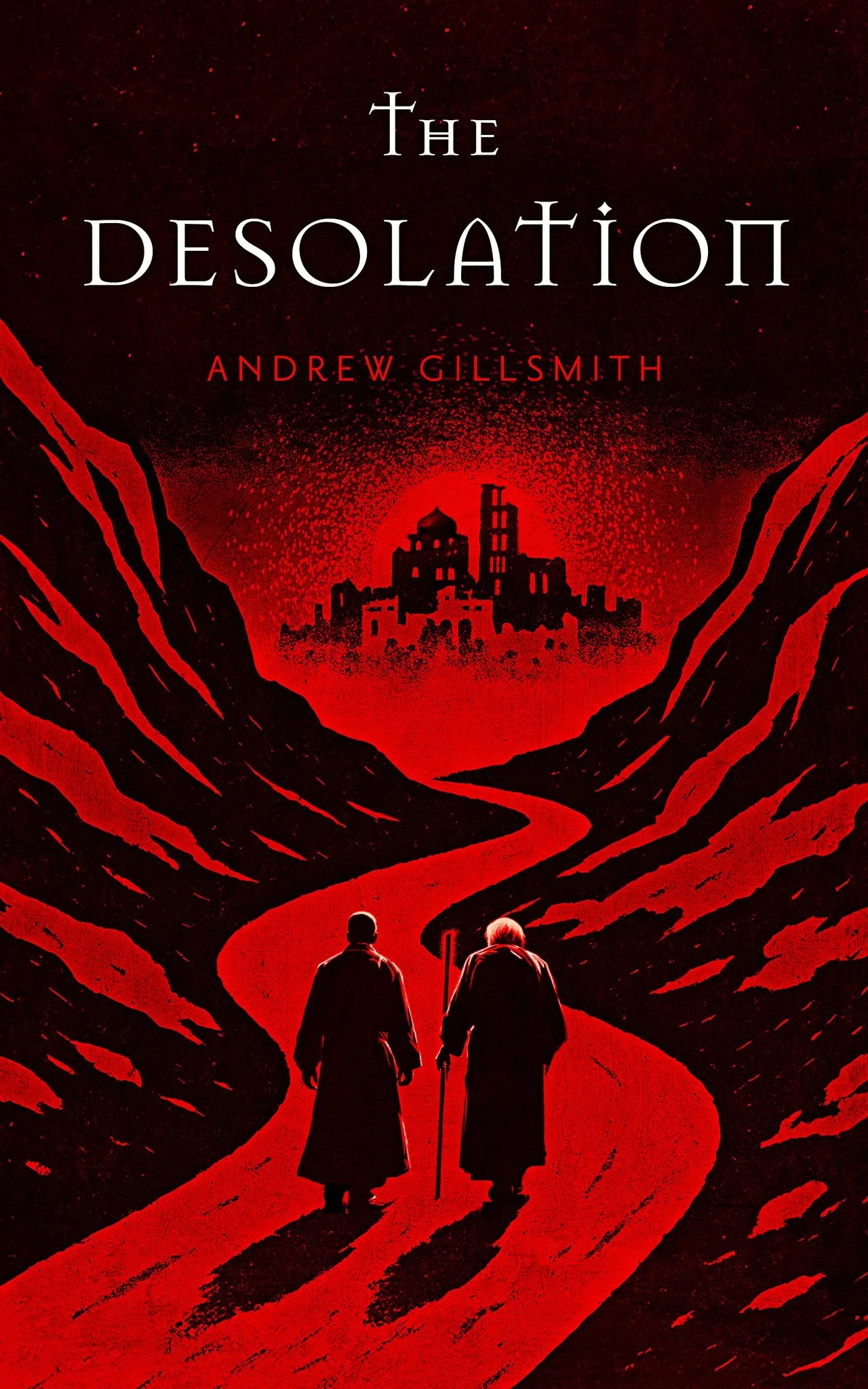
The Desolution by Andrew Gillsmith
An undead conscience may be the most terrifying monster of them all.
So… you may have noticed that for each of the books I've copied the blurbs from their store pages either in full or in pieces to set the stage for the rest of my review of them. “The Desolation” only really needs that one sentence to describe it. What I didn't know going into this was that it is a collection of three stories centered around a pilgrimage to Jerusalem, which got tossed into an alternate dimension (allegedly still on the same plane as the rest of Earth, but considering the Lovecrafrian horror show it becomes, is it really?), one day and killed everyone within the region before anyone could really do anything about it. All things considered, a very interesting premise with some very “wtf, where did this come from?” moments that kept me reading with morbid curiosity.
Since this is a collection of short stories, I'll keep the character descriptions rather short so that, if one does pick this novel up, they can discover more about them at their own reading pace.
First character that we get introduced to in this horror show is Janusz, a Catholic priest from Poland who wants to undertake the pilgrimage to Jerusalem as his final journey for a sin he committed. He's arrogant, anti-social, and just wants to get the whole thing over with, alongside a side goal of a) seeing Jerusalem before he dies, and b) dying of the Desolation sickness because of the rapture that everyone who gets it seems to be in. He has some… and I mean some, redeeming qualities that take a bit to come back, but for the most part, he deserved his end.
Then there's the Liar, a man who lies so much that it's become his whole identity. He has no Jiminy Cricket telling him what's wrong or right, he has no consciousness. When we're introduced to him, all he wants to do is take care of his friend, the Idiot, who seemingly has memory problems. While consciousnessless, he does care for his friend, and thinks purely analytically. One thing about him is that he doesn't suffer the same illness everyone else eventually gets in the Desolation zone, and no one, even he, knows why.
Lastly, there's Leibowitz, who, for all intents and purposes, is the unexpected Boogeyman in this book. His humor is laced in irony, and he claims he got that humor from Him. Always talking in riddles, he leaves both Janusz and the Liar with more questions than answers.
Plotwise, I'll be talking about the first two short stories, since they both bleed through to the third. The first short story has Janusz starting at New Jerusalem, a facsimile of the original. There he sees an old man who knowingly smirks at him from across the room at the last sermon he'll ever be in. After that, he gets on a bus to the outpost of the Order of Lazarus who are all terminally ill and love the Desolation for it is as if it was Truth incarnate to them. He gets bunked with the same old man as before and then it's off to Jerusalem, with the pilgrims thinning out day by day. Conversations are had, the old man disappears and reappears at random, and at some point, the story ends with a tsk tsk from Leibowitz.
The second story has the Liar dragging the Idiot to the outpost of the order of Lazarus, whereupon the Idiot is admitted to the hospice. The Liar fears for his friend and wants to remove him from the Desolation zone after talking with some members of the order over protein paste, so he does so taking a finger of St. Thomas with him. Shenanigans abound, Leibowitz shows up and talks with the Idiot, leaves a cryptic message to the Liar, and leaves. After some more shenanigans, the Liar wanders off into the sunset alone.
Lastly, before I start critiquing one part of this short story collection, let us peer at the world building that is the Desolation. The Desolation showed up out of nowhere, killed a few million people, and just sits around the land of Jerusalem and the wider whole of Israel, forcing cultures together in huddles that hope for it to disappear at some point. Because Jerusalem has become the Abyss from Dark Souls, people built New Jerusalem as a nostalgia theme park with everyone loving it but the Jews, because it is a giant false idol to the real sites that once were used. Actors play Romans, city folk, Pharisees, merchants and more, acting out various faith based events that once happened in Jerusalem in the distant past. Meanwhile, sitting on the edge of the Desolation is the chapterhouse of the Order of Lazarus, an outpost, a half-way home where everything is built to remind you that your stay is temporary. Staffed by the terminally ill and dying, it serves as the final frontier of civilisation before the pilgrims wander into Desolation proper.They see the zone as the final Truth, where the lack of human civilisation, with disease and entropy abound brings out the true reason as to why life exists. Which brings me to the Desolation sickness. Starts with a nosebleed, ends up with the eyes rolling back into your head with only the whites staring out after that. You can find them in any kind of pose, kneeling, sitting down, curled up in a fetal position, this disease does not care what one is doing before being dragged into its sweet embrace. It comes for most who wander into the Desolation. Then there's the common diseases that pop up randomly depending on who is wandering about.
Meanwhile, the whole world is trying to forget the Desolation exists, because if they do acknowledge its existence, then they have to figure out the unknown, and they don’t want to deal with the Lovecraftian implications that it brings.
As for the religious parts of the book, there are various quotes from the Old and New Testament of the bible that help portray the region. At first I was apprehensive about the amount of biblical quotes tossed at me, but as the stories continued, I found that it helped out somewhat explaining what was going on without really explaining in depth.
Now, the one thing that I didn’t particularly like was the way the short stories were presented. I thought there was untapped potential to both explain more about the Desolation and more about the political reality that the new world brought about. Nothing too much more needed to be added, just a chapter or two with a PoV of a Polish political member tossing away Janusz’s case file and then holding a talk about the Desolation effectively removing people from lawful retribution or a UN member frantically trying to figure out what happened to the people of Jerusalem and surrounding regions at day zero of it happening. Ultimately, even without a more fluid interconnection between the three short stories, it is still a great read, and I do ask that you pick it up for yourself to form your own opinion about it. I am ultimately a guy on the internet hammering out my opinion on a laptop. Someone else could probably come up with an even more in-depth analysis of this work at some point, given enough time.
Semifinalist Pick
Now, before I reveal my semi-finalist pick, I do have to thank again the authors who submitted their works for someone to take a finetoothed comb over in a competition, as well as thank everyone who took the time to read this part of the text. Unless you scrolled all the way down here to see what I picked without reading anything. To those who did, go back and start again from the beginning.. It is a bit long, but without fully explaining each book, as well as a thing that irked me about them, then my semi-finalist pick wouldn’t be as clear as it currently is. Then again, since I wrote rather positively of all five, then it might be just as unclear as if I wrote less. Anyhow, without further ado, drumroll please for the semi-finalist pick…
.
.
.
.
.
.
.
.
Ultimately, my pick as a semifinalist was either “Die Young” by Morgan Shank or “Violence and Vigilance” by David T. List. The other novels were all great, and like I’ve been saying throughout this whole page, I do recommend reading all of them, but in the end, the two aforementioned novels were the best in how they brought about the story, reveals and various world building elements without too much explanation.
Both Morgan Shank and David List told more through the environment and what could be read through the pages than outright saying why things were currently happening the way they were happening. Not saying that either fully did so, they did have some moments of someone outright stating why parts of the world were the way they were, but for the most part, it was more showing and not telling, which I find immerses me more into the world. All things considered, taking into account how both writers portray their world, the more clear writing style of David T. List, as well as the rather artistic unfolding of the final chapters and the full picture of what was truly happening unfolding bit by bit, cemented “Violence and Vigilance” as my semi-finalist pick. I was not expecting the roller coaster journey that I was put on when I first opened this book, and at first, I kept finding something else to do due to the slow start, but after I finally understood that I wasn’t meant to make sense of the various PoV switches… I was on board for whatever chaos was about to happen. Combine that with the fact that this is the first book he’s published with a vague hint of book two happening at some point in the future, and I cannot wait to see what madness comes into creation in the chapters of book two. Thank you for writing this novel and congratulations on making it as a SFFI semifinalist.