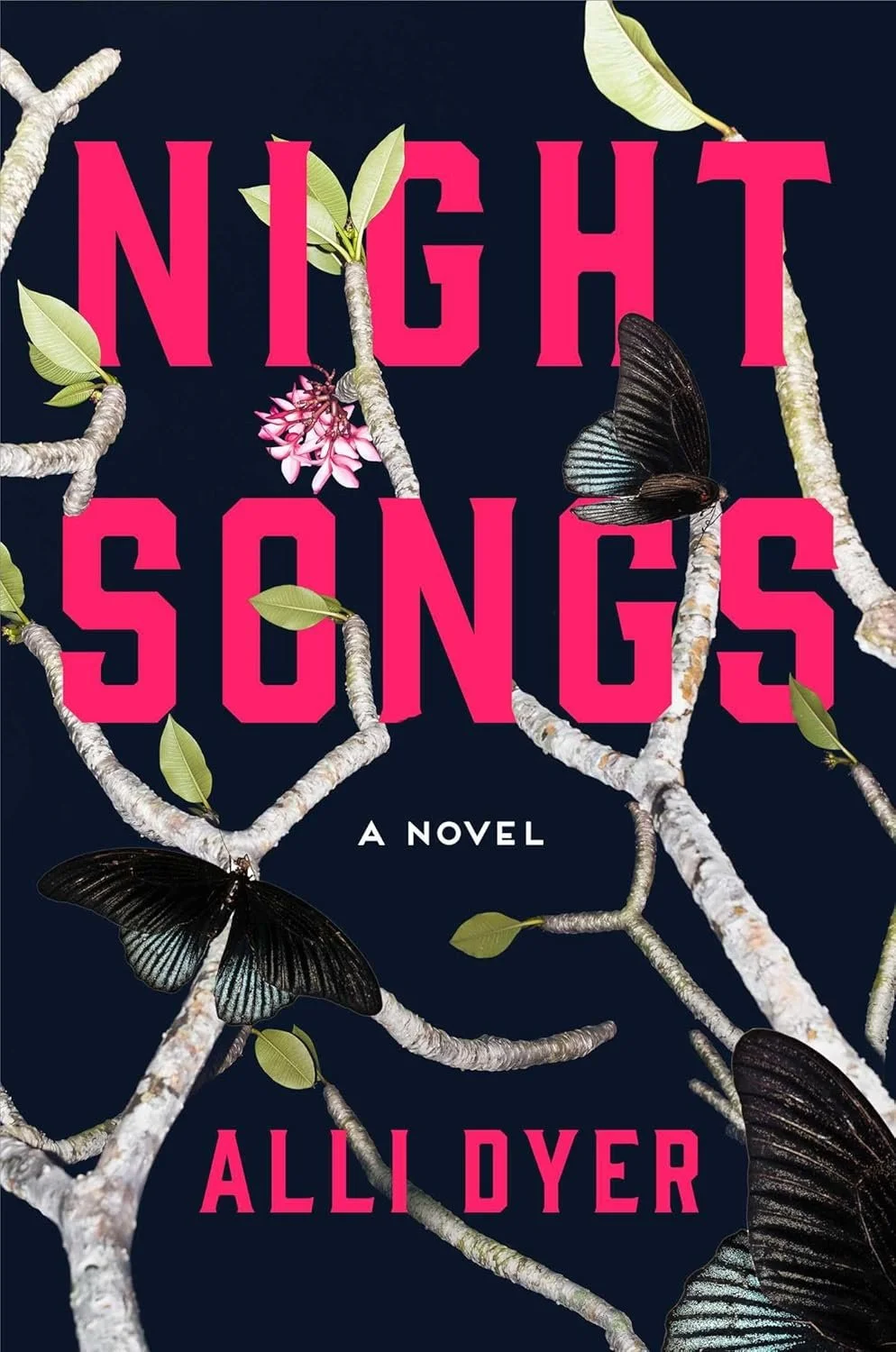
Night Songs by Alli Dyer
Blurb:
In this haunting family saga, a young woman must delve into her country star mother’s music to break a curse that has plagued the women in her family for generations—before her time runs out.
On the morning of Rhea’s eighteenth birthday, she makes a shocking discovery—her mother was the famed singer of some of country music’s most iconic tunes, the legendary Lulabelle “Belle” Powers, and she’s just inherited her massive estate. Eager to know more about this woman she barely remembers, Rhea travels to Nashville to retrace her mother’s footsteps. But as she gets to know Belle’s closest friends and learns more of her story, she can’t help but think something is being kept from her.
It isn’t until years later that her mother’s best friend Hess reveals the truth—her mother believed all the women in her family were cursed to die at thirty-three—Belle’s exact age when she passed away in a mysterious plane crash. Hess dismisses the curse as pure superstition, but Rhea feels something sinister stalking her, her own life beginning to mirror her mother’s as she gets closer to her thirty-third birthday. Desperate for answers, Rhea delves deeper into her mother’s music, uncovering Belle’s last unpublished album Night Songs, which leads her back to her roots in ways she never could have imagined.
Alternating between Rhea’s journey and Lulabelle’s untold rise to country queen, Night Songs is an electric story of inheritance and resilience, love and freedom, and the power of music to connect across generations.
Review:
“My mother had led me here, where I might be saved, maybe even freed.”
-Alli Dyer, Night Songs
On Rhea’s eighteenth birthday, she unveils a truth that shatters her world: her birth mother was a famous country singer—and she’s just inherited her massive, expensive estate. Eager to discover her mother’s past and what made her vanish, Rhea goes to Nashville and follows in her mother’s footsteps, pursuing a career in music, songwriting, and singing. Only, years later, Rhea’s newfound infamy and lifelong relationships are dismantled, alongside her life, once again when she learns that her mother believes a curse has caused all of the women in her family to die at age thirty-three. Determined to understand the danger she might be in, Rhea delves further into her mother’s history and uncovers an unpublished album entitled Night Songs, which might just hold the answers—and terrifying truths—Rhea is after.
I loved this novel, which was my first introduction to Dyer’s works despite it not being her debut novel. I loved the characters, especially Rhea, and how she was so often torn between the desire to learn more about her mother and to survive to see the rest of her life as a singer and as an individual. I loved the setting, a Midwest town (and then city) which were so vividly described that it was easy to imagine I was there with the characters wherever they went. I loved the conflict of the novel, and how the curse Rhea is fleeing impacts all of her actions throughout the book.
Dyer creates a profound work where conflict is found in abundance, and where everybody has different visions of what happened in the past. As a prior psychology major, I especially liked the idea that almost every character saw the death of Rhea’s mother in a different light or way, and how they all had different interpretations of the curse she believed she was chasing. There’s a principle in psychology called The Mandela Effect (a term coined by researcher Fiona Broome between 2009 and 2010) which is defined by how individuals can remember the same exact situation differently. That principle perfectly proves just how excellent Dyer’s execution of this concept was in this novel. Everyone sees things differently in the narrative, so nobody can be trusted—maybe not even Rhea.
The author has a firm grasp on what makes a story engaging. Although not all of the manuscript focuses on the curse Rhea is fleeing, the stakes rose in numerous ways that felt just as important.
Night Songs is perfect for readers who love unreliable narrators, misconstrued histories, magical realism, horror, strong female friendships, queer representation, urban settings, and, of course, music.
Dyer is a legend of urban fiction, which I usually don’t like to read if given the choice. The pitch drew me in, but I was hooked by the vivid writing, the raw characters, and the unique but relatable struggles that Dyer’s main character, Rhea, faced.
I can’t wait to see what Dyer writes in the future, and I’m thrilled to have been accepted to read the ARC version of this manuscript. This was a novel I will be thinking about for a long time after finishing it—that’s for certain.