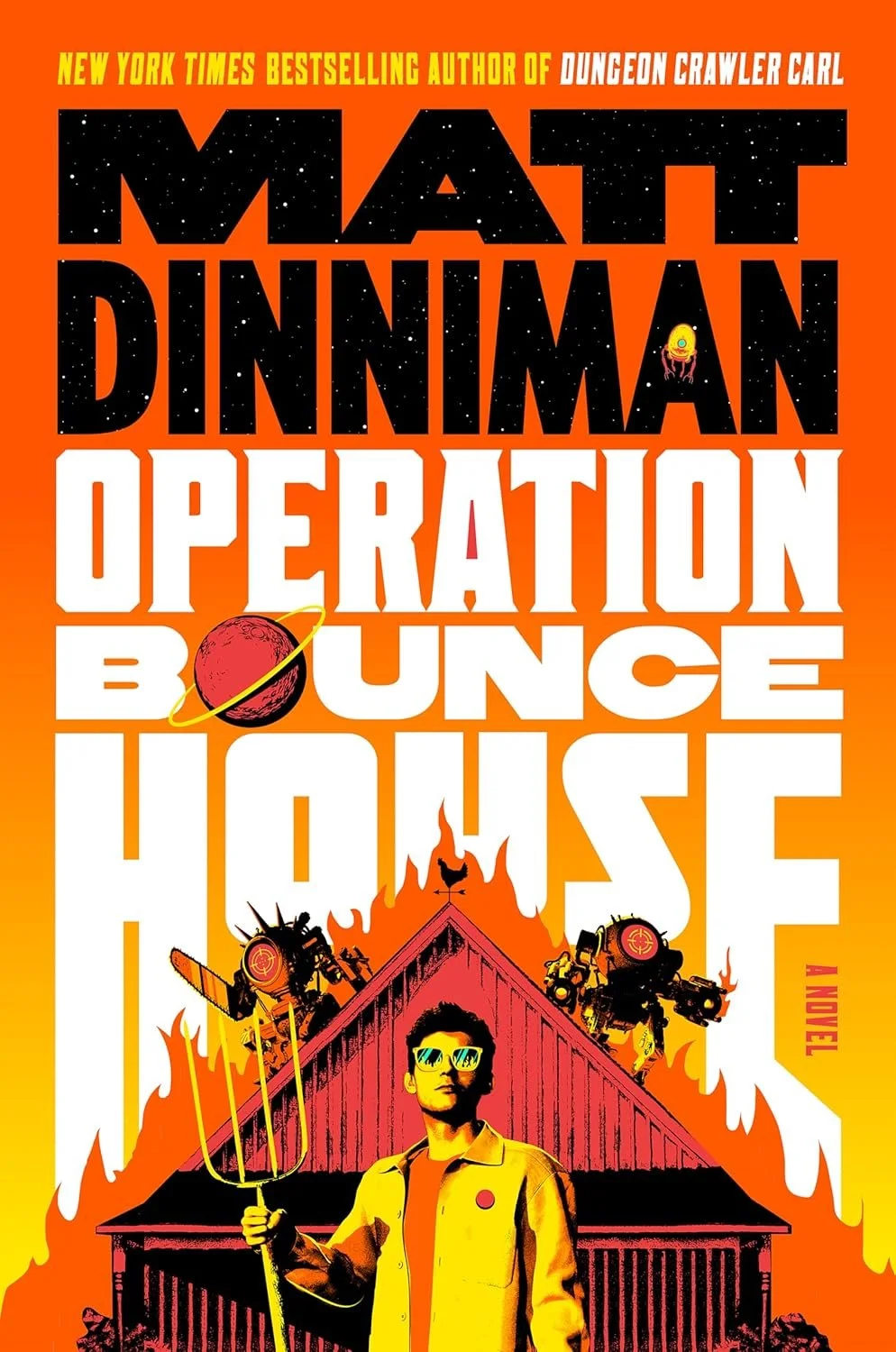
Operation Bounce House by Matt Dinniman
Blurb:
A man must fight for his planet against impossible odds when gamers from Earth attempt to remotely annihilate it in this epic, fast-paced novel from the New York Times bestselling author of the smash-hit Dungeon Crawler Carl.
All colonist Oliver Lewis ever wanted to do was run the family ranch with his sister, maybe play a gig or two with his band, and keep his family’s aging fleet of intelligent agriculture bots ticking as long as possible. He figures it will be a good thing when the transfer gate finally opens all the way and restores instant travel and full communication between Earth and his planet, New Sonora. But there’s a complication.
Even though the settlers were promised they’d be left in peace, Earth’s government now has other plans. The colossal Apex Industries is hired to commence an “eviction action.” But maximizing profits will always be Apex’s number one priority. Why spend money printing and deploying AI soldiers when they can turn it into a game? Why not charge bored Earthers for the opportunity to design their own war machines and remotely pilot them from the comfort of their homes?
The game is called Operation Bounce House.
Oliver and his friends soon find themselves fighting for their lives against machines piloted by gamers who’ve paid a premium for the privilege. With the help of an old book from his grandfather and a bucket of rusty parts, Oliver is determined to defend the only home he’s ever known.
Review:
If you follow this blog, you will know that I tend to be pretty vocal about the books that genuinely grab me, and Matt Dinniman's Dungeon Crawler Carl is one of those series that holds a very special place as one of my all-time personal favourites. So, when I found out he had released Operation Bounce House, I picked it up without a second thought. Going in, I was excited but also curious. Dinniman had already proven he could write something truly special, and I wanted to see what he would do with a completely fresh story and a brand-new set of characters.
What I found was something that surprised me in the best possible way.
From the very first pages, Dinniman wastes absolutely no time. You are dropped straight into Oliver Lewis's world without ceremony, and within those opening pages, you already have a strong sense of who he is, what he cares about, and what is at stake for him. There is no lengthy setup or hand-holding. Dinniman respects his readers enough to trust them to find their footing quickly, and that confidence in the pacing sets the tone for everything that follows. It is the kind of opening that tells you immediately you are in safe hands as a reader.
One of the things I found most impressive about how the story is structured is the way Dinniman handles background and context. Rather than front-loading the novel with exposition, he weaves in scene recordings throughout, a clever flashback device that drip feeds the reader information at carefully chosen moments. It fills in the gaps around Oliver's world and history without ever feeling like a detour from the main story. Every time one of these recordings appears, it adds another layer without slowing anything down, and that balance is genuinely hard to get right.
The heart of the novel, as I experienced it, is not really the action or even the central conflict, as gripping as both of those are. It is the relationships. Oliver, Roger and the group of friends around them are where the story truly lives, and Dinniman writes their dynamic with a warmth and authenticity that makes you invest in them quickly and deeply. There is an easy familiarity between these characters that feels earned rather than convenient, and it gives the more intense moments of the novel a real emotional grounding. You are not just watching events unfold. You are genuinely worried about these people.
The humour woven throughout is also very much a feature rather than a distraction. Dinniman's wit is sharp and well timed for the most part, and a lot of it comes through the supporting cast in ways that feel organic to who these characters are. It keeps the tone from ever becoming too heavy, which matters in a story that deals with some genuinely dark subject matter underneath its more playful surface.
That subject matter is where Operation Bounce House really caught me off guard. The premise of a corporation turning the forced eviction of colonists into a premium video game is inventive and wildly entertaining on the surface, but Dinniman uses it to say something with real weight. Running underneath, the action is a thoughtful and at times uncomfortable reflection on artificial intelligence, on how easily profit-driven thinking can strip the humanity out of devastating decisions, and on how disturbingly simple it is for people to disconnect from real-world consequences when those consequences are mediated through technology. These are ideas that feel genuinely relevant, and the fact that Dinniman embeds them into such an accessible and fast-moving story is a real achievement. It is the kind of book that stays with you a little after you put it down, and that is not something I take for granted.
I do want to be honest about the one area where I had a slight reservation. There are moments in the novel where the story builds towards something emotionally significant, and just as you are about to fully feel the weight of it, a joke arrives and releases the tension before it has completely landed. I noticed this a handful of times and it did pull me out of the moment slightly. That said, sitting with it afterwards, I think Dinniman is doing this deliberately and with purpose. These characters are facing something genuinely frightening, and humour is often how people survive situations they cannot otherwise process. In that light it is actually a humanising and realistic choice. But there were one or two moments where I personally wanted to stay in the heaviness just a little longer before being let off the hook.
As for where the story could go from here, I find myself genuinely uncertain about whether I would want a sequel, and I say that as someone who thoroughly enjoyed the book. It is less about any dissatisfaction and more about the fact that the story's ending leaves things in a place that feels open rather than incomplete. Whether a follow-up would work would depend entirely on what Dinniman chose to do with it. That kind of open-ended quality is actually a sign that the story has done its job. It left me thinking rather than simply tying everything off cleanly.
Operation Bounce House is a confident, creative and surprisingly reflective novel that I would recommend without hesitation. It moves quickly, it makes you laugh, it makes you care about the people at the centre of it, and it has more to say about the world we live in than its premise might initially suggest. Fans of Dinniman's previous work will find plenty here that feels familiar and comfortable, but what impressed me most is how willing he is to push into new territory and do something that stands entirely on its own. It is a genuinely great read.
