Sir Gawain and the Green Knight by Pearl Poet
Blurb:
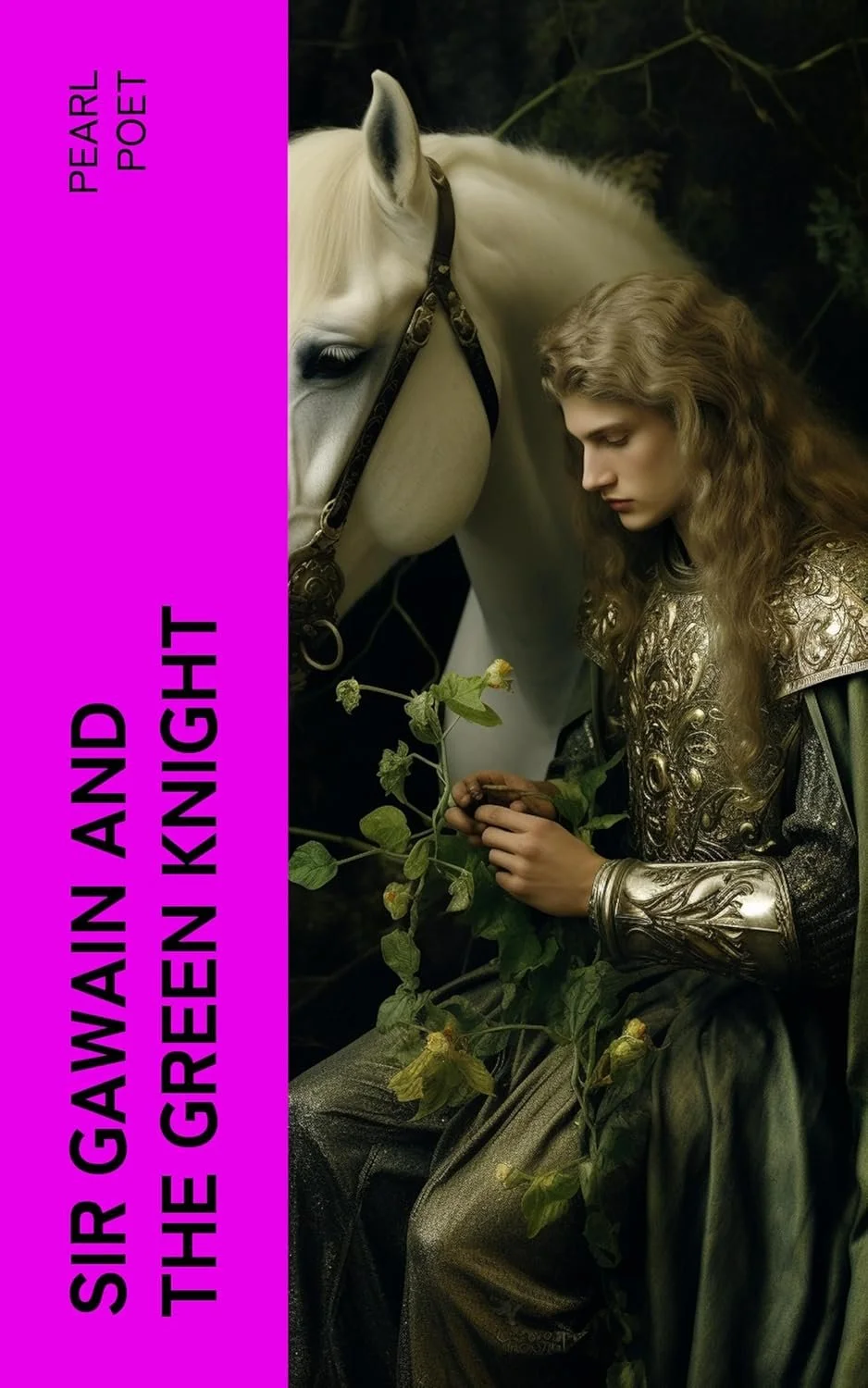
Sir Gawain and the Green Knight is a world-known late 14th-century Middle English chivalric romance. The author is unknown, as the story was passed by minstrels and city poets for decades. It received its title centuries later. It is one of the best-known Arthurian stories. The plot combines two types of folk motifs: the beheading game and the exchange of winnings.
Review:
Context & Translation
If you look within the cover of your favorite copy of “The Lord of the Rings” you will find a short, if not quite concise, list of other published works by J.R.R. Tolkien. There are, of course, the additional volumes comprising his lifework, the Legendarium of Arda, among which the most well recognized are the “The Hobbit” and “The Silmarillion.” But beyond those lands of Middle-earth lie other writings, not relating directly to his seminal work at all, but often inspiring it.
Among the separate works are more popular ones like “The Father Christmas Letters,” “On Fairy-Stories,” and “Beowulf: The Monsters and the Critics.” However, nestled within, is another, somewhat odd academic translation, borne of his work as a philologist out of Oxford. Tolkien’s translations of “Sir Gawain and the Green Knight, Pearl, & Sir Orfeo” were first published together posthumously in 1975.
These three old poems are believed to be originally written by the same medieval Poet, and were most definitely transcribed by a singular copyist in the late 14th century. Taken together, they form a slim but surprisingly weighty volume: uneven in enjoyment, but revelatory if you care about Tolkien, English myth, or how stories shape nations.
To start at the start, I found Tolkien’s introduction to be substantive and enriching, typical of his other more well known writings. He had a way of contextualizing the work with his particular writing voice, opting for verbosity to achieve the most precise representation possible of his opinions and descriptions. As an example, when describing the Poet, he wrote,
“He was a man of serious and devout mind, though not without humour; he had an interest in theology, and some knowledge of it, though an amateur knowledge perhaps, rather than a professional; he had Latin and French and was well enough read in French books, both romantic and instructive; but his home was in the West Midlands of England; so much his language shows, and his metre, and his scenery.”
Beyond this introduction, I found in further reading that the Poet here is likely to have also been a contemporary of Geoffrey Chaucer, author of the Canterbury Tales. However, while these writers were both writing in England at the same time, they were not likely influenced by each other’s work or even knew of each other (useful reminder here that at this time, no Bible, and thus no “serious literature,” had yet been translated into Middle-English (proto-English), which was before now seen as a second-rate language when compared to Latin, Old French, and some proto-Italian dialects).
Being contemporaries may only seem a great coincidence, but instead it may better represent how at this time of 14th century England, we have mounting evidence of the seminal formation and solidification of not just the present-day English mythologies, but of the English language itself as a valuable and worthwhile tool for literary pursuits. More on that later. For now, let’s dive into the stories themselves.
Story Notes & Analyses
Sir Gawain and the Green Knight
A Christmastime story for a Christmastime game. Cast yourself back to ancient Camelot where lies King Arthur’s Round Table and his loyal knights. England is not yet unified. The Anglos and the Saxons are independent peoples and regional Kingdoms rule the land. It’s a time when myth and folklore still haunt the dark woods, slowly being pushed towards the shadows as Christianity, recently introduced by St. Augustine, continues to grow in influence across the isle. This fluid, mist-drenched mythological period where everything is there and yet not there, is where Sir Gawain and the Green Knight is set.
It was written much later, after England became unified, and yet as a new nation still struggled to form its own unique identity and place in the world. Arthurian Legends must have been especially potent in these times, effectively grabbing hold of a nation’s attention and instilling a sense of pride, honor, and “proper moral compass” that would befit the now ubiquitous Christianity, still led by a strong central Papacy (or, at least, one of them, Western Schism be damned).
Our story is written in a style known as “Alliterative Revival.” Yes, it rhymes. It has a natural ease in its verse, and reads as if it could be spoken nearly as plainly today as much as be sung in ancient gatherings. Perhaps we have a talented translator to help thank for this.
for at the hue men gaped aghast
in his face and form that showed;
as a fay-man fell he passed,
and green all over glowed.
It is truly a mythical tale. Within its dark, misty atmosphere, it presents the idealized version of Knighthood, with all the chivalric virtues it entails. By being explicit in these virtues, we might apply a moral framework upon the story to map nicely against the ideal Christian consciousness.
More Christian symbolism is on display as well. We see heavy usage of Numerology to communicate themes and ideals, including the first known English usage of “Pentangle” to describe the endless knot forming a five-pointed star prominently laid upon Sir Gawain’s shield, with Mother Mary at the center providing him his supposed motivation for his quest.
It’s rare to see the same Pentagram shape used so explicitly with Christianity, but here it’s made clear. Perhaps by using “Pentangle” to name the same shape we are meant to co-opt it, separating it from its more ancient Greek origins that originally connected it to the elements of the world.
Christianity and the ideals of Knighthood are central tenets to this Arthurian legend, but what sets it apart from other legends of its time, and in fact what continues to set it apart into today with renewed interest, is the story’s explicit connection to nature and the supernatural, and specifically the use of the color Green.
The “Green Chapel” where Gawain is to re-connect with the Green Knight on New Year’s day to finish their game is a metaphorical location rather than actual chapel. In actuality, it is just an earthen mound and small cavern. To call it a chapel feels almost tongue-in-cheek, showing us that in these woods, this is where true prayer and communion takes place.
The eponymous Green Knight, colored green along with his horse, is a haunting and otherworldly magical figure. Made regal with gold and gem inlays, the court of Camelot is awestruck. The vivid green color drenches the Knight, his axe and even his horse, denoting a mystical connection to both the natural and supernatural upon this foreign visitor.
To start, the Knight boldly enters the Round Table, horsed, and armed with a drawn green and gold axe and holly-branch. His inherent connection to the natural world, life, and the old ways contrast against the washed-out colors of the court hunkered down for a drab midwinter’s celebration. Arthur’s in need of a story. So while the Green Knight enters on cue with full confidence and strength to spare, he also comes in peace, shown by the upraised holly-branch. He presents his deadly game in good will. As the game begins, the signaled magic becomes evident once the Green Knight is beheaded by Sir Gawain, and by these powers, he simply picks up his own head, reminds Gawain of their destined date, and rides out whence he came.
That Gawain keeps the Green Knight’s axe upon his departure is no mistake. It signifies a constant reminder of the game he volunteered for, and it offers a connection to the otherworldly world of magic he enwebbed himself within.
After a year, our young knight of the Round Table journeys forth to meet his appointed time, and is to have many misadventures along the way, often against beasts and other monsters you might find in nature. In the final week we see Gawain arrive at his second castle, Lord and Lady Bertilak’s, for a brief reprieve.
Here, another game unfolds for Gawain to maneuver as he is tested three times across three days and three hunting trips, challenged to uphold the five chivalric virtues expected of Knights. Following these tests, Gawain is mercifully directed along the final stretch to what is known as “The Green Chapel.”
Sir Gawain meets the Green Knight for a second beheading scene, and the Knight attempts three swings to return the mark originally given. Gawain, failing in courage, winces against the first two, but is steadied for the third. In completing the symbolic number sets for three, two, and five, all our relevant themes come together as the Green Knight ultimately opts not to behead Gawain. He instead gives him a small cut upon the neck, a final outward symbol of his inward failings. Not totally let-off, but altogether a decent outcome for our anxious protagonist.
If you look, there’s so much more that could be said about this story. Which characters conjured the magic and the game. The symbolism of the Girdle and the Ring. All of it is interesting, and worthy of examination, but we’ve tread enough ground today.
For me, let me just say it was an intoxicating poem. I’m not super familiar with Arthurian legends, but this seemed so peculiar and engrossing, it’s the headliner that drew me in to pick up this little book. I’m happy to say it truly stands the test of time.
Pearl
If “Sir Gawain and the Green Knight” was a story hearkening back to (or forewarning of) a mythological past deeply connected to nature and ancient magic, then “Pearl” looks forward, serving as an explicitly Christian parable.
The style and format was also different. I found it much more difficult for the modern reader. Perhaps being sick with the flu when originally reading this had some effect, but I often found the layered metaphors and allegories indecipherable, especially compared to the other two stories it’s sandwiched between. I confess, I had to return to it multiple times to piece together this densely layered elegy. Let’s cut to the chase, for this alone I didn’t enjoy “Pearl.”
The stanza structure was unique and complex for its time. Each stanza with 12 lines, with each stanza connecting together with “link” words. Five stanzas per section, each section’s final link word linking to the next section’s opening word. Sections arch between each other, forming a circular structure across the entire poem to create an overall symmetry. It’s impressive, and the form matches the theological premise of its story, creating a complete whole. So yes, it also rhymes, and for that at least there’s a semblance of a fun time.
In the story’s Prologue, the narrator falls into a dream vision as he searches for his lost Pearl. He meets from across a stream a Pearl-Maiden with whom he begins a Dialogue.
On the flowery plot I fell, methough;
Such odour through my senses shot,
I slipped and to sudden sleep was brought,
O’er that precious pearl without a spot.
The dense dialogue has the Pearl-Maiden sermonizing to our narrator a Christian message. She herself then weds a Lamb. They speak of sin, reward, and repentance. She then sports her own divine Pearl which she then peddles back to the narrator to (presumably) make a quick quid.
The Epilogue ends the story with the narrator asking about the afterlife. Here we get more Numerology, this time straight from the book of Revelation. Pearl reveals she is one of the 144,000 brides in New Jerusalem, and the full count of lines in the Poem is 1212, reflecting the repeated mentions of twelve in Revelation. To conclude the Epilogue, our narrator awakes and, like Scrooge, now wants to renew focus on following God and more closely heed Christian virtues.
All told, “Pearl” reminds me of classic Greek philosophy dialogues whose structures were often used as a device to illustrate and help introduce new eras of thought, but with this iteration, it’s evolved into an explicit Christian theocratic message that would have made even Boethius blush.
Perhaps its heavy-handedness was thought to be necessary to balance the dense complexity, however I found it rather off-putting and literally preachy. I would not recommend this story, but at least it’s not terribly long and can easily be read in a single sitting.
Sir Orfeo
After the doldrums of “Pearl” I was apprehensive in my approach to “Sir Orfeo.” However, I was quickly appeased when I jumped into the final poem and found it to be the shortest and simplest of the three. It read more as a classic romantic fairy tale, and was thankfully not heavy-handed with theological preaching or even its allegories. If anything, it goes so far in the opposite direction as to not imply any theocratic or virtuous signalling.
The poem is a retelling and adaptation of the classic Greek story Orpheus and Eurydice, blended with heavy Celtic influences. Rather than journeying to the land of the dead, Underworld (or, Hades), King Orfeo must travel to the Fairyworld kingdom to find his abducted wife, Heurodis, who was taken from beneath a grafted tree by the Fairy King.
On the morrow, when the noon drew near,
in arms did Orfeo appear,
and full ten hundred knights with him,
all stoutly armed, all stern and grim;
and with their queen now went that band
beneath the grafted tree to stand.
A serried rank on every side
they made, and vowed there to abide,
and die there sooner for her sake
than let men thence their lady take.
And yet from midst of that array
the queen was sudden snatched away;
by magic was she from them caught,
and none knew whither she was brought.
This tale also differs from Orpheus, as it has a happy ending. He wins back Huerodis and brings her back to his Kingdom in Wessex where he is not initially recognized. He cleverly tests his appointed steward’s loyalty before revealing himself as the long-missing King Orfeo, who successfully recovered his missing wife, Queen Heurodis, and who together finally reintegrate into the Kingdom as King and Queen once again.
A pervasive magical atmosphere hangs over this fairy story. It depicts magical impossibilities simply and without reflection. The imagination on display was impressive and even for a story lacking much complexity it still succeeded in affecting awe through the page. Orfeo’s devotion to Huerodis was complete, and with her loss, so lost was the Kingdom, to him.
He won her back by being an excellent harpist and logician when speaking to the Fairy King to convince him to release her to him. These two traits call back to King David of the Old Testament, and to Greek myths where a clever mind can outfox a daunting foe. All these Judeo-Christian, Greek, and Celtic inspirations meld seamlessly into the story. It’s no surprise it’s persisted through the ages, even as unheralded as it is.
While not the standout of the three stories, it certainly stood out as the biggest surprise for me, and I would absolutely recommend it to anyone interested in medieval literature and poetry.
Themes and Influences
Taking in these three stories as a whole presents a true quandary. They were written by the same copyist and are believed to be written even by the same author. Tolkien had previously published “Sir Gawain and the Green Knight” and “Pearl,” but of “Sir Orfeo,” only his extensive notes and drafts remained. That is why his son, Christopher Tolkien, was the one who ultimately compiled them into one posthumous volume.
Yet in these three stories I see completely different styles and even more interesting very different central theses. “Pearl” teaches us how to return focus to God as the Pearl goes through multiple symbolic evolutions; its meaning and even genre is still debated. “Gawain” teaches us how to live virtuously and chivalrously, and of the strange magics that can be found in nature. And finally “Orfeo” is a, relatively more, simple combination of other popular culture’s stories and motifs, formed together to present an attractive and classic romance.
Rising to the top, I see two main themes from these I find most interesting:
Influences on English identity & language
Influences on Tolkien’s own mythology
The implications of the first are huge. We weave together allegories, elegies, fairy stories and more. We see different styles of poetic structure written down in English for perhaps the first time. Bless the contemporary translation for making this approachable compared to the original Middle-English. These heavyweights provide mounting evidence, along with the Canterbury Tales, that English was a language to be taken seriously for literature, helping raise its stature in Western Europe. And with the mingling of real places like Wessex, and invoking popular figures like King Arthur, the national identity, intentional or not, only deepened with these mystical poems.
Of the second theme, Tolkien was undoubtedly influenced by these stories as he built out his Legendarium. In particular, you can see startling ties between the story of Beren and Lúthien, and both “Pearl” and “Sir Orfeo.” In fact in the entire Silmaril cycle you can see connections all throughout these poems. Love, loss, and consolation. Worldbuilding, magic, and myth-making. Tolkien was inspired by other ancient writings, especially from Scandinavia. He saw how stories could forge a cohesive identity and shared moral framework between people. And with stories he saw how people can resonate with them and find their own deeply personal connections.
As a Tolkien fan, I found these readings immensely interesting and enriching. On the whole they were also enjoyable.
As a relative novice to Arthurian legends, I found this little book compelling and showed a level of depth and nuance that I was stunned by. I’ve since read other books influenced by these, or set around the same period and place. I’ll save further comparisons to those works for those reviews.
It’s been fascinating to see how the world influences our myths, and in turn how our myths influence our world. As we start 2026, may our stories continue to be both inspiring and evergreen.
Sources and Further Readings
Pentangle Description: https://www.litcharts.com/lit/sir-gawain-and-the-green-knight/lines-491-1125#summary-21469
"Teaching Tolkien's Translations of Medieval Literature: Sir Gawain and the Green Knight, Sir Orfeo, and Pearl:" http://www.thisroughmagic.org/beal%20article.html#:~:text=This%20is%2C%20of%20course%2C%20a,both%20primary%20and%20secondary%20sources.
