Blurb:
“Now reach back,” she said, “and tear off your wings.”
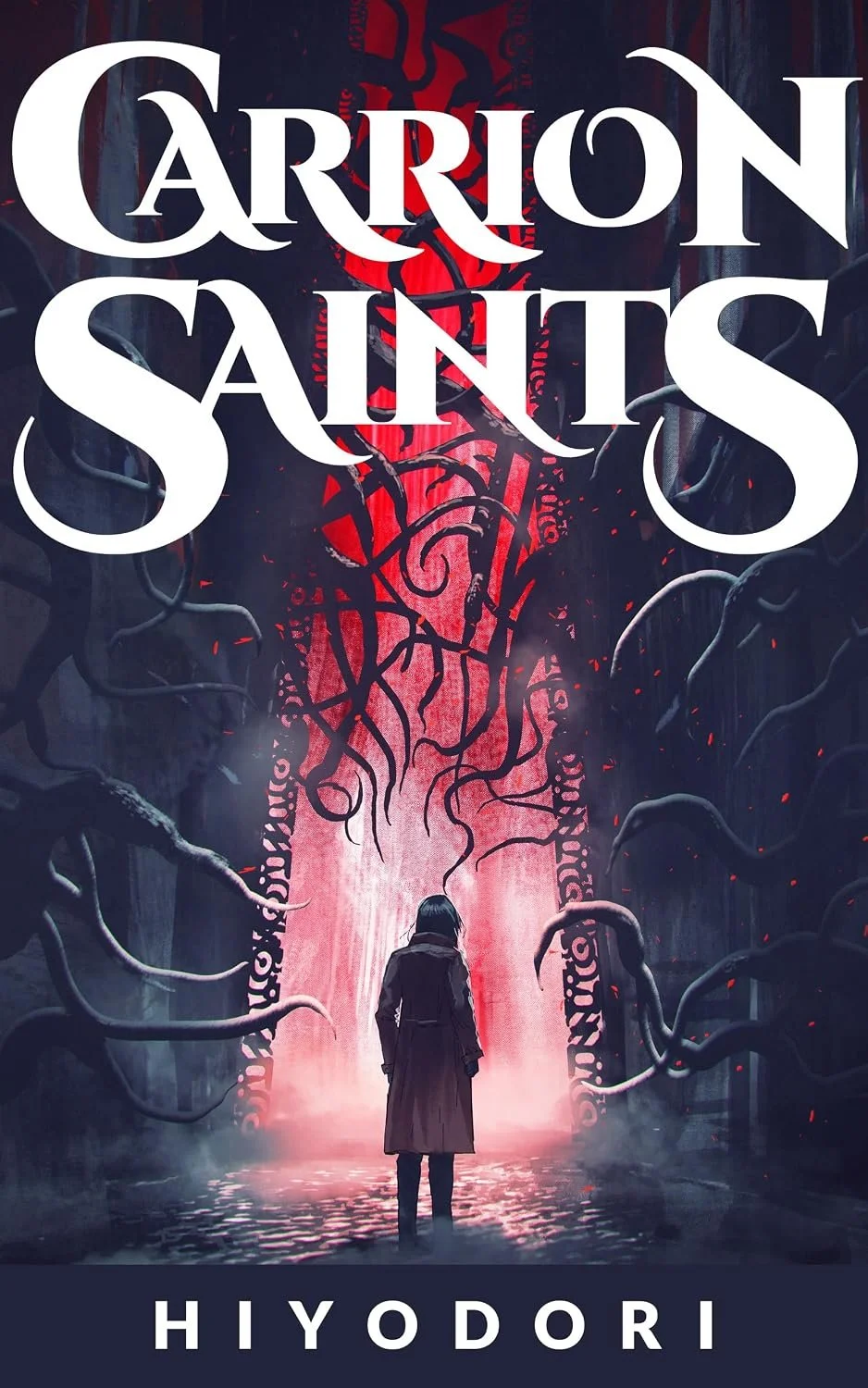
Carrion Saints is a sapphic enemies-to-lovers romance between an immortal saint and a severed head.
Crow can pass for human. She may come off as eccentric, but she’s good at hiding her wings. As a saint, she’s devoted her endless life to protecting humanity from other immortals: the ones they call monsters. She’s finally ready to take on the worst monster of all, a great evil sealed at the edge of civilization.
Magnolia is the worst monster of all. A villain who amuses herself by preying on valiant heroes. At first glance, she looks powerless. She looks, in fact, like a decapitated head (a very chatty one). But her magic lets her issue absolute commands to humans and immortals alike. She’s been waiting centuries for a challenger powerful enough to break the seal binding her in the wilderness. In other words, she’s been waiting centuries to magically seize control over someone like Crow.
Crow has always been patient and forgiving. Sadistic, remorseless Magnolia awakens new depths of loathing in her—a hatred of frightening intensity. And now, she's forced to use her full power to grant Magnolia’s one heartfelt wish: to see the rest of the world. To make up for all the years she spent trapped alone with only trees for company.
What follows is an ultra slow-burn romance between true enemies. Between good and evil. Between a winged woman and a talkative severed head (who occasionally sprouts the rest of her body, just to keep things lively). They travel together across a post-apocalyptic landscape marked by strange magic and scattered human settlements. Yet the apocalypse happened a long time ago, and eons will pass before their gradually fading world dies for good.
In the meantime, these immortals are stuck with each other. Even a saint and a monstrous villain might eventually fall in love—but the path there will be dark, crooked, and sometimes surprisingly cozy.
Review:
SFF Insiders is here to provide you with our official rating for the finalist book, Carrion Saints by Hiyodori! Check out what our SPFBO judging team had to say below.
Amanda
This book felt like an obscure inside joke I was not a part of. I say that without sarcasm, it felt well placed, just in a realm outside my own, one I don't understand. I wanted to like it, and in some ways I did. The writing was beautiful. It was well crafted with an interesting world, including those outside of it. I was surprised at times, in the ways I want to be. And it’s nice to read a unique perspective in fantasy, its nature was far outside of the norm.
The world unfolded slowly, and from Crow’s perspective read nicely. My mind liked the preoccupation of putting together the pieces of the mortal world amidst the inner turmoil Crow endures. I loved travelling and thoroughly enjoyed Hiyodori’s atmospheric glimpses. A fallen, failing world is a fairly familiar experience for SFF readers, but this was both fresh and crisp, I loved the sense of being behind a lens playing with focus, and I wanted so much more of it.
The travelling did bring a lot, and I mean a lot of dialogue. This story gives new meaning to the saying “devil on your shoulder.” To me, the relationship that develops between Crow, an immortal saint protecting humans, and Magnolia, a magic devouring monster, is anything but love. I understood Magnolia, and as annoying as it was, the character was solid for me. I would have loved it if Crow had taken action on ridding herself of Magnolia a lot sooner than she could grow her codependence. Where Magnolia made sense, Crow didn’t to me. I could hardly rationalize Crow’s believability and struggled with the overall sense of relativism (despite the constant undertones of comparison) I felt I was supposed to accept as the book strung along. Perhaps this is because I have a dualistic moral worldview, so for that I tried to give this book all the grace. But though her thoughts were eloquent and the world beautiful, I lived in a disbelief that only grew with the pages, even at the end.
I think the marketing of this book really hurt its enjoyment here. Calling this a romance was a bit sadistic to the reader. I joke, but I also kind of mean it. I held out a hope for this story I really shouldn’t have, and felt like inferring a depth I didn't quite see come full circle was meant to replace it.
At the end of the day, this wouldn’t be a book I would recommend unless very specifically so. I think there is a place for it, and certainly no one can deny Hiyodori’s writing prowess. But this one was not for me.
Jon
This summer, I was with my family committing to a several day drive road trip to Florida from a family members house before driving back. On the drive back, the first leg of the journey was consumed by "Carrion Saints", the occasional navigation alongside several reminders to not make everyone suffer through the scenic route and napping (I blame residual jet lag).
"Carrion Saints" place in the SPFBO XI competition is valid, it's well written and the story is satisfying by the end. However, I cannot find myself to fully enjoy the novel because, despite it being a stand alone, I believe it might be closer to a companion piece that can still be enjoyed as a stand alone but more enjoyment might've been wrought if I was familar with Hiyodori’s work.
To best illustrate this, let me take two companion books. One from George R.R. Martin and one by Terry Mancour. On the enjoyment spectrum, one was difficult read that might've threatened the health of my kindle, and the other, a relaxing finish to a two week binge of reading. One I read when I was 15, the other I read a few months ago, but still, I vividely remember both to a similar degree as well as the vibes.
If you want to skip this part, feel free to, and skip ahead a bit to go to actual outline of the characters, the plot and the world a few lines later. Basically once you see another line like the one below:
First, "The World of Ice and Fire" by GRRM. Unrelated but we might get GTA 6 before "Winds of Winter". Anyhow, side tangent about that aside, "The World of Ice and Fire" is a companion book about the prehistory of Westeros before the events of the books, and the show. Naturally, you can read it like any old fantasy history novel with barely any knowledge about Westeros, the events of the entire series, and the show, like I did. Or you can do all of what I had not done, and then read it. There would probably, taking a guess here, be a differing level of enjoyment. While I am reading about X killing Y for some unrelated reason having being given barely any connection to them, those who have read the books and seen the show would be pointing at the book, then their shelf, and say to themselves "Oh that is why this House is like that now". As an example of course, I don't know if it was exactly like that for those who've read both the main series and the companion book and it has been four or five years since I've read "The World of Ice and Fire", and my mind has slowly been replacing my memories of that with a barrage of new novels.
Secondly, there's "The Golden Goblin" by Terry Mancour, a companion book to the Spellmonger series. How I went into this companion book was the complete opposite of how I went into "The World of Ice and Fire". As I was reading this this year before the newest novel came out, I had finished the main series and the two spin off beforehand. And so, naturally, my enjoyment of a companion novel that I could've read as a standalone, was much higher. I was able to point at figures in "The Golden Goblin", and point at a previous book and say, "Oh look, I recognize them, this is great". Whereas someone else would be getting mixed messages about why there's midieval style buildings, a space opera tank, and bioengineering in the same chapter.
All of this to say that "Carrion Saints", at least for me, fell into the first category of companion books. At some point in time though, I'll probably dive into the other parts of Hiyodori's works and maybe get some post read enjoyment of seeing why "Carrion Saints" was the way that it was.
Now then, if you are here, you have either skipped the long text wall explaining two different companion books in comparison to "Carrion Saints", or you've read it all. If you have, thank you.
Going back to "Carrion Saints", we have the two characters, Crow and Magnolia. Two very different ladies. Or creatures. They're about as a different as a bird and a plant. I'll see myself out. Crow, the protagonist of the book, is a Saint, something that harvests cores from mortals after a mutually beneficial relationship and murdering monsters.
Then there's Magnolia, a monster that has a habit of murdering people via suggestions.
The Saint of this relationship, Crow, is remorseful over something that happened in her past and is cordial and friendly towards humans.
And then there's Magnolia. I cannot stress how much I loathed this character until about maybe 90% in. I get that she is the supposed antagonist of this story. I take that back, she is the antagonist of this story. She is an irredeemable monster that talks to the point that if I had to save either her or JarJar, I'd pick JarJar. Besides that though, the last 10% she is tolerable, and she's somewhat mellowed out, so it's not like that throughout the whole book, but still, I liked the silence every once in a while.
After that, there's the plot. The gist of it is, Crow wants to murder the four evils of the world, and has succeeded at all of that, except for the last one, which happens to be Magnolia. After Magnolia unceremoniously takes over Crow and causes some havoc, they start wandering and wandering, and wandering, a few years, centuries pass. Some shenanigans later, a call back to something that might be of import in a prior book somewhere, and some more shenanigans, and the end was, like all other books, an end.
Lastly, there was the world building. We have a world not too unsimilar to Earth, but with Immortals, split between Saints and Monsters, that showed up after some unknown horror happened to the planet. Around the same time as those things appeared out of the wood work, humans started being born with cores that let them do magic. For the Immortals, both Saints and Monsters, the cored humans became food sources. For some, the Saints, it was a delayed gratification thing, for others, the Monsters, it was an all you can eat buffet as long as there were enough people with cores around.
Naturally, humans allied with the Saints and tried rebuilding the world from there. By the time Crow and Magnolia meet, the numbers have dwindled however. And well, the rest you'd have to read because if I said more, that'd be taking away from the suspense of the latter half of the book.
Now, the one thing I'd have to critique about "Carrion Saints" is that there is a lot of talking, not a lot of telling. Now, dialogue is never a bad thing, it's always nice to get some, as I was starved of dialogue reading "The World of Fire and Ice". But there is a point where the dialogue becomes less a part of the story, and the whole story with some stuff happening without.
Depending on what you go for, this will work or won't, I leave that up to your own disgression.
Overall, if you want a romcom with lots of talking done by a murderous plant and silent suffering by a Saint, as well as world that has a lot of depth when you read it, "Carrion Saints" is for you.
Grady
Carrion Saints is a contemplative and provocative Dark Fantasy billed as a slow-burn. While the slow-burn aspect is true, for me it’s even more helpful to think of it as a deep-dive into the abyssal zone of the weird. Either way the effect is similar: it takes a long time to arrive where we want to go, and once we’re there the payoff is worth it. But instead of steadily building into an explosive release, the deep-dive takes a plunging fall into the depths of darkness, where all familiarity is stripped and our freezing new reality becomes normalized and inescapable. In Carrion Saints, after years of characters losing bodily autonomy, it’s only upon that desolate sea-floor where we find our answers.
I make this metaphor because our story is set in a fascinating post-apocalyptic world, one that’s slowly waning to its inevitable end, and as a result is filled with unending melancholy. Fitting right into this vibe we enter a deep character drama between two near-divine beings, Carrion Crow and Magnolia.
Like her fellow Saints, Carrion (“Carrie”) Crow is tasked with destroying humanity’s Great Adversaries, and the last one, the mysterious Woman in the Hills, has been awaiting her. Magnolia (“Maggie”) is that Woman in the Hills, the final Great Adversary. She confoundedly—effortlessly, even—controls Carrie before she ever gets close to her protected forest. She forces Carrie to free her from the bonded tree which kept her physically rooted for generations, and now able to wander, Maggie subjugates her new pet Saint, enlisting her on a final journey, and only meting out a little freedom at a time.
“Now reach back…and tear off your wings.”
In contrast to this abrupt introduction, their journey is long and meandering. The control of Carrie is often subtle and nearly unnoticeable; Maggie maintains a veil of reality that keeps her questioning her own thoughts, all the while trying and failing to escape control. While interesting, it is at times repetitive. Previous conversations are often revisited, tracing over themselves with subtle iterations to demonstrate growth, but it’s a technique that requires patience.
This pattern is aided and abetted by Hiyodori’s writing, which is consistently strong and evocative throughout. Some may call it long-winded as dialogue between Carrie and Maggie often chewthrough pages, but I quite enjoyed spending that time with our characters as they grew on each other to reach ever-deeper levels of comfort and mostly-emotional intimacy. Maggie is extremely “chatty,” showing off a clear, confident, and witty voice, while Carrie must mostly endure every word, only giving her perspectives begrudgingly. It’s a choice that serves to slowly peel away her defensive shell and give insight into her uniquely tragic past.
Told from Crow’s perspective, the story fully centers on this tension between these two. It creates an effective gravitational orbit of influence between them. Due to their quasi-divine status, and the constant reminders of the futility of their broken world crawling to its end, the heavy stakes of their personal goals can feel both grand and mysteriously muddled.
You might think this could result in an apathy infecting everyone—and this may well be the case with some side-characters—but for our main duo, they continue to strive for meaning and purpose for themselves which I found oddly sentimental.
Not everyone will agree, but I found the drenching melancholy endlessly intriguing. Complemented by the knowledge that Hiyodori layered in connected stories and characters from her other works, this fragmented and mysterious world-building reminiscent of myth and folk-lore created a mist of mystique that strengthened the overall atmosphere. It really clicked with me.
As Carrie and Maggie’s bond developed (as an aside, I appreciate the informal nicknames they used for each other. Good name choices can scratch a satisfying itch, and I thought “Carrie” and “Maggie” were wonderfully fitting), we explored deeper questions around the troubling knot of consent in relationships where there is an inextricable power dynamic. How could you possibly square that inherent conflict, if at all? If you don’t have autonomy, can you reliably believe yourself to know what feelings are fully yours? These questions provided a quietly philosophic backbone that lingered in my mind since finishing the book weeks ago. They were addressed head-on in the text, and even suggested potential answers, but it also left ample room for interpretation, inviting me to contemplate, which I appreciated.
And so overall, I thoroughly enjoyed this lengthy dive as I love an introspective book that cultivates a highly specific vibe. However, it’s undoubtedly a long journey, and so the length paired with the specificity of the writing, means Carrion Saints can be a great example of a subjective experience that truly won’t be for everyone. But as the adage goes, a book written for everyone is written for no one, and I feel the distinctiveness we have here is a hallmark of confident authorship that I respect.
Hiyodori’s made a beautiful book here, and I look forward to seeing more from her in the future.
Khan
Carrion Saints is a book with a lot of ambition. Hiyodori has clearly put serious thought into building a world with its own history, rules and mythology, and that dedication shows on nearly every page. Unfortunately for me, that same dedication is also where the book started to lose its grip.
The story follows Crow, a saint who is a returner, and Magnolia, one of the Four Great Adversaries. Their backstories are easily the strongest part of the book. Learning where each of them came from gave real insight into their motivations, and at times I found myself rooting for both of them.
My biggest difficulty was the pacing. The plot keeps moving, but it often felt like the characters were taking detours so the world could be expanded, rather than heading towards their destination. Readers who love rich lore will probably enjoy this, but for me it made for a slow and heavy read, and my attention drifted in several sections.
The dynamic between Crow and Magnolia is where I had the most mixed feelings. Their relationship is built on conflict, and there are key moments where the story seems ready to move forward decisively, only for the characters not to follow through. The book also introduces an intriguing power imbalance between characters that doesn't quite add up at first. I liked the idea behind it, as it suggests that no one is truly unbeatable, and it does get explained later on. However, those repeated moments of hesitation started to feel more like they were there to keep the plot going than genuine character choices, and I wish the answers had come a little sooner.
As the story develops, their relationship also shifts into something I didn't see coming. I'm all for unexpected turns, but this one didn't feel earned to me. I struggled to see how the bond between them had grown, and I would have liked more moments that showed what drew them together beyond their rivalry.
Crow's emotional journey surprised me too. A significant part of the book explores her past and a loss that clearly shaped her, and these sections were some of the most affecting. Later, though, that weight seems to fade without much acknowledgement. This could be read as growth, or as part of her nature as a saint who follows orders and keeps going. Still, after so much time spent on it, the change felt sudden.
Overall, Carrion Saints wasn't for me, but I can see who it is for. Readers who love following a single character through a constantly expanding world, and who enjoy getting lost in lore, will likely find plenty to enjoy. It may also be part of a larger series where some of these threads pay off. As a standalone read, it has strong ideas and memorable characters that didn't quite come together for me.
Kristen
Carrion Saints follows Crow, an immortal who has devoted her life to protecting humanity from other immortals, specifically monsters. She has tasked herself with tracking down and challenging the most powerful evil that has been sealed away for ages, Magnolia. What unravels is a true slow-burn enemies-to-lovers romance that is dark, twisted, and yet still manages to have a touch of heart.
In all honesty, this review was extremely challenging for me to write. This was my first introduction to Hiyodori, and I was very excited to dive in after seeing others within the book community sing praises of the author's previous works. However, I do feel that this book just wasn't for me, and that's okay. As a reader, I completely understand that what isn't my “cup of tea” so to speak, can be another person's “best book of 2026”. Not every book is going to resonate with every reader, and I think there's something important in acknowledging that.
We are thrown right into the action in the first few chapters, with Crow setting out to kill Magnolia. The premise immediately caught my attention, especially with the set up and promise of a dark and complicated relationship. However, after some intriguing magic leaves Crow under Magnolia's control, I felt like the story began to drift. The heavy dialogue and slower pacing made it difficult for me to remain fully engaged, and I found myself hanging at many points wondering when the plot was going to pick back up. While I can appreciate a slower build, I personally struggled to find the momentum I was looking for as the story progressed.
The descriptive prose was probably the book's greatest strength for me. Hiyodori's writing paints a vivid picture, creating an atmosphere that feels immersive and enchanting. There is a richness to the descriptions that I can absolutely see captivating readers who enjoy getting lost in the world and its lore. Additionally, the initial power imbalance between our two characters felt very believable. The dynamic between Crow and Magnolia had an intriguing foundation. I appreciated the tension, and later on the growing relationship dynamic, that came with their circumstances and the control Magnolia held over Crow.
Overall, Carrion Saints wasn't a book for me, but I can absolutely see it being a favorite for readers who love immersive lore, descriptive prose, and dialogue-heavy writing. While I struggled with the pacing and found myself wishing for more movement within the plot, I can still recognize the strengths of the story and understand why its particular style might appeal to other readers. I'm glad I gave this one a chance, even if it ultimately wasn't the right fit for me.
SFF Insiders Rating: 6.2/10
