Blurb:
From Alix E. Harrow, the New York Times bestselling author of Starling House, comes a moving and genre-defying quest about the lady-knight whose legend built a nation, and the cowardly historian sent back through time to make sure she plays her part–even if it breaks his heart.
Sir Una Everlasting was Dominion’s greatest hero: the orphaned girl who became a knight, who died for queen and country. Her legend lives on in songs and stories, in children’s books and recruiting posters—but her life as it truly happened has been forgotten.
Centuries later, Owen Mallory—failed soldier, struggling scholar—falls in love with the tale of Una Everlasting. Her story takes him to war, to the archives—and then into the past itself. Una and Owen are tangled together in time, bound to retell the same story over and over again, no matter what it costs.
But that story always ends the same way. If they want to rewrite Una’s legend—if they want to tell a different story--they’ll have to rewrite history itself.
Review:
“It begins where it ends: beneath the yew tree.”
Alix E. Harrow thinks a lot about storytelling and myth-making. How it makes us feel, how it creates culture and history. How, if you’re a clever little shit, these features can be exploited for your gain. She writes about Fantasy, and how it flows from the real. The ‘Roman Empire’ of her mind is Nicola Griffith’s meticulously crafted “Hild,” and in her genre-blending she needs you to know that Lady knights are inherently sexy. Take these foundations together, and paint them with a prose as poetic as a primrose, and it blends together into a garden tapestry of rare quality.
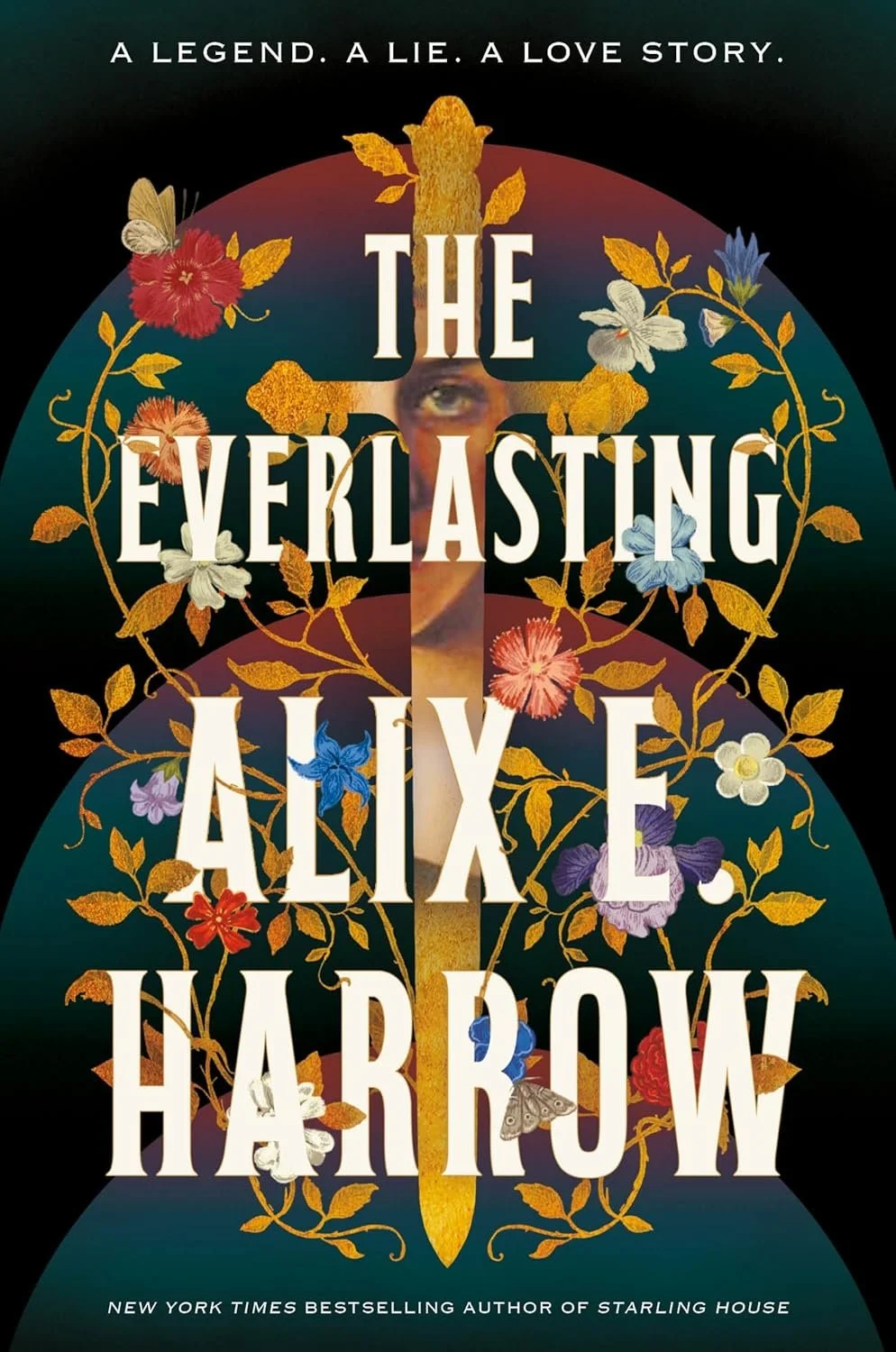
Before I read “The Everlasting,” partly as preparation, partly inspiration, I first read the aforementioned “Hild,” and the medieval poem, “The Green Knight” (shameless plug to check out those reviews). They were certainly not required reading, but they do illustrate Harrow’s core thesis on the importance of myth and storytelling in the cultural and national lens. They also showed that heroes are who we make of them, birthed from the stories we tell. This power is difficult to understate: we shape our values, our very societies, around the iconoclasts our heroes represent in our collective psyche.
And in recognition of this, stories and myths have in turn been used as tools by powerful people, imparting meaning for themselves, and wielding them over those they influence.
In “The Everlasting,” Alix E. Harrow extends this concept literally and to great effect.
How best to represent all this? A second-world Arthurian-inspired Fantasy featuring a time-loop, naturally! And how to quickly visualize this time-loop in a compelling way without explicit spoilers…
Well, imagine if you will, a great tree with a wide trunk and dense sprawling branches that endlessly bisect amongst themselves across the sky until each, finally, terminates in a delicate red flower as beautiful and unique as the world.
Imagine you traced a journey starting from the base of the tree trunk up a main branch, along its full length to one of the stems’ ends, and there beheld the perfect beauty of a single breathtaking red flower glistening in the sun. And then at the height of your admiration, you suddenly pull up and away, and see all over an endless ocean of small red flowers gently flowing in the wind, each connected to other branches of the same trunk from which you began.
That is sort of what this time-loop is like, endlessly tracing up the trunk to the end, then back down again. I’m sure this metaphor didn’t help, but trust me, in “The Everlasting,” the loop itself, featuring an actual Yew tree, is used for gripping story-telling. It drives the narrative force, the motivation of our villain to build her perfect national mythology, and the salvation of our heroes. And also the bittersweet end to our story. I’m no time-travel apologist, but I found the mechanics straightforward without drawing too much focus; the disparate timeline details aligned neatly, and most importantly as a plot device, it only enhanced the story and served to strengthen our characters rather than cheapen them.
Our villain is sympathetic in a tragic sense. Predictable in a warm and cruel sort of way. The ego and mania of trying to perfect your environment, the drive to control everything around you. It was only part of their undoing. As much as the villain wields the time-loop inelegantly, the true god of this universe, the author, wields it as a master painter.
Harrow isn’t shy. Nor does she seem brash. But she is sure, and she is confident, and she arrives at her points after careful consideration, and from what I gather, some amount of internal torment.
Maybe it isn’t internal torment, but Paul Harding, Pulitzer Prize winning author of “Tinkers,” speaks of this constant distilling down of writing until every word of a sentence becomes effused with meaning, every sound composed of rhythm and serving the story’s characters. Harrow here seems to take a page from this philosophy, but goes perhaps a step further.
Her writing is pure magic. It’s honey in how it sticks. Its smell, tantalizing. No word wasted. Each phrase, working on multiple levels to serve the story and our characters. It bursts of ripe apples, the juices flow down your chin with every bite.
Beyond the prose, she leverages the time-loop to knead into the story our central romance. Deeply meaningful, inexact, and working upon the unconscious. What do I mean by that? Well, again imagine two people starting as strangers, and they share with each other a brief but tender brush of affection. Kind of strange, right? They would remain strangers at that point. But then imagine replaying that moment over and over, with slight variations that were never quite the same. And then, rather than fully resetting each interaction, they were instead layered on top of one another, overlapping and adding together, never fully erasing what came before.
It’s like da Vinci’s sfumato painting technique, popularized in oil paintings like the Mona Lisa: dozens of thin, nearly translucent brush strokes combined to make a smoky, hazy, in depth effect. It’s not invisible. No definitive, sharp, or flat lines. The constant entanglement of our character’s souls unwittingly fuse inextricably together. They became inseparable in a way that was utterly impossible to understand. And this was shown to us in both writing and story. Una, the Lady knight, and Owen, the historian, never had a chance to be with anyone else.
Okay, let’s back up. This is getting pretty heady after all. What perspective is this even written in exactly? First, third? It’s an interesting question to answer because it’s in fact not exactly obvious. Technically, it’s written in epistolary first person, even if it often reads as second person:
“It’s your turn to tell it, love.”
Epistolary first person means it reads like letters being written between two people. In this case the lines are blurred between “letters” and just “prose,” but it helps delineate where we’re at. Either Una or Owen are writing, and they’re not just writing their story, they’re writing it to each other. What does the decision to form a story like this do? Well, it takes us as readers, and puts us into the eternal back and forth that’s happening between the two characters. We insert into the story and become stuck in the painting ourselves. This structural decision helps blur the lines and make the whole reading experience much more, experiential.
“The Everlasting” is a book of multitudes. Deeply sweet and ethereal romance. The fulfillment of the Arthurian legends. The myth-making, the nation-building. And yet, also undressing how overt propaganda is the counterfoil to these positive narrative aspects. Who have we crushed and suppressed in service of our unification? What does extolling our chivalric values bring at the expense of our communities?
Una Everlasting was the legendary knight who forged and saved the Dominion. She lived under the weight of her own legend, desperate for escape. Owen wrote of her daring quests: her conquests, her mercies. How she brought the grail back to her Queen and united the nation. He lived in awe of her, and was desperate to find meaning in his own life. They loved each other unconditionally and throughout all of time. They both were played the fool. There are further layers surrounding this core. But on the outside we have Harrow cradling it all, breathing life and fire into it, casting long shadows on the walls of the cave.
“They say it ends where it began: beneath the yew tree.”
I was speaking to another friend of mine who is a huge fan of Arthurian stories and she reviewed an ARC copy of this last year and absolutely loved it. I heard enough such sentiments from folks that I was fairly convinced this would be a special read for me. So much so, I reached out to Alix to congratulate her upon its launch to show my support and confidence before I had even read it myself. So, I wanted to mention this was certainly a case where I was a bit positively primed to enjoy it, even if that’s a thing that happens to all of us.
It’s also a book that’s not for everyone. There are a couple of explicit scenes that make it unsuitable for children, after all. It can technically be repetitive. I know for some, “time-travel isn’t their thing.” This is certainly true, but if you’re interested in giving time-travel another shot, this may be the story to try it again.
I’ve also seen this described as “Romantasy-esque.” If you removed romance from the story, it would no longer work; it really is at the core, and is central to the plot. Based on my knowledge of genre definitions, I think it would therefore qualify as a “Romantasy.” So if that’s a deal-breaker for you, then this is your warning.
Lastly, if you’re not particularly interested in more literary prose, I suppose you could find more friction here than in other new releases. It’s not overly purple, but it’s undoubtedly beautiful and has a certain density in its character. For those like myself that really appreciate that style of writing, we will give it extra credit as a result, but if you don’t, you may not be as enamored.
None of the above are critiques, however. They’re just notable preferences I’ve seen others reference. Not everything can be for everyone, after all.
I honestly can’t find an ill word against this book. It’s sweet and tender, and like the best of the Arthurian legends and other medievalist stories, it comprises many hallmarks of a new classic poised to stand the test of time.
A beautiful fantasy, a beautiful myth, a beautiful bit of propaganda. Alix E. Harrow, take your flowers.
