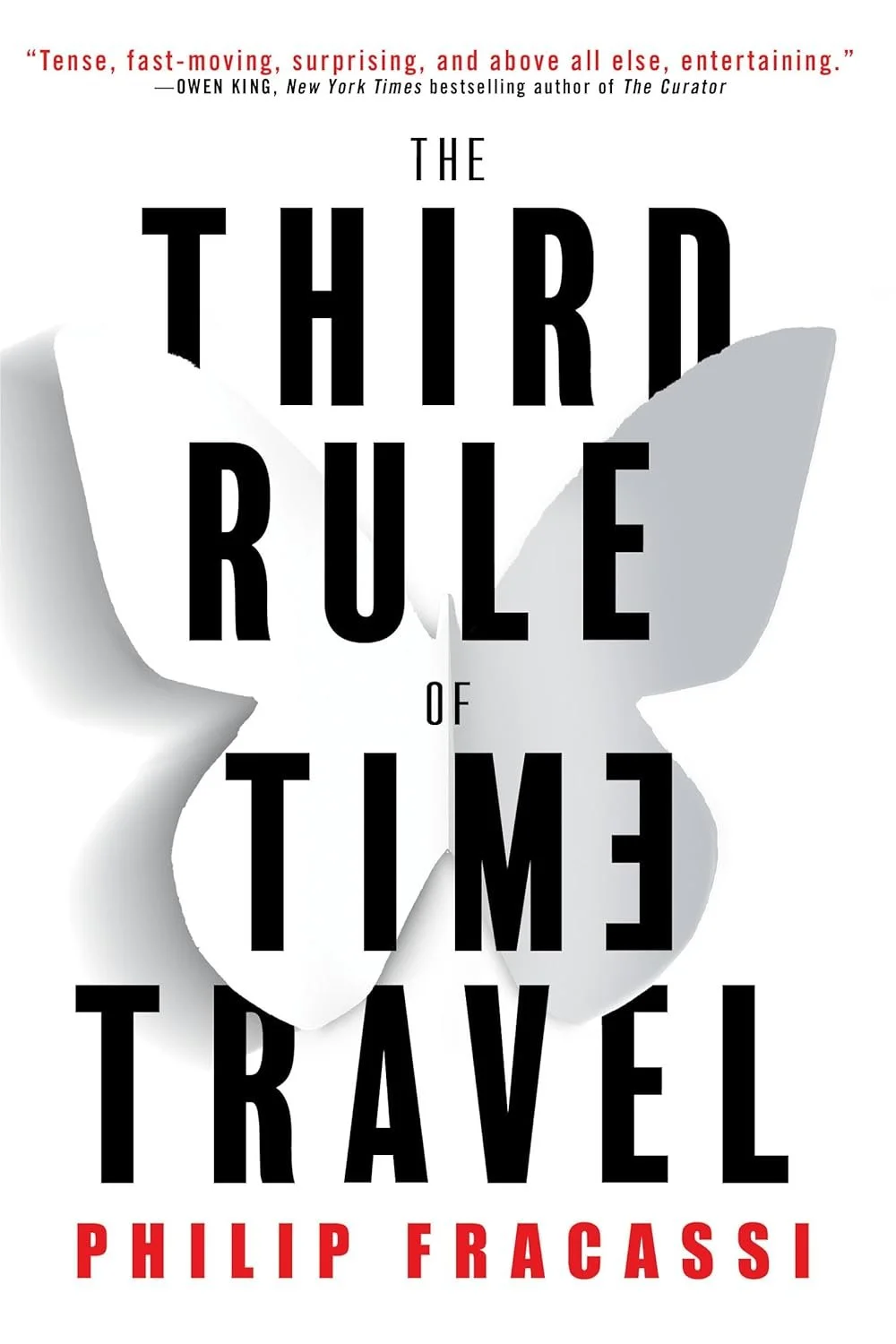
The Third Rule of Time Travel by Philip Fracassi
Blurb:
Rule One: You can only travel to a point within your lifetime.
Rule Two: You can only travel for ninety seconds.
Rule Three: You can only observe.
The rules cannot be broken.
In this electrifying science fiction thriller from acclaimed author Philip Fracassi, a scientist has unlocked the mysteries of time travel. This is not the story you think you know. And the rules are only the beginning.
Scientist Beth Darlow has discovered the unimaginable. She's built a machine that allows human consciousness to travel through time—to any point in the traveler's lifetime—and relive moments of their life. An impossible breakthrough, but it's not perfect: the traveler has no way to interact with the past. They can only observe.
After Beth's husband, Colson, the co-creator of the machine, dies in a tragic car accident, Beth is left to raise Isabella—their only daughter—and continue the work they started. Mired in grief and threatened by her ruthless CEO, Beth pushes herself to the limit to prove the value of her technology.
Then the impossible happens. Simply viewing personal history should not alter the present, but with each new observation she makes, her own timeline begins to warp.
As her reality constantly shifts, Beth must solve the puzzles of her past, even if it means forsaking her future.
Review:
I went into this one almost completely blind. No real research, no plot summaries read in advance, just a striking cover and a couple of passing mentions that planted enough curiosity to pick it up. That's honestly become one of my favourite ways to discover a book. There's something nice about going in with zero expectations and letting the story itself do all the convincing, rather than walking in already primed by a synopsis or a dozen other people's opinions. This one rewarded the gamble completely.
From the very first pages, it grabbed me and didn't let go. I read it in two days, which for me is a sign that a book has completely taken over my attention. I wasn't just reading it during designated reading time; I was thinking about it in between, at work, before falling asleep, anywhere my mind had a spare moment. That's always the real test of whether a book has actually gotten under my skin, not just whether I enjoyed the chapters I read, but whether I kept drifting back to it when I wasn't even holding it. It reminded me of the way Dark Matter pulled me in, that same sense of being unable to set the book down without immediately wanting to pick it back up the moment I had to. Both books share that quality of making you feel slightly disoriented in the best way, like the story has started leaking into your own sense of time while you're reading it.
What really won me over was the central concept. The idea of being able to witness your own past but never touch it, never change it, never reach into it, is such a simple rule on paper, yet Fracassi wrings an enormous amount of tension and heartbreak out of it. Time travel is well-trodden ground in fiction at this point, and it can be easy for a story like this to fall into familiar traps, either overcomplicating the mechanics until the emotional core gets lost, or leaning so hard into nostalgia that it forgets to build real stakes. This book avoided both. It felt like a genuinely fresh angle on familiar territory, restraint as the source of drama rather than rules that bend or break for convenience whenever the plot needs an escape hatch. The fact that the traveller can only observe, never intervene, turns every trip into the past into something almost unbearable to read, because you know nothing is going to change, and yet you desperately want it to.
Beth was the part of the book that stuck with me most. Her arc as a scientist desperate to prove herself, while slowly losing grip on her role as a mother, felt painfully real rather than melodramatic. The book doesn't shy away from showing her neglecting the people in front of her while she chases something she can't fully control, and that imbalance becomes the emotional spine of the whole story. It's less "scientist discovers time travel" and more a meditation on what we let slip through our fingers while we're busy trying to build or prove something, and how blind we often are to it until it's gone. I found myself frustrated with her at points, not because she was poorly written, but because she was written so well that her blind spots felt like the blind spots of someone real. That's a hard balance for an author to strike, making a protagonist's flaws land emotionally without making the character unlikable, and Fracassi managed it.
That theme, not appreciating what you have until it's no longer there, runs through the entire novel, and it's handled with a deftness that elevated this beyond a simple sci-fi thriller for me. The rules of the time travel itself are introduced gradually, each one earned through the characters living out the consequences rather than being dumped on the reader as exposition. You don't get a lecture about how the technology works; you get to feel the weight of each rule through what it costs the people bound by it. And there's something quietly devastating in how the story eventually suggests that rules like these exist to be broken when what's at stake is everything you truly love. It raises the question of what any of us would risk, or break, to get back even ninety seconds with someone we've lost.
The ending floored me. It's the kind of conclusion that doesn't just wrap up the plot but recontextualises everything that came before it, leaving you sitting with bigger questions about what life and time actually mean. I closed the book and just sat there for a while, turning it over in my head. It's the kind of ending that makes you want to put the book down, go find the people you love, and just be present with them, which, for a novel ostensibly about a time machine, might be the most honest thing it could possibly leave you with. Looking back, I'm genuinely glad this was a blind pick. Sometimes the best reading experiences come from the books you know almost nothing about going in.
