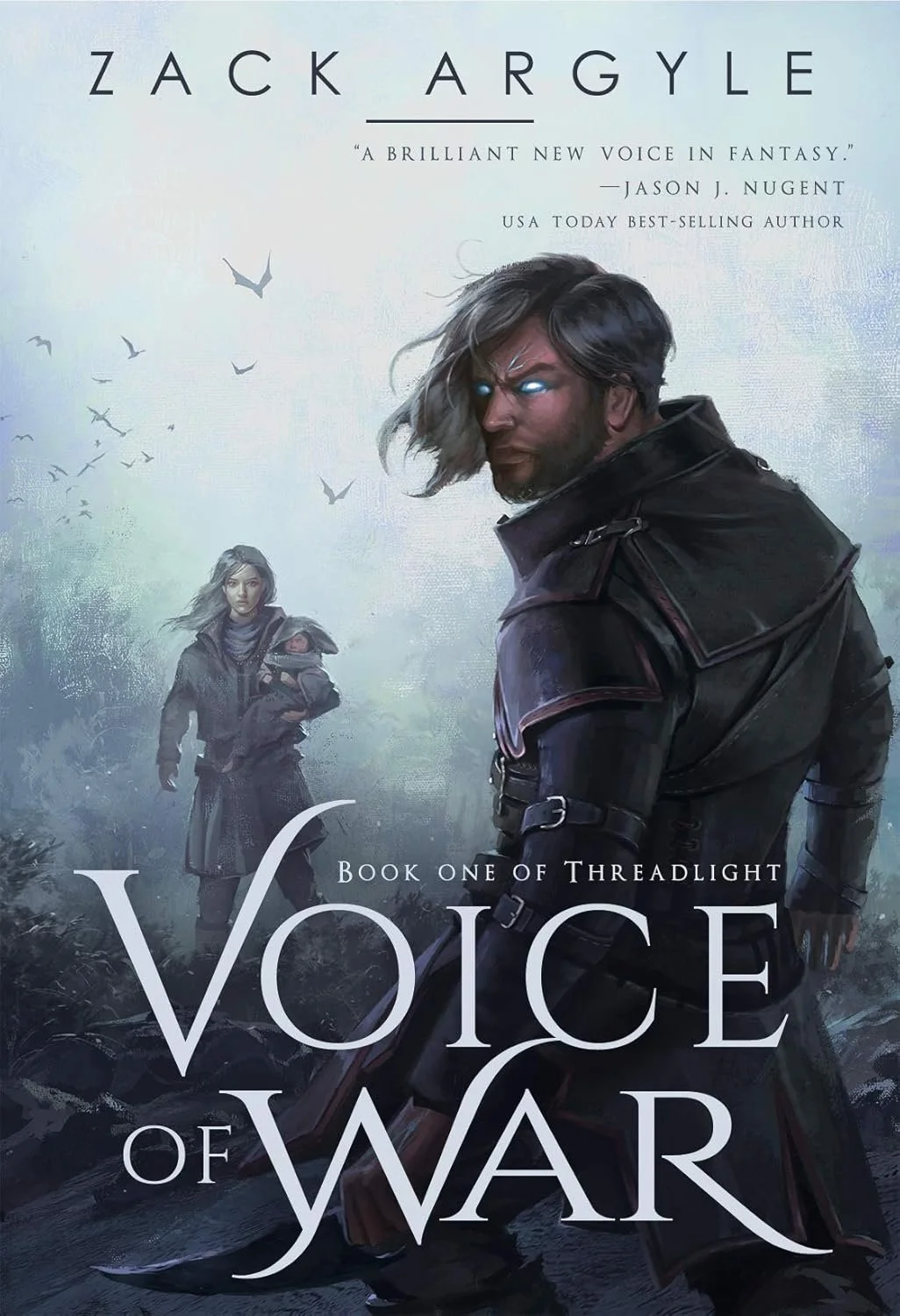
Voice of War by Zack Argyle
Blurb:
THEIR CHILD WILL SAVE THE WORLD, IF THEY CAN KEEP THE DAMN KID ALIVE.
While preparing for the birth of his first child, Chrys Valerian is tasked with uncovering the group responsible for a series of missing threadweavers—those able to see and manipulate threadlight. With each failure, the dark voice in his head grows louder, begging to be released.
A young girl from a secret city in the center of the Fairenwild veers off course to explore the streets of Alchea, never expecting that her journey would end in chains.
Far in the deserts to the south, a young man's life changes after he dies.
When Chrys learns who is responsible for the missing threadweavers, they come for him and his family. He must do everything in his power to protect those he loves, even if it means trusting strangers or, worse, the growing voice in his mind.
Together, these three will change the world—whether they intend to or not.
Voice of War begins the award-winning Threadlight series, filled with unique magic, exotic creatures, and a diverse cast of characters you'll love and hate.
Regarding Spoilers:
In this review there are no explicit spoilers around who does what; this is certainly not “spoiler filled.” But it would be accurate to describe my discussion of characters, the story structure and its elements as containing “light spoilers.” We additionally go into some basic description of the magic systems and analyze relevant thematic elements that relate to central conflicts. So, if considering these you prefer to remain completely blind, this review may not be for you. Otherwise, please enjoy. Thank you!
Review:
Book One of the Threadlight series wastes no time throwing you into the action. It mixes magic, prophecy, religion, imperial society, and family danger all together in an immediately enticing concoction that faces you head-on. When laid out like that, it can seem like a lot, but debut author Zack Argyle weaved those threads in a fluid and engaging way to give us high-stakes and tension from the jump.
Our main character Chrys Valerian grounds us as an expectant father and high ranking General in the capital city of Alchea. He’s tasked with pulling apart the confounding threads left over from the aforementioned opening action, and tries to make sense of the vague danger confronting not just himself and the city, but also his family directly. The family threat is a driving force for the story, and gives us continuous and intimate stakes throughout.
Perspectives
Beyond Chrys, “Voice of War” delivers a varied set of perspectives, coming from vastly different backgrounds and locations. Having that variety helps to quickly flesh out the world, adding depth and layers to the different cultures, regions and history. As journeys progress, their paths cross which serves to further tie together the disparate frayed ends, helping create a more cohesive whole.
Chrys and the younger Zeda teen, Laurel, have a particularly engaging dynamic as they need each other in new and different ways throughout. They both have their own secrets to hide, some more successfully than others, which define them in ways they’d rather not. Chrys’ inner Apogee presence constantly tempts him for control of his body in times of turmoil and danger. It’s a dangerous secret and shame, which he risks not telling anyone, not even his wife. On the surface he presents an immaculately organized and controlled persona to compensate, even if it was his past surrender to the Apogee during war which helped him stand out and rise military ranks even faster. No one knows about this separate presence within him that helped, if viciously, and it’s a secret he’s afraid might expose him one day.
Between his identity as a loving family man and this secret presence, I wonder what’s beneath these two defining aspects that make Chrys unique? They are such strong characteristics, anything else gets lost in the wash. And yet they’re parts he could one day lose. Without them, what would remain? I hope to learn more about who he is as an individual as the trilogy progresses.
Laurel on the other hand, has a more poorly hidden secret, because it’s only herself who doesn’t realize the full extent of her addiction to threadlight, the magical source that allows her to fly through the world on a whim. A power which of course comes at a cost. Everyone who spends time with her realizes she’s always tapping into it, yet she always feeds herself some excuse as to why she needs to use it at a given moment. She loses status in part because of it and makes ever more reckless decisions.
For anyone who has personal experience with addiction it can be fairly tragic to watch her navigate life this way. But she is shown to be a kind and loving person who wants to help those close to her. These layers, dimensions, and the real world sense of tragedy make her perhaps my favorite character in the book.
Much later on we meet Alverax, a young man who lives far away from the rest of the action. He’s a knucklehead and utterly impulsive, but he possesses a moral spine like our other protagonists which directs his rash behavior. Because of his inherent recklessness, it leads him to trouble often, or even to be easily manipulated. Coming into the story so late, we don’t spend much time with him, but he enters with a thunderous awakening and makes a massive impact on the story.
As these three characters come together, it’s a fiery conclusion. What pulls me through the story more than anything is to see what happens to them and their families. Argyle has put careful craft into their stories, and by the end I cared deeply about their fates. In terms of priorities, I’d wager he’s got me about right where he wants me.
Magic
This world’s threadlight magic is zesty. Chromatics are the term for magic users here, those born with typically blue or green eyes (Sapphires and Emeralds) that allow them to access the magical plane of threadlight. Achromatics are the brown-eyed normies who comprise the majority of the world’s population with no magical powers. The two sided hard-magic system is fairly basic to start out with, but the concept of every object’s core-thread and how it’s the source of gravity is inventive, challenging me to constantly reframe my mental model of our world against this one where the rules are very different. How do birds fly? Wait, are there any birds in this world? We may need to read to find out.
Beyond these more humble beginnings, magical discoveries continue to evolve at a nice pace; we see powerful new Obsidian blades, two more magic-granting eye colors providing new abilities, and we also learn more about an ancient magical artifact, the Coreseal, and how it’s been adapted for functional use in modern times, with hints as to how it ties into larger systems overall.
So how does the hidden Apogee presence fit into all of this? The power this persona possesses is immense but feels even more left-field than all the threadlight magic put together. It’s a great mixup that gives us another mystery to consider as we progress.
At the end we have a fun web of elements to explore, but very few answers. I’m absolutely happy with this setup for the first novel in a trilogy. It adds more intrigue and suspense to help pull us forward, beyond just the character drama.
Writing and Pacing
Okay, so we know what’s pulling us through and what’s intriguing about this whole setup. But how does it feel to actually live within the pages? Line to line, and scene to scene, Argyle’s prose is consistently solid. It’s straightforward, effective and eloquent. Descriptions aren’t overly purple nor long-winded, but there’s enough meat on the bone that scenes still feel rich and immersive. It’s a fine and effective balance.
As the different scenes are linked together I also see just how well-plotted a story this is. Every change of perspective is placed strategically to progress all the pieces further along. Within each scene we also see great control of pacing throughout. We go from action, to quiet moments of reflection, to planning, and then back to more action again with a natural rhythm that never feels dull nor over the top. Do I personally prefer a bit more description and a more passive voice? Usually yes, however, I think the story is served well here by this execution and I’m not complaining one bit.
Themes
These elements are all well and good, but what’s the point? Why should we care about this second world, its magic system, the problems facing all its people, or even the characters we’ve met along the way? Actually, anyone with a heart or empathy might care about those things inherently, but we are dealing with purely fictional characters after all. So to help enhance all of this, there are a few thematic threads that rise above the weave which stand out with how applicable they are to our world, and the struggles we face every day just trying to live our lives.
Leading the line most prominently is the persistent question facing Chrys throughout, like a dull pressure behind the eye: what destruction is he willing to work upon the world and those around him, in order to keep his family safe? With the threat of the Apogee always present, it’s a question that’s always nagging him, tempting him to cross every line.
At what point does he become the villain in even his own story? If you’re willing to abuse and kill innocent people in service of this goal, perhaps that is the moment the threshold is crossed. For some it may be later, when the destruction becomes more widespread and systemic. For others it may be sooner, as soon as you give up control of your body or turn back on your word. And even if you know you’ve crossed that threshold, is it a decision you would make again, if you had no other choice? It asks us fundamental questions of our love for our family, our neighbors, and of our duty to society.
Laurel faces these questions as well, especially when considering her protection of her family, both human and animal, weighed against the protection of her Zedalum society and the continuous maintenance of its secrecy for the safety of its people.
After that big theme for me comes another heavy one: the insidious and ever-present struggle of addiction. A small twist we see here is that the substance being abused, threadlight, is (virtually) freely available to users at all times, in all places. With other substance abuse problems, there’s usually procurement involved or cost associated. But here, it’s as accessible as the air we breathe. That absolute lack of a barrier must make this addiction especially difficult to overcome.
Anyone who’s been affected by substance abuse in the real world should be able to empathize with the struggle we see Laurel go through. It clouds the judgment, changing the calculus of every decision if not changing the personality directly. It becomes innate to the person and as inseparable from them as their eye color and voice. Imagine fully removing an aspect like that from who you are? To do so completely is daunting, frightening, and at times can leave one feeling hopeless. Such is the challenge. This is why support systems are so important and without them it’s no surprise how a person would be set up for failure. Expected, even.
These themes and their questions hang over the story as a pall of fog. It gives the story emotional depth, a real bite, and melancholy. I can’t wait to see how they’re handled in the rest of the trilogy.
Up Next
Beyond the continued handling of the themes, there are a few other aspects I’m also looking forward to for the rest of the series. Chiefly, it’s to make sure our characters are safe and that they might live in some semblance of peace with their loved ones. But additionally, I have so many questions that have been expertly teed up and are now begging to be resolved. To keep this review in the territory of “light Spoilers,” I’ll keep these somewhat vague. But if you know, you know:
What is going on with the Apogee, where will we go from here?
What even is the Apogee, and how did…this happen to begin with?
What in tarnation is happening with the new Ember and Obsidian-eyed characters?
What is the significance of the Wonderstone? It seems significant and I wish we had a clearer understanding of the stakes it represents for our world beyond what it means for the culture it’s close to.
Who originally gave Chrys the Obsidian dagger from the opening pages, how did they know the significance of his soon-to-be child, and what is their role and motivation in all this?
If we can get some resolution before the end of the trilogy on these loose threads, I think we’d have a pretty satisfying tapestry on our hands (apologies for the many “thread” puns, I assure you I’ve removed even more).
The periphery characters also have the chance to play ever larger roles, specifically Chrys’s family, including each of his wife, mother, and son. In this novel they were all great additions, but I imagine that the prominence of their roles might only increase going forward and that could be a very intriguing prospect indeed.
Meanwhile, the villains currently don’t have any open questions that burn for me. Their motivations are clear and understandable. We get the perspective they aren’t purely evil, but they do enough heinous deeds that their cause is no longer sympathetic either. Something I’m very much hoping for is more involvement from them as well; seeing their actions, those consequences, and even seeing more of their personalities to give us more depth and intrigue. So if I had a criticism about our antagonists in this first novel it’s that they were a bit flat at times. But hold that with a pinch of salt; it’s not an overly long first book, and I will hold the majority of that judgement until the end of the series.
Final Thoughts
For me, I wasn’t sure what to expect when I initially picked this up a few months ago at Worldcon. Clearly, had I more knowledge or confidence, I would have directly opted for the absolutely gorgeous Threadlight Trilogy Convention Edition that was somehow not yet sold out. However, I’m glad I at least pulled the trigger on this first volume.
Beyond buying a copy at the con, I also had the chance to briefly meet with Zack and his wife as they were panelists on different talks I attended (i.e. a captive audience for me to gab with). In meeting and speaking with them, I can further vouch they’re both genuinely wonderful and kind humans. Five stars!
Did you know they also run the Indie Fantasy Fund? It’s a non-profit that offers grants to indie authors every year. I donated earlier this year when I first heard of it, and I highly recommend checking it out to learn more: https://www.indiefantasyfund.com/
But to bring this home, I’ll say that Argyle has constructed a memorable ride with “Voice of War.” It pulls on the heartstrings, provides satisfying action, and expertly sets up tension and intrigue.
The opening volume isn’t a doorstopper, and I actually appreciate how restrained it is. Some may wish there was more exploration and world building to help flesh out the universe even further, but I think for this tone and plot it would run the risk of being superfluous. The choice to stay more tightly centered on the characters and their families makes the story an intimate one, at least relative to other Epic Fantasies, and because of that, for me it’s already off to a tremendous start.
Besides personal preferences, there’s very little for me to pick at here, so if you’re a fan of a fast-paced and well-plotted Epic Fantasy, I would give this a strong rec. Now all that’s left is to get my hands on the rest of the Threadlight series, because I can’t wait to see how it concludes.
