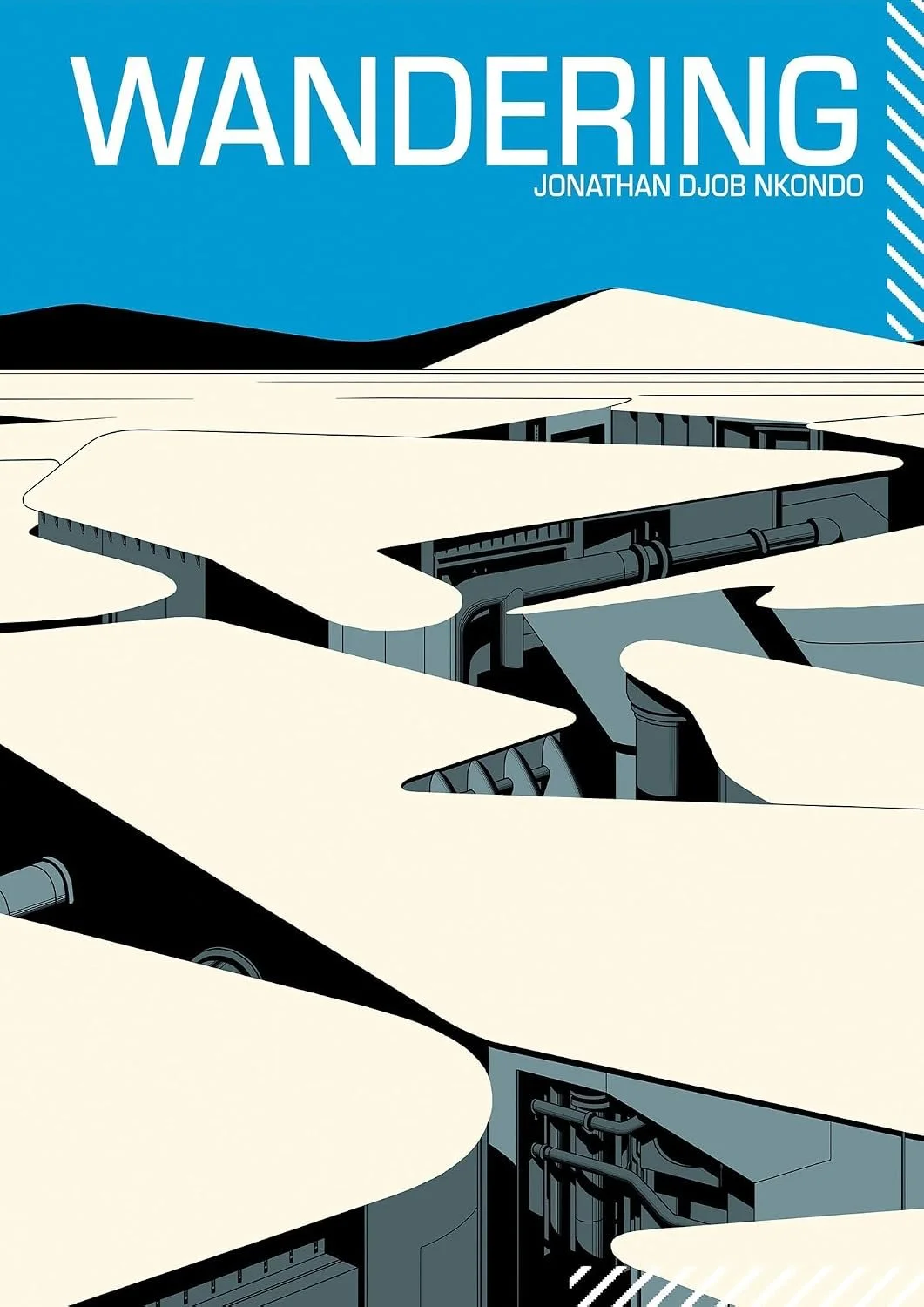
Wandering by Jonathan Djob Nkondo
Blurb:
Cartoonist and animator Jonathan Djob Nkondo (Scavenger’s Reign) weaves a visionary story following the wandering paths of two men, each shaped by their respective environments—one in the arid wastelands above, and one in the urban sprawl below the surface.
Though they never meet, their lives mirror and resonate with each other, creating a haunting sense of synchronicity and missed connection. Set in a world where the surface has become a vast, arid desert dotted with strange geometric creatures and billabongs, Wandering imagines a society that has retreated underground. Beneath the scorched crust, life continues in sprawling subterranean complexes—theaters, malls, food courts, and highway interchanges—forming a claustrophobic echo of the world above.
Themes of alienation, routine, freedom, and the trappings of modern life turn this textless, nonlinear, and atmospheric graphic novel into an unsettling contemplation of the trappings we choose to surround ourselves with.
Review:
A graphic novel from one of the directors and animators of Scavenger’s Reign? How could I not pick this up? However, maybe I should have read more about this one, because when I started flipping the pages, I genuinely thought I received a defective copy because I couldn’t see any text. A quick search online turned my worry into fascination, because now I was intrigued to see whether or not a 200-page graphic novel with zero text would manage to tell a compelling story. I can’t remember if I have ever read a graphic novel that went this long without dialogue.
SPOILERS AHEAD!
What I liked:
The visuals were expectedly stunning. Whatever you’re expecting from Jonathan Djob Nkondo, the graphic novel delivers. With almost every page being a single art piece with a minimalist approach, the images are all equal parts intimidating and dramatic. This dystopian cyberpunk world reeks of familiar problems that seem to have festered with unchecked capitalist expansion, devolving society into a crude collection of consumers that barely subsist under the whims of their unseen overlords. As hypermodern and glimmering as the city is, it is also equally seedy and decrepit. The difference lies in which parts you’re paying attention to. From a beautiful opera audience that observes live surgery in the opening scene, to the overcrowded streets full of epilepsy-inducing ad-boards and billboards, the dichotomy of this deranged future is evident and immersive right from the get-go. Ironically, the crowds are there to fill the outsides, but within, the people are as empty as they come. Especially our nameless protagonists.
Within this daunting world, we follow two separate stories. One is an everyman who is part of society, while the other is a seemingly homeless wanderer who lives outside of society. Both are lonely, neither seems happy, and both struggle to subsist in this dystopian future. Where the commoner has access to life in a society, he is also plagued by all of society’s evils. He seems to have marriage troubles, is unable to simply commute in his city without getting mugged or heckled by roadside vendors, and despite being a member of society feels very much out of place. His world is so chockfull of people, ads, amenities and opportunities, yet his life feels empty and hollow. In parallel, the wanderer goes about the empty expanses of this dystopian world, hunting birds and expending tremendous effort just to satisfy his basic needs. Is he happy? Not clear. Is he content, though? Again, uncertain.
The complete wordless nature of this graphic novel leaves almost everything open to interpretation. To me, Wandering reads like a cautionary tale of alienation. Alienation that stems from an unnatural expansion of a consumerist society whose growth rests not on the evolution or well-being of the human race, but on capital gains. The planet has been milked dry, now populated by megastructures that claim to hold unimaginably magnificent luxuries, all of which seem out of reach even for those living within their vicinities. On the other hand, the human protagonist, who is no longer part of this ‘futuristic’ society, has been reduced to a hunter-gatherer, devoid of any aspect that resembles the modern human. This protagonist resembles our collective ancestor in a way that suggests a hard reset for what human civilization was meant to be. Maybe that is what the final panels of the intersection of these two stories hint at.
Can I explain the ending to Wandering? No, I cannot. I can only offer my interpretation, and that is that regardless of whether you passively embrace the machinations that lead to this dystopian future or vehemently reject it, humanity fails to build a utopian life in this future. Workman or caveman, suffering waits for us all. Something deeply inherent in our society and our civilization seems to have gone wrong, and unless we can identify what that unnamed thing is, we will be condemned to keep wandering the wasteland of our planet.
Wandering by Jonathan Djob Nkondo was a fantastic read, albeit one that demands a little too much from the reader than it offers. If that’s up your alley, you’re in for a treat.
What I didn’t like:
Honestly? Nothing. However, I have to point out that the no-dialogue/no-text treatment of this story is going to be divisive. Just a quick look at the Goodreads page proves my point. On the one hand, the lack of dialogue or text leads to a uniquely immersive experience that’s akin to walking through an art gallery and interpreting a visual journey by yourself, engaging your thoughts at a deeper, more visceral level. On the other hand, however, that very ‘feature’ of this graphic novel might be a massive turn-off for many readers. The lack of dialogue can also lead to a lack of clarity. The open-to-interpretation nature of this narrative therefore becomes a series of pictures that—if the art style doesn’t appeal to you—will feel beautiful but meaningless.
In the end, it’s up to you to decide. The graphic novel worked for me, but I also have to acknowledge that it is not for everyone.
Conclusion:
A wordless dystopian graphic novel with large, atmospheric images that tell two parallel stories of loneliness and belonging.
TL;DR:
WHAT I LIKED: Artwork, open-to-interpretation story
WHAT I DIDN’T LIKE: Nothing in particular