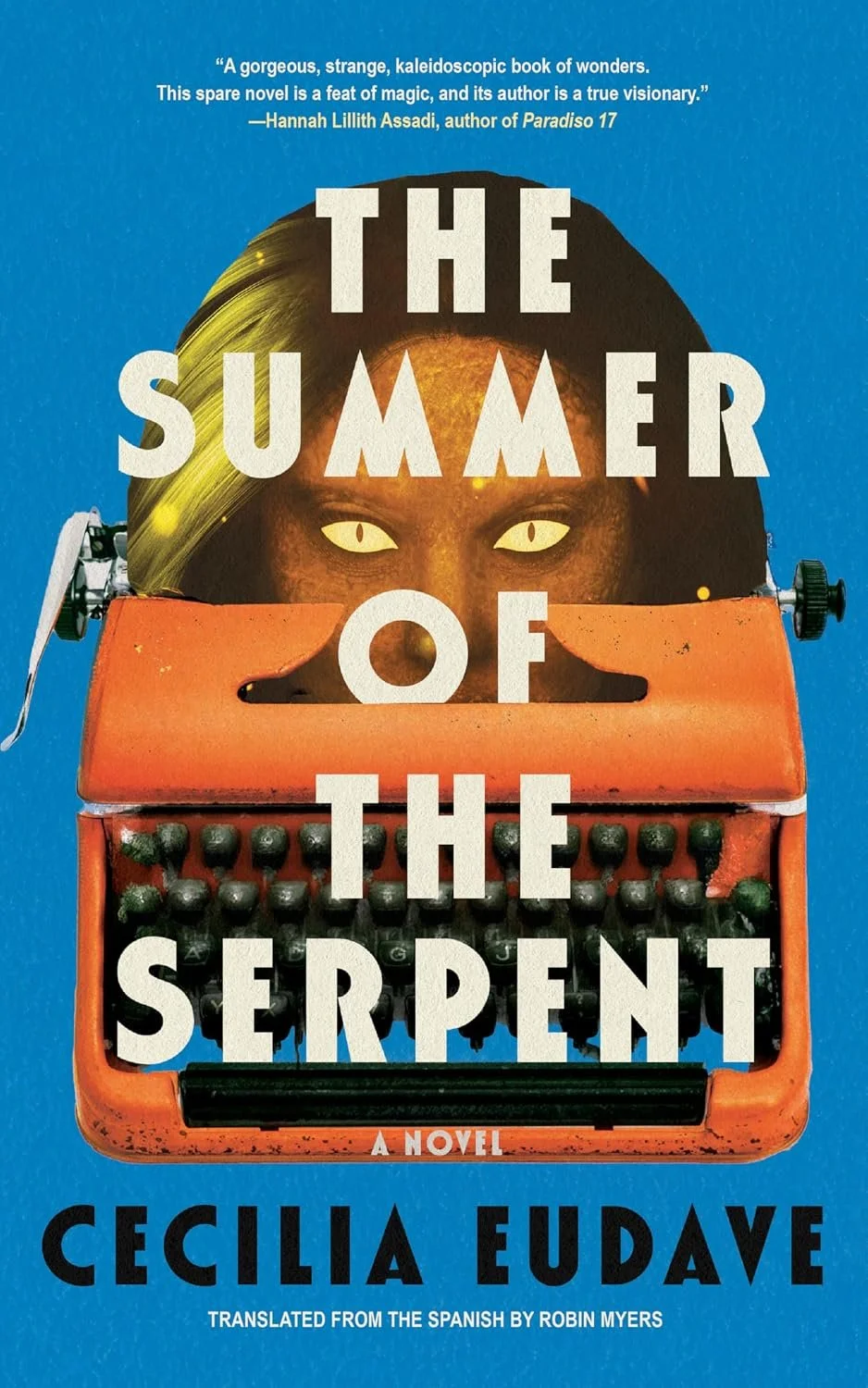
The Summer of the Serpent by Cecilia Eudave
Blurb:
This surreal, horror-tinged, Guadalajara-set work of Latin American “literature of the unusual” is a kaleidoscopic descent into the small violences and hidden horrors of one sweltering summer, forming a coil of vignettes that slither under the skin for a strange, deeply human portrait of memory, myth, and family.
For fans of Samanta Schweblin, Mónica Ojeda, and Brenda Lozano.
Guadalajara, Mexico, 1977. In a quiet residential neighborhood, children witness things they can never forget: a serpent girl weeping in a carnival glass box, a neighbor who dangles his dog from a tree, and a ghost who returns night after night, desperate to tell its story. Meanwhile, the grown-ups drift through the season half oblivious, their spirits eroding as the relentless summer wears on.
Told in colliding voices—children and adults, ghosts and the haunted, the living and the almost-invisible—The Summer of the Serpent is a prismatic portrait of the past, where memory is shot through with myth. Each narrator offers a fragment of the truth, until the stories twist together into a shape as elusive and mesmerizing as the boa constrictor that winds its way through the neighborhood.
Strange yet deeply human, this brilliantly fragmented novel captures the moment when childhood innocence begins to corrode—and how those memories can coil through a lifetime.
Review:
As a reader of speculative fiction there are times when you come around to reading some works that are quite confusing in handling their narrators and their style of world building, but the prose is so good that you keep on going despite often taking a little while to even understand who the narrator of the current chapter is. 'The Summer of the Serpent' by Cecilia Eudave is such an immersive work. Taking a handful of characters in a Guadalajara neighborhood in the summer of 1977 and weaving a deceitful tale of a different kind of horror.
This is a short book, having only nine chapters in total. But the author uses her unique literary style to make this little space work as a deep dive into the minds of her multiple characters, taking us on a rollercoaster ride into the thoughts, hopes, anguish and ambitions of her characters, letting us only emerge after we are already vested in their myriad and unusual interests. The little events are seen through the eyes of the different characters giving new perspectives and angles, and simple things are made rather poignant through the use of her unique creative atmospheric directions.
As I have mentioned before, the story is told from the perspective of multiple characters, slowly unraveling its mystery and the real horror hidden behind everything else. Cecilia even makes interesting use of telling things in second and third person also in a few chapters. The one that dealt with the viewpoint of the pet Boa was really done marvelously. She used all her expertise in constructing prose and letting us get under the skin of her characters to make a somewhat simple story turn into something unusual and deceptive.
The one character that can be called a protagonist is Maricarmen—and we get to learn that she is the most important character in the last chapter actually—has the most normal way of viewing things. But she often gets caught in her inner thinking, taking us readers along for the ride. Other characters all get not more than one chapter and the author's style kept us floundering at times trying to guess who the character might be showing us the world through their eyes this time. This interesting approach kept me going forward at a considerable pace despite often the subject of the chapter being quite mundane things.
The author, despite her unorthodox approach, did manage to touch upon many relevant points of social issues and the human psyche. About the disgust and contempt less fortunate people of neighboring countries of America feel about them. About the despair one feels not being able to succeed in their desired passion, rather having to work in jobs they hate to provide for family; the anguish of failed or otherwise celebrities when their youth abandons them; the innocence of childhood and how it gets spoiled by the perversion of adults etc. among others.
But the most prominent thing she focuses on is the abject nature of cruelty, how it often arises from normal people in mundane ways twisting everything. Most apparent in this inner monologue by one of the characters, "Maricarmen, now that you’re gone, I wish I’d told you, but now I can’t: I couldn’t understand, either, that sometimes there’s no obvious reason for cruelty. It just wells up, or it waits for us, while some kneel down and revel in it."
The problem with the book is that due to the nature of its way of exposition of things and the horror having been shoved into the background to focus on the literary aspect might be a hard sell to some readers. Then there is also the matter of the novel being too short to properly flesh out some of the concepts it was trying to focus on. There is also no real explanation regarding how the protagonist comes to the state she ends up in or any real mention regarding whether the horrific situation that happened was resolved or not.
Nevertheless, the prose was enticing enough for me to enjoy this one. I do hope more of Cecilia's work can be translated into English and I get to enjoy her unusually addictive prose.

Guest Reviewer Bio:
I am Rakib , a Surgical Oncologist from Bangladesh, currently working for the government, who enjoys fantasy, sci-fi and horror in all their forms. My favorite hobby used to be searching in the used book stores of Dhaka for hidden gems (quite hard to find good fantasy or sci-fi when you live in a country like Bangladesh) which I could add to my collection and slowly devour later. I try to read 50-60 books, and about twice as many comics/manga each year. I also love rock music, rpgs, and fighting games. I have been writing about these for almost twelve years on my blog and also try to be active on Goodreads among other sites. You can follow me on Bluesky @ihate00.bsky.social