Centauri's Shadow by Ross Garner
Blurb:
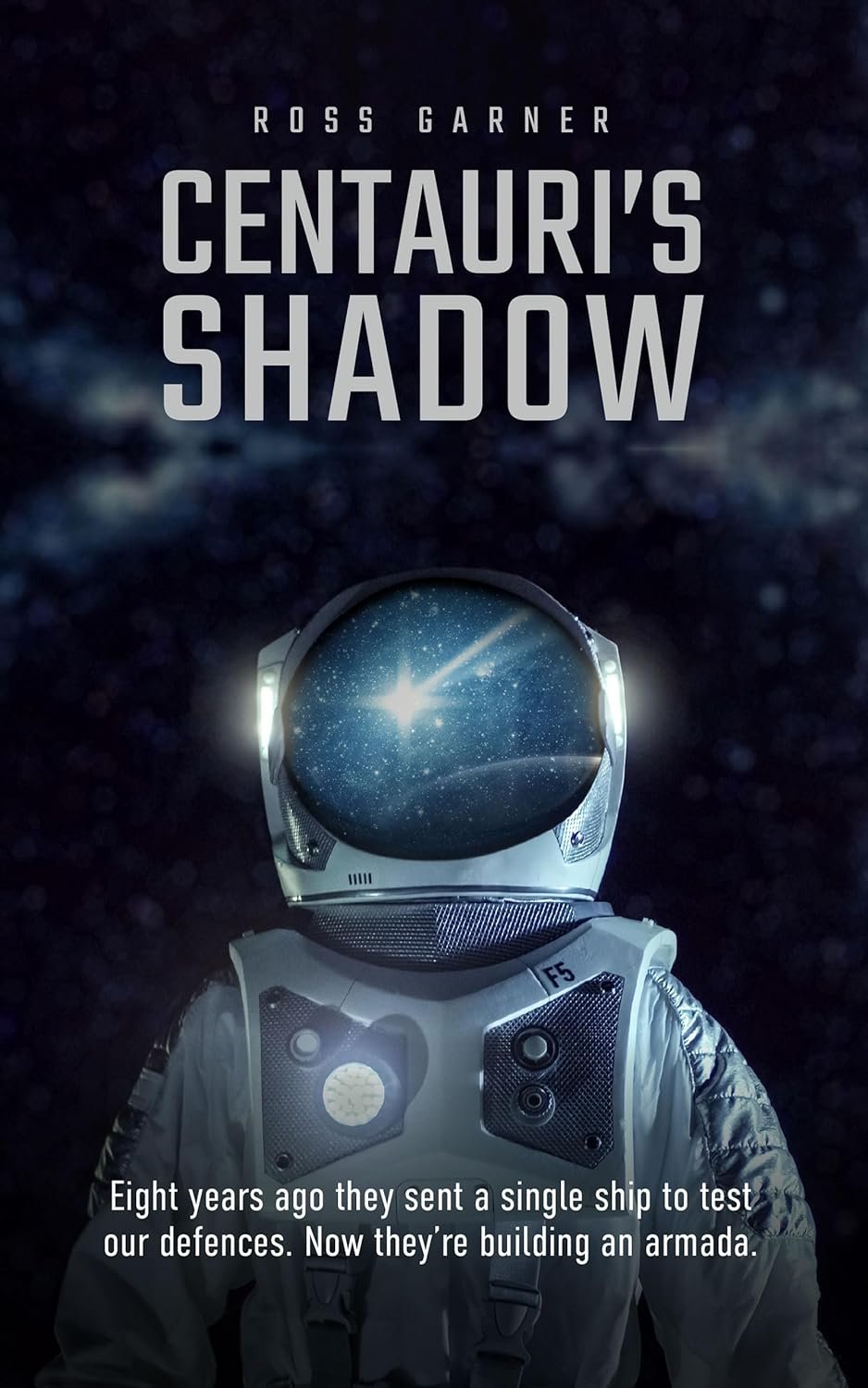
‘Eight years ago they sent a single ship to test our defences. Now they’re building an armada.’
Cole grew up in the shadow of grief. Kyoko grew up in the shadow of war. Two pilots, separated by time, set out on parallel journeys to Proxima Centauri. What they find could be the start of something new. What they bring with them could be the end of all we know.
In this sweeping science fiction debut from Ross Garner, readers will find an Earth that is transformed by fear of an imminent invasion; a space station in orbit that acts as a gateway to other worlds; a Martian colony with all of the threat and violence of the Old West; and a distant star where answers can be found.
What is 'the signal'? A greeting, or a threat?
Review:
There is a specific kind of ache that comes from watching a person break in slow motion. Centauri’s Shadow by Ross Garner, feels as though I’ve spent weeks living inside the mind of someone who has been systematically dismantled by the universe. No, this isn't your standard "humanity vs. aliens" blockbuster. The backdrop is a sprawling, sure: high-stakes invasion, complete with the horrifying destruction of our Mars colony, but the story Garner is actually telling is far more intimate and devastating. It’s a profound study of the invisible tethers between our childhood ghosts and our adult sins, and honestly, it’s one of the most emotionally resonant pieces of Science Fiction I’ve picked up in years.
A Fractured Memory
What immediately struck me was Garner’s daring use of a non-linear structure. The narrative doesn't move in a straight line; instead, it ripples. We follow a pilot on a grim, final mission to annihilate the enemy species, but the true weight of the story rests on a second protagonist whose life we see in scattered shards. One moment we are in the present conflict, the next we are thrown back to his childhood near the Mars tragedy, and then further back to a time before his world was ash.
It reminded me of that specific, disjointed storytelling style you see in Lost, where every flashback feels like a puzzle piece you aren't quite sure where to fit. But stay with it. As a reader, you have to trust the author, and Garner earns that trust. By the time I reached the final act, I realized that these childhood glimpses were essential foreshadowing. They are the only way to truly understand why this man makes such agonizingly difficult, and sometimes outright self-destructive, decisions at the end of the world.
Nature vs. Nurture
As I dove deeper, I found myself obsessed with the "nature vs. nurture" debate Garner weaves into this man's arc. Our protagonist is a biological marvel: innately capable, resilient, and intelligent. That is his nature. But his nurture is a relentless hammer. After losing his parents and seeing his brother emotionally shattered, he is chewed up by a foster system that doesn't know what to do with a boy who carries the literal and metaphorical scars of a planetary massacre on his face.
The book uses its non-linear jumps to show us these two forces in a constant, violent tug-of-war. We see the innocent child he was, and then we are immediately confronted with the violent, closed-off young man he becomes on Mars. It’s a heartbreaking juxtaposition. You can see the exact moments where the lack of love and the weight of his trauma began to harden his biological potential into a weapon. He moves through a believable, painful evolution: he starts by wanting to be left alone, then moves to a desperate need for respect, then a hunger to be feared. But the most gut-wrenching realization for me was that, beneath the scar tissue and the anger, he simply wanted to be loved.
The Hero and the Horror
What makes this character so "real" to me is that Garner refuses to make him a saint. He is an incredibly capable hero, but he has done some truly horrible things. He is a person who is perpetually terrified, yet performs acts of immense bravery. This duality is the core of the book's tension. As we learn more about his role in the alien conflict, we start to see that his willingness to pull the trigger on an entire species is the direct result of a life where he was never shown the value of his own existence.
The pacing is relentless, but it never feels like it's rushing past the emotional beats. The non-linear groundwork ensures that when the ending finally hits, it feels like a tectonic shift. It is heart-wrenching, cinematic, and absolutely, undoubtedly earned. It leaves the status quo of the galaxy irrevocably changed, not just by technology or strategy, but by the desperate agency of a man trying to reclaim a soul that was nearly lost.
Empathy
I can’t recommend Centauri’s Shadow enough for those who like their SFF with a side of psychological heavy-lifting. Garner has taken the "alien invasion" trope and turned it into a mirror, forcing us to look at how we treat the "broken" members of our own society before we send them off to fight our wars.
Author Journey Note: Ross Garner is clearly a writer of immense ambition and even greater empathy. To take a structure this complex and make it feel this organic is a feat that many veteran authors wouldn't dare. He values the "human" in humanity, and he isn't afraid to let his characters be messy, violent, and deeply flawed. This is a brilliant debut of sorts for this kind of storytelling, and I’m already looking forward to seeing how his voice continues to evolve. He’s an author who respects his readers' intelligence, and that makes him an essential new addition to my shelf.