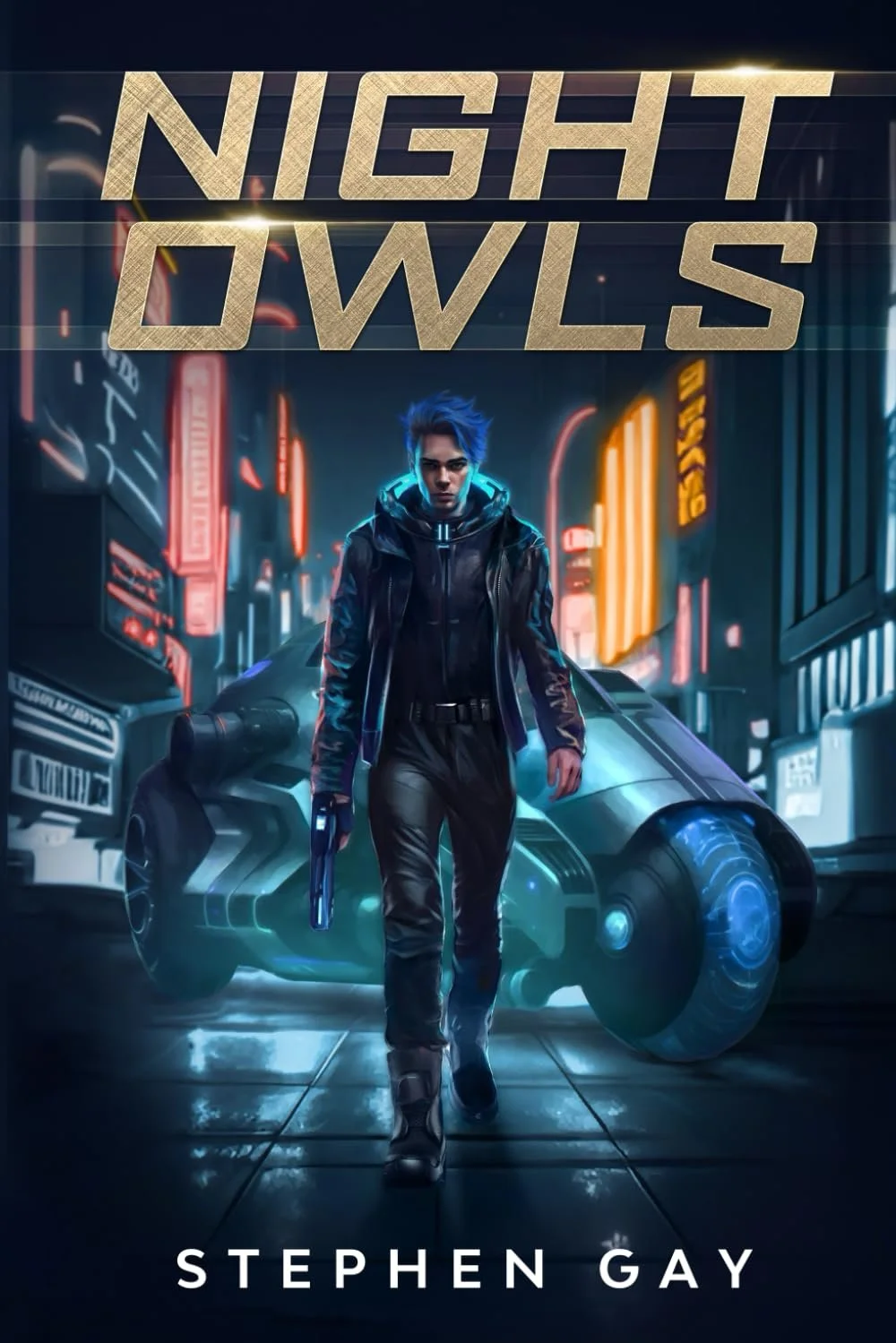
Night Owls by Stephen Gay
Blurb:
The Night Owls series delivers sci‑fi thrillers with lunar heists, corporate conspiracies, and found family—what begins with a stolen card becomes a fight to keep the lights on for everyone.
When a street‑smart hustler from the Grey District lifts the wrong control card, he puts a target on his back—and a dying Moon on the clock.
Ethan Keller keeps the lights on by throwing illegal dome parties after hours and running small hustles by day. But the high‑level card in his pocket connects to vanishing fusion cells and a blackout crisis New Luna can’t survive. A relentless security enforcer wants Ethan erased. The outages are stretching longer. Air is running thin. And the only way out is through.
Outmatched, Ethan leans on the people who never let him fall—his crew. The Night Owls: a relentless hacker, a class‑crossing girlfriend, and a ride‑or‑die family willing to cross vacuums, outsmart sentinels, and crack systems to expose the truth.
This is the choice that breaks people—or makes them.
Can Ethan and the Night Owls rip the mask off a lunar conspiracy before the next blackout turns deadly? Or will the music die with the lights?
Perfect for fans of Firefly; Killjoys; The Expanse (James S. A. Corey); Red Rising (Pierce Brown); The Maze Runner (James Dashner); Ready Player One (Ernest Cline); and Artemis (Andy Weir)—Night Owls blends space‑opera scope with a heart‑forward sci‑fi thriller punch: found family, lunar heists, clean high‑stakes action, and a closed‑door romance.
Review:
Sometimes a book comes along that manages to capture a specific subculture so vividly that you can almost hear the bass thumping through the pages.
Night Owls by Stephen Gay, is unlike anything I’ve encountered in the genre recently. Set on a Moon they call "Luna," this isn't the sterile, cold lunar base we’re used to seeing in hard science fiction. Instead, Gay gives us a world that feels alive, messy, and vibrating with the energy of a generation trying to find joy in the dark. It’s a story where the neon lights of underground raves bleed into the shadows of a brewing revolution, and it’s every bit as electric as it sounds.
Neon Rhythms
The premise is brilliantly unique: a group of young people throwing illegal rave parties in the low-gravity subterranean pockets of the Moon. There’s a palpable sense of "underground" here, both literally and figuratively. Gay captures the essence of techno culture and the sanctuary of the dance floor in a way that feels incredibly authentic, which is a breath of fresh air for SFF. These parties are a form of escape and a subtle act of defiance. And this, in the end, is a story about a subculture that becomes the unlikely heart of a massive political conflict.
The Lunar Burden
What I found most fascinating as a long-time reader of the genre is how Stephen Gay handles the "Corporate Moon" trope. If we look back to the days of Robert Heinlein and The Moon is a Harsh Mistress, the rebellion was often about fighting against colonial oversight. However, Gay updates this for a modern, perhaps more cynical, audience.
In this vision of Luna is a web of gargantuan corporations with nefarious agendas that use low-income people as expendable assets. We have moved from the political ideals of the 1960s to a contemporary struggle against late-stage capitalism in space. Gay explores this socioeconomic hierarchy with a critical eye, showing how these people are caught in the gears of a larger game between Earth and the burgeoning culture on Mars. The worldbuilding feels expansive and lived-in, painting a picture of a solar system on the brink of a systemic shift where the "company store" has been replaced by corporate-owned atmosphere and gravity.
Metamorphosis
I’ll be honest with you: the protagonist was a bit of a hurdle for me at the start. He begins the journey being—well, frankly—a little annoying. He carries that specific brand of youthful arrogance that feels like a shield against the hopelessness of his environment. He is impulsive, frequently self-centered, and possesses a certain "invincibility complex" common to those who spend their nights dancing on the edge of the law. Initially, his motivations are shallow; he is a creature of the moment, seeking the next high, the next beat, the next temporary sanctuary from the crushing weight of corporate Luna. For a few chapters, I wondered if I could truly root for someone who seemed so oblivious to the brewing storm around him.
However, as a friend who reads a lot of character-driven fiction, I can tell you that the growth arc here is one of the most rewarding I have experienced in recent science fiction. Gay allows the character to be broken by the reality of the political conflict. We watch as the bravado of the rave floor is stripped away by the cold, hard vacuum of corporate consequence. This protagonist is forced to confront the fact that his actions have ripples: that his desire for personal freedom has costs for the community he claims to love.
The beauty of his development lies in his gradual realization that his "annoying" impulsivity can be tempered into a tactical asset for the rebellion. He stops reacting to the music and starts conducting the chaos. By the middle of the book, that grating ego matures into a fierce, protective loyalty. Watching him transform from a boy chasing a neon dream into a man who understands his responsibility to the lunar underclass is incredibly moving. By the end, are fully invested in his survival and his burgeoning leadership. It is a very well depicted transition that makes the high-stakes political endgame feel deeply personal and earned.
Unapologetically Unique
The pacing of Night Owls is excellent, mirroring the high-energy music that defines its setting. There is an "unlawful" edge to the story that kept me hooked, a feeling that anything could go sideways at any moment. As the scope of the story expands, you realize that these small-scale parties are just the tip of the iceberg in a much larger, interplanetary conspiracy. It’s a cinematic experience that manages to be both a gritty social commentary and a high-octane thriller. I haven't read anything quite like this mix of rave culture and lunar politics, and it’s exactly the kind of "newness" the genre needs right now.
Visionary Pulse
Stephen Gay has done something truly impressive here by marrying a very specific modern subculture with the grand tradition of the lunar rebellion. He has a keen eye for the social dynamics of the "underclass" and a gift for making the political feel personal. Following his author journey feels like being on the guest list for something truly special; he’s bringing a vibrant, neon-soaked perspective to the stars, and I’m already looking for the next installment to see where this revolution leads.