Blurb:
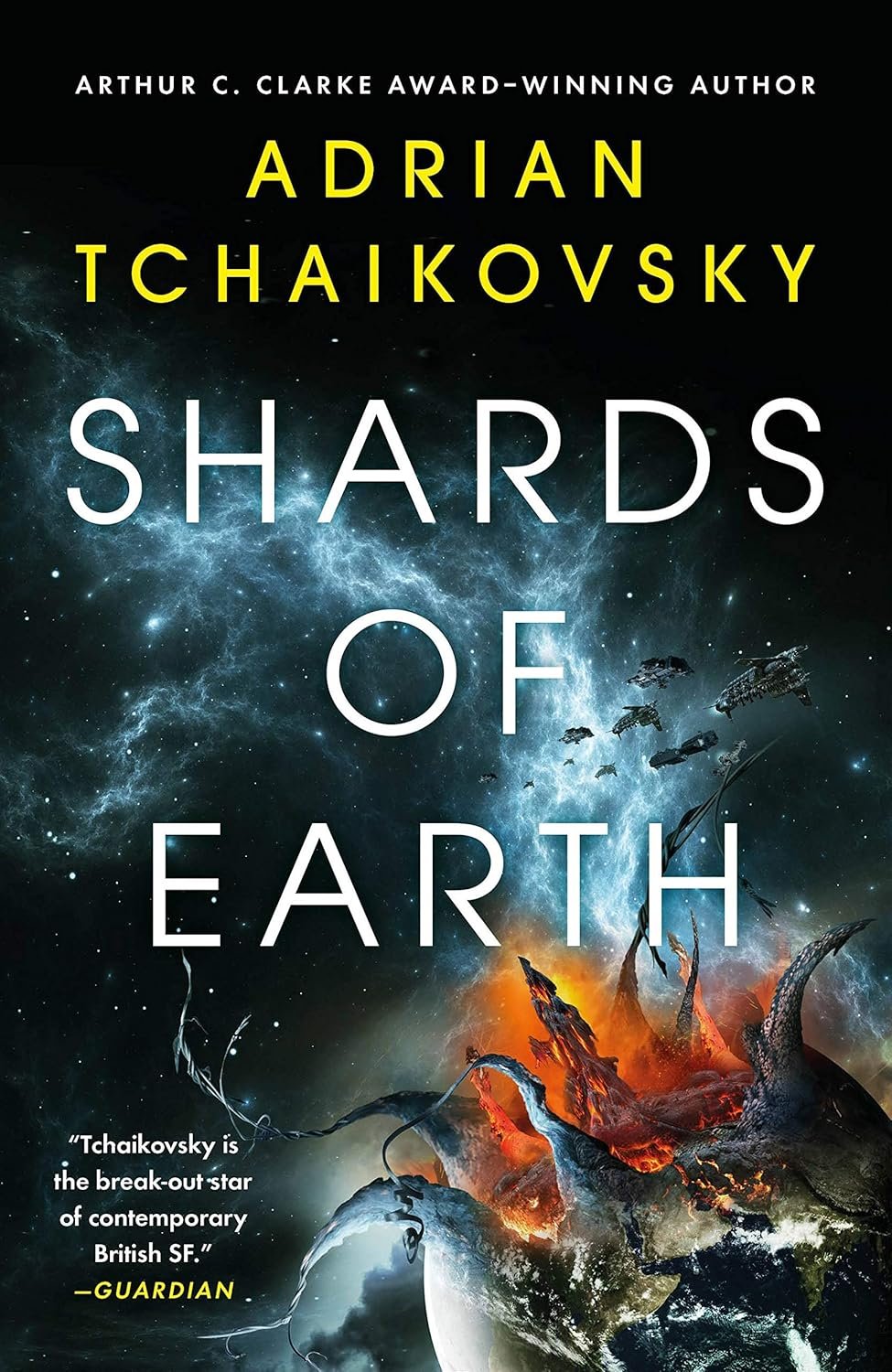
The Arthur C. Clarke award-winning author of Children of Time brings us an extraordinary space opera about humanity on the brink of extinction, and how one man's discovery will save or destroy us all.
The war is over. Its heroes forgotten. Until one chance discovery . . .
Idris has neither aged nor slept since they remade him in the war. And one of humanity's heroes now scrapes by on a freelance salvage vessel, to avoid the attention of greater powers.
After earth was destroyed, mankind created a fighting elite to save their species, enhanced humans such as Idris. In the silence of space they could communicate, mind-to-mind, with the enemy. Then their alien aggressors, the Architects, simply disappeared—and Idris and his kind became obsolete.
Now, fifty years later, Idris and his crew have discovered something strange abandoned in space. It's clearly the work of the Architects—but are they returning? And if so, why? Hunted by gangsters, cults and governments, Idris and his crew race across the galaxy hunting for answers. For they now possess something of incalculable value, that many would kill to obtain.
Review:
When worlds are reshaped into silent, geometric monuments of death, the scale of the tragedy is almost too vast to comprehend.
Finding the words to describe the sheer magnitude of Shards of Earth by Adrian Tchaikovsky is a challenge, because this story is truly epic, a whole experience.
Let me put it this way: this is arguably one of the finest pieces of science fiction I have read in the last twenty years. It has soared into my personal "best of all time" list, sitting comfortably alongside The Expanse, a series I have championed for a decade.
Tchaikovsky has always been a formidable force in SFF, often referred to as the Brandon Sanderson of sci-fi for his staggering productivity and consistency, but with this book, in my opinion, he has reached a new zenith of storytelling.
The Architecture of Extinction
The premise of this universe is as terrifying as it is conceptually brilliant. In the distant future, humanity has spread across the stars, finding a precarious peace among various alien species. Then, the Architects arrive. These are planet-sized entities, beings of such impossible scale that their motivations remain a chilling enigma. They select inhabited worlds and reshape them into intricate, beautiful, and utterly dead works of art: gigantic celestial sculptures made from the pulverized remains of civilizations. This is a cosmic transformation that leaves the galaxy, more than understandably, in a state of primal dread. The war against these entities was won decades ago, but as the story opens, that seventy-year silence is about to be shattered.
Touch the Void
To combat a threat of such scale, humanity developed those with unique supernatural abilities known as "Intermediaries" or "Ints." Idris, one of our central protagonists, is a relic of that war, a man whose mind was surgically and telepathically altered to touch the consciousness of an Architect. These Ints are the only ones capable of influencing the planet-sized minds of the enemy, but the cost is a life lived in the "unspace," a terrifying dimension used for interstellar travel where something malevolent seems to lurk. Idris is a haunting, deeply sympathetic character; he is a savior who never asked for the burden of god-like perception, and his struggle to remain anchored in a world that sees him as a tool is masterfully portrayed. His story is painful, electrifying, and heartwrenching in many, many ways.
The Crew
While Tchaikovsky’s Children of Time was a masterpiece of ideas, it sometimes lacked a central, relatable human core. Shards of Earth corrects this beautifully by focusing on the eclectic crew of a salvage ship. The dynamics here are reminiscent of the very best space operas. We have Solace, an "Amazon" warrior from an engineered sub-species of humanity that reproduces through parthenogenesis, a fascinating look at a specialized, all-female society. Then there is Olli, a foul-mouthed, brilliant specialist who inhabits a powerful mechanical rig due to her physical differences. The crew is a mix of humans and aliens who actually feel alien, each with distinct life views, worldviews, and even "galaxy views." Watching these disparate souls navigate the looming shadow of the Architects is what truly made the story click for me.
Choreography
I don't say this lightly: the action scenes in this novel are some of the most bombastic and cinematic I have ever encountered in prose. Tchaikovsky possesses an incredible ability to weave dark humor into the middle of high-stakes, brutal combat. There is a particular scene involving a legal hearing that is interrupted, as the author puts it, with "extreme prejudice" involving rail guns and absolute bloodshed. The writing style here feels even more refined than in his previous works; it is elegant, vivid, and carries a rhythmic intensity that makes the pages fly. He captures the chaos of a firefight with the same precision he uses for the quiet, existential terror of jumping through unspace.
A True Master
What makes Tchaikovsky such a titan of the contemporary SFF scene is his ability to balance complex sociological evolution with "big idea" science fiction. He presents a future that feels like a believable evolution of our current technological and sociopolitical trajectories. From the autonomous robot societies that have moved beyond their humanoid origins to the intricate commercial deals managed by alien lawyers on a cargo ship, the worldbuilding is rich and layered. He provides just enough information for you to connect the dots without ever resorting to childish hand-holding. It is a sophisticated, adult vision of the future that respects the reader's intelligence while delivering a heart-pounding adventure.
Infinite Reach
Entering the world of an author with such a vast back catalog can be daunting, but Shards of Earth is the perfect proof to why Tchaikovsky is essential reading. His commitment to the genre is palpable on every page. There is a level of confidence in his prose, a sense that he knows exactly where every gear in this massive narrative machine is turning. If his fantasy work like City of Last Chances showed his range, this series proves he is a master of the cosmic scale. I finished this book feeling a rare sense of total satisfaction, and I am already eyeing the rest of his bibliography with renewed hunger.
Author Journey Note: It is truly a privilege to be reading during the era of Adrian Tchaikovsky. The man’s ability to maintain this level of peak quality while producing work at such a staggering pace is a marvel of the literary world.
He is an author who consistently pushes the envelope of what Science Fiction can achieve, blending hard-concept ideas with characters who stay with you long after the airlock closes.
Following his journey is a masterclass in watching a creator refine their craft to near-perfection; he is undoubtedly one of the most important voices we have in Science fiction and Fantasy today, and we are lucky to have him.