Preaching to the Choir by Adrian Tchaikovsky
Blurb:
Elena Mendes thought she understood what “old money” was.
She knew her boyfriend Ross Enderbough was rich. Like, “old money” rich. She knew he was the scion of some eccentric British line that predates the whole United States. She knew he didn’t really get on with his family, and that he fled to America to study free of their influence.
Ross has been summoned to Enderby, the family mansion built as a monastery centuries ago, for an exclusive, mysterious family gathering that happens only once a generation. Spouses and partners aren’t invited, but Ross has asked Elena to come anyway for moral support.
But there are secrets in the mouldering old pile, and terrors in the unkempt woods on the estate. And Elena slowly comes to realise that “old money” means so much more than she’d ever imagined…
Review:
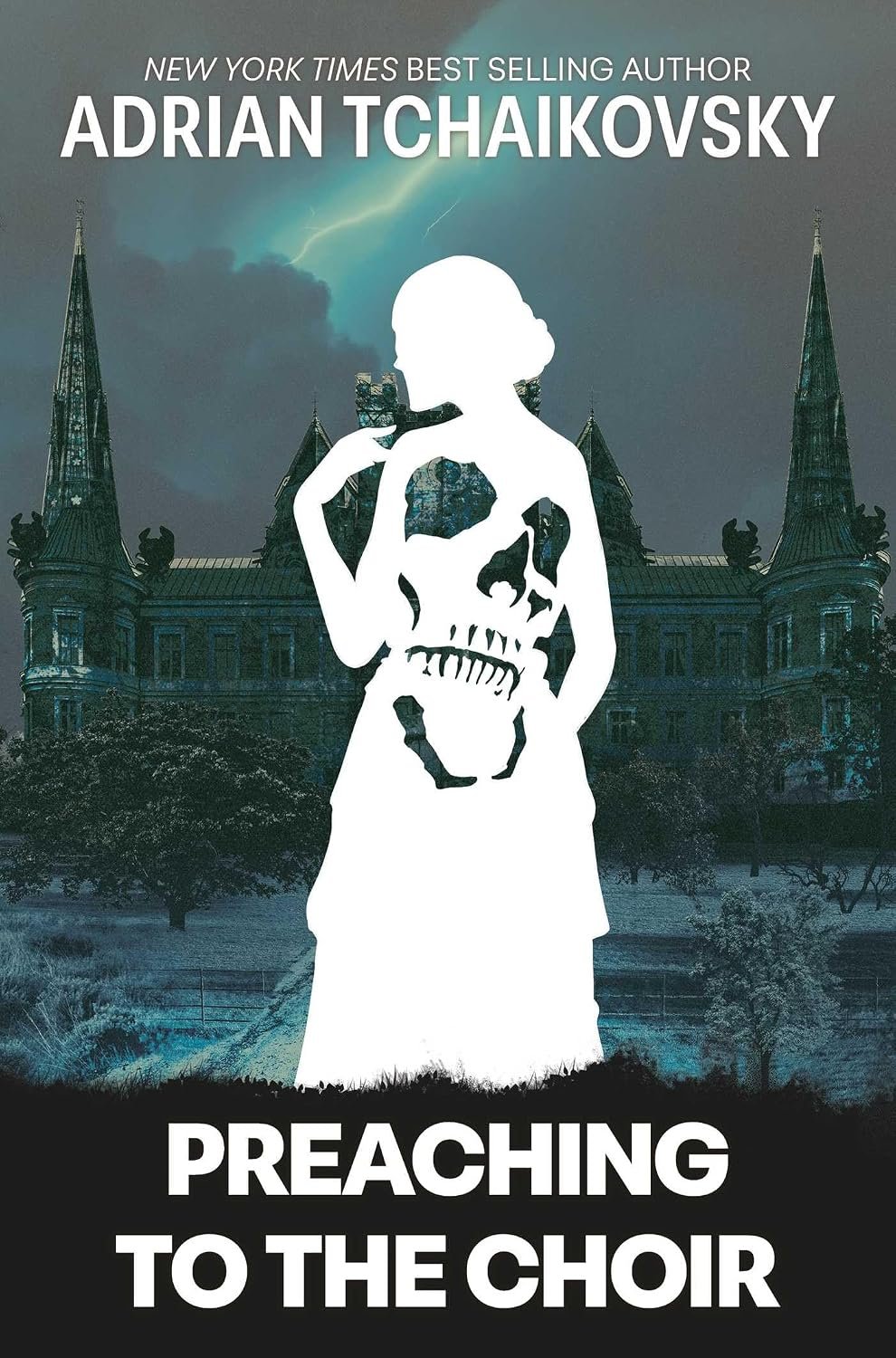
At this point, if I see a new Tchaikovsky novel, I’m likely to blindly pick it up. That’s honestly what I did with this one too. All I knew about this book was its title and cover. What I got once I started reading the book, however, was this profoundly mesmerizing, eerie gothic horror mystery that left me just as unsettled as it engaged all my faculties.
What I liked:
What pops out of the page almost immediately as you start reading is the eerie atmosphere of this gothic mansion that is the setting of the entire book. The Enderby mansion is everything you expect from a horror setting like this: labyrinthine, old, full of secrets, and most importantly, sinister in character. The mansion itself feels like a looming presence, hiding dark mysteries that not only hint at supernatural phenomena, but also suggest an evil origin for the Enderboughs’ elite status.
While the plot itself is pretty straightforward, the complexity of the conflict that remains shrouded in mystery makes for quite the unsettling read. Every single chapter hints at something sinister, something that we can all imagine. The fact that Tchaikovsky doesn’t divulge much makes the mystery all the more intriguing and terrifying. Even when the ‘attacks’ happen, and we start getting a clearer picture of the angels/demons/monsters/whatever-that-thing-was, it only adds to the unnatural nature of the origin of the Enderboughs’ powers. We never truly understand everything about this supernatural presence until the very end. However, it’s the way Tchaikovsky uses them to explore a darkly real and relevant theme is what made Preaching to the Choir such a fulfilling read.
These supernatural powers aren’t as overt as you’d expect. In fact, they offer the subtlest form of advantage to the Enderboughs, which brings me to my favorite part of the book. In many ways, the book is a twisted look at a Faustian bargain, one that also comments on the deeply unjust economic disparity that exists in the real world. After all, it is nearly impossible to find a single uber-rich individual whose fortune cannot be traced back to foul means. The Enderbough family is no different. Their ancestors have indulged in every war profit, exploitative labor practice, election fraud, and much more to retain their status. In fact, the very reason they even have all this money and power stems from the fact that they are influential in the world. And that influence, comes at a cost. The privilege of that influence is manifold, while the drawbacks are nearly non-existent. Doesn’t that sound unreasonably unfair? Subtract the supernatural elements from this equation, and you won’t take long to figure out what Tchaikovsky is really trying to say.
I can’t really say more without spoiling the book, so this is where I’ll stop. However, know that the book will leave you with just as many questions and reflections as it answers. And that’s a good thing. Any book that continues to make you ponder days, weeks, even months after you’ve turned the last page is a book worth reading in my opinion.
What I didn’t like:
I don’t think there’s anything in particular that I hated. That being said, characters continue to be one of the aspects of Tchaikovsky books that I have a hard time resonating with. Apart from Elena, I wasn’t really able to relate to or even understand the rest of the cast. I get why the elders were so distant, but even the youngsters remained just as hard to relate to. In fact, apart from Elena, I had a hard time keeping track of all the characters and their backstories, their relation to the family, and their current status. As much as the atmosphere and mystery immersed me fully, the characters left me detached and oftentimes confused. So, if that’s a problem for you, keep that in mind when picking up this book.
Conclusion:
Eerie, atmospheric & so very unsettling, Tchaikovsky’s profound gothic horror mystery will leave you reflecting on the sinister secrets of the economic elite.
TL;DR:
WHAT I LIKED: Atmosphere, reflective themes, horror-mystery elements
WHAT I DIDN’T LIKE: Characters