Blurb:
Violence & Vigilance is book one of Turesia Untamed, an epic fantasy series featuring an eternal vendetta, scars of grief and loss, untethered rage, and hope against all odds.
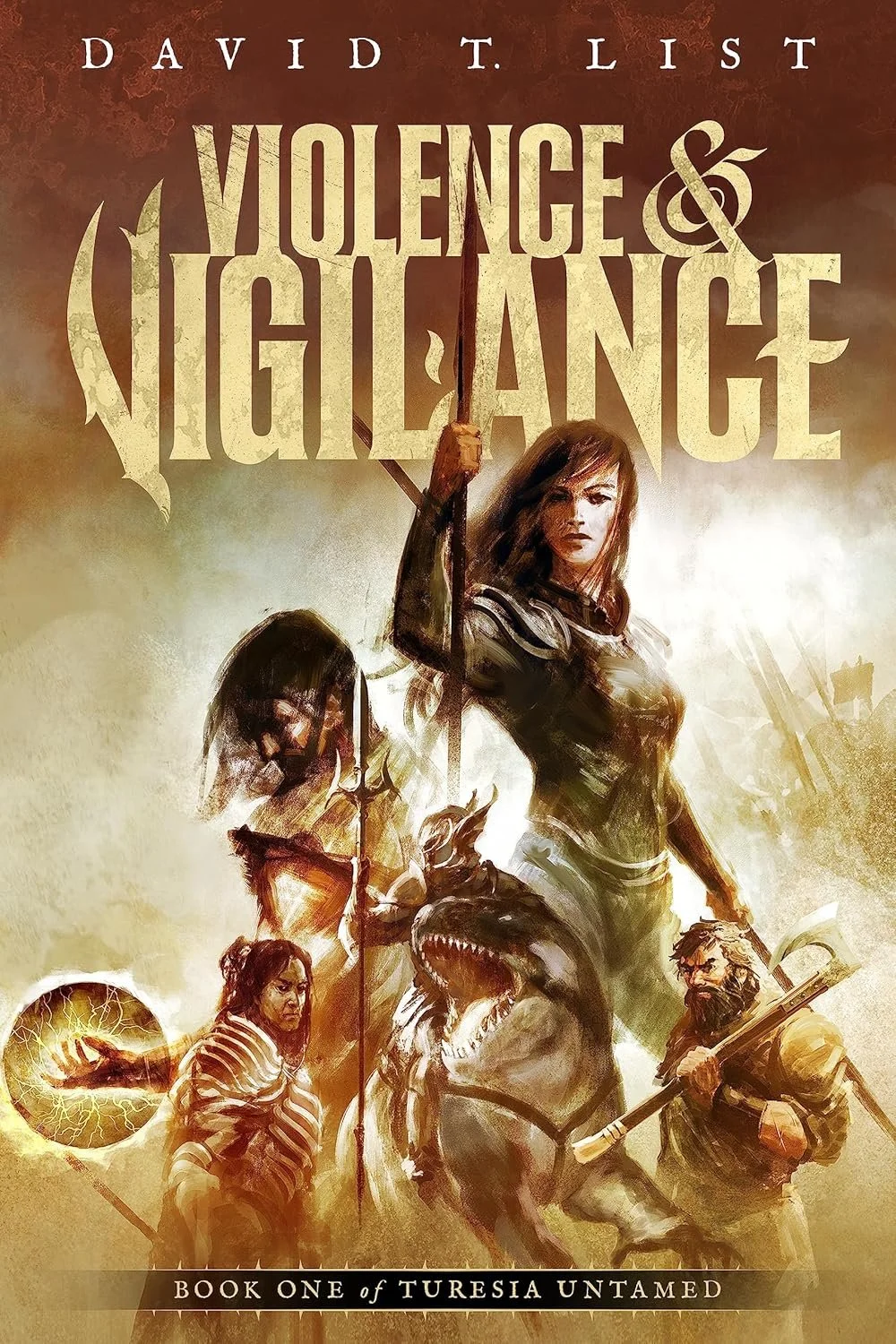
Irdessa the Undying, a renowned arena fighter in Fohrvylda, has escaped imprisonment but at great cost. Broken and alone, she must outwit and outfight her pursuers.
Basalt Kale, a failed Consonant monk of the lowest order, embarks on a quest to improve Ausgan but discovers vile secrets of his order that he cannot abide.
The heathens of Fohrvylda amass ships and beasts of war to sail the Faithless Sea and assault the monks of Ausgan, who will greet the steel-bearing invaders with elemental destruction.
Violence & Vigilance is a story of survival with dark humor, exotic settings, savage beasts, and damaged characters. If you enjoy the grittiness of Joe Abercrombie's First Law or the urgency of Pierce Brown's Red Rising, you'll love Violence & Vigilance.
Review:
Violence & Vigilance has the juice. This Dark Fantasy is a deserved finalist for the latest edition of Mark Lawrence’s Self-Published Fantasy Blog-Off competition. I wish author David T. List (DTL) luck against the nine other finalists.
And thank God it has the juice, because this book is long. By far the longest I’ve read in the competition so far, and the weight of so many words acts as both a promise to the reader to live up to, and a threat that it may not. Anytime something enjoyable happens you think, but can it keep this up? And if something doesn’t hit quite right, you clench a little, thinking, Is this when we lull and irrevocably get off the rails? While it’s a case where your mileage may vary, it’s only within a narrow range given the high quality of writing, and for me it never hit that lull. You could always pick at places to slim it down, but I rarely found that indulgent richness begging to be removed. For me, everything moved characters forward, and it was all good.
I loved every page of this mammoth, and when I say DTL has the juice, it’s because he writes so vividly, and with so much energy and personalization, that even minor side-characters have points of view worth holding, even if they are brief. The many, many side-characters can take getting used to, but the shifting settings and perspectives helped paint a cohesive whole, forming synaptic connections to each neural node in an organic and compelling way, bringing this world to life. He has the juice because he writes courageously from a place of humanity not every author can easily access.
Look no further than the dedication, a simple and heart-rending line: “To Evie, I would have fought all of Turesia for you.” It refers to a tragic loss while writing the book; he taps into the sorrow and pain in a deeply human way. He’s spoken on how the writing process was a therapeutic avenue for processing grief. It’s an honesty that bleeds through the page.
Without entering spoilers, Violence & Vigilance is the story of two opposing islands, steeped in histories of animosity and diametric opposition. Ideologically different, the title itself references their empires: Violence, for Fohrvylda and the barbarian empire that rules with steel and beasts, and Vigilance, for the Ausgan monks who use supersensory song magic to control their environments. The seemingly immortal leaders of both empires are diametrically opposed to one another. The lore goes deep, and throughout the novel we learn more and more about their feud and how this cold war between the two developed over time. The threat that the Heathen Tide will cause open conflict between them hangs heavy over the entire story. Being a duology, it seems to be a threat that’s fulfilled in the second book, which is currently being written.
Given the dark themes and bleak outlook, most would consider this Grimdark Fantasy, but there is also a lot of hope for a better future. And despite their bloody natures, many main characters don’t seem as morally gray as the genre often indicates. So call it Grimdark, call it Dark Fantasy. I think both work.
The fact I’ve made it this far without mentioning individual characters is exhausting work. I’ve wronged you, readers.
In each island we follow main characters who look to break free from these empires. They’re compelled to comply, and the risk of death is always present. Idressa the Undying is a Fohrvyldian prisoner who explicitly faces death every day as she’s forced to battle in arena games for years. Basalt Kale is an Ausgan Monk taken at birth by the magical monastic empire, and he implicitly faces death as dissenters are unceremoniously thrown into pools of lava. Both are intense—audacious even—but it works.
This story of opposites complement each other wonderfully. Irdessa is confident and used to confrontation. She doesn’t seek leadership but it finds her time and again. She’s considerate and compassionate beneath her rough exterior.
With Irdessa is Kraus. Or rather, Kraus the thirsty. A barbaric alcoholic who is over the top in everything he says and does. He’s seemingly only driven by an unquenchable thirst to be drunk. But he also shows himself to be both fiercely loyal, and an absolute weapon on the battlefield. When he and Idressa fight together, as begrudging as it is at times, they seem unstoppable. By tending to each other’s wounds both physical and psychological, they forge a deep friendship at the heart of their story. I recently discovered Kraus was heavily inspired by two real-life friends of DTL who both tragically passed. Kraus embodies both of their fearlessness and boldness. Having real life inspirations can give an author permission to be colorful and outrageous. Embracing this was a master-stroke as it made Kraus an instant favorite of mine.
Meanwhile, Basalt Kale is unassuming, quiet, and doesn’t feel he belongs. He has friends and even romantic partners, but his is a more solitary tale. As a Monk that struggles with the fundamentals of the song magic, he is only good at cancelling it, even if it hurts others in the process. He starts his journey in a dark place but compels himself to unravel the mysteries of his own island’s tyranny out of compassion for the small villages that the capital continuously targets. Throughout these discoveries he finds beneath his soft exterior an incredible strength, power, and resolve for justice.
His story presents a compelling central mystery which continuously ratchets up the tension. The side characters he interacts with, like Obsydia, also provide political depth and personality that always kept me off-balance and my interest piqued. There’s not just the mystery of the monastic empire’s power, but Kale’s own power as well and how it relates to the status quo that together forms a gravitational pull against both the singular and the whole. It works to evolve Kale’s story forward, embracing his differences and becoming a more active participant in life when he started so subdued and awash in melancholy.
DTL originally wrote these as two separate novels. It helps explain not only the length but also the depth and independence both storylines have to each other for much of the book. It’s a bit like A Song of Ice and Fire, where you have the Starks in Westeros and the Targaryens in Essos, and while they both coexist in Game of Thrones, the stories don’t adjoin even if they are inextricably on a collision course. Here also, our characters are unknowingly driving to each other, both by survival and escape, yet almost they can’t help finding themselves at the center of plots to overthrow their respective empires. They’re not just finding themselves in these positions, but embracing them to become more self-actualized when they began as reactive and passive participants consigned to their fates.
Big picture, it’s just great and effective storytelling that works. We’ve got wizards and barbarians fighting amongst themselves, with the promise of them hacking and blasting away at each other on the horizon. Newly invented creatures like the ravenous Orcane (amphibious whale mounts), and the Uergata (massive, noble, goatmen), breathe life and mystery onto the page as much as any magic. It’s all great fun.
DTL has been transparent that this story, set in the archipelago of Turesia, is but one set in his larger connected world of Silexare. It’s certainly ambitious, and many times I’ve seen stories fall under their own weight of expectation.
So it’s in the details that bring the cream to the top. Before I knew anything about the larger connected world, I went into Violence & Vigilance nearly blind. Within a few pages, even the first chapter starting from the perspective of a corrupt Fohrvyldan commander, it was evident to me that DTL could write both evocatively and effectively. The dialogue, insinuations, setup and execution of those initial scenes set not just a dark tone, but raised the bar incredibly high. I suspected if this wasn’t to be our blog’s pick for the finalist, it was going to be close. By the end, I knew. DTL delivered.
